What it trains, and what standing on one leg adds
Every rep is the same hinge as a two-leg Romanian deadlift: the hips travel back, the hamstrings lengthen under load and the glutes bring you upright again. The difference is that one leg now carries everything. On top of the hinge, the muscle on the side of the standing hip (the gluteus medius) and the inner-thigh muscles have to stop the pelvis tipping or turning, the foot and ankle make constant small corrections, and the trunk resists being twisted by a weight held in one hand.
That changes what the exercise is for. The loads are far lighter than in a barbell RDL, so it is not the lift for building maximal hinge strength. It is very good at showing and evening out a difference between the legs, at teaching the hip to stay level over one foot, which runners and field-sport players need with every stride, and at giving the hamstrings plenty of work with modest weights. Most people use it as the second hinge of a leg session, after a heavier two-leg lift, or as the main hinge on a day with only dumbbells. The hamstring exercises guide shows how it sits beside leg curls across a week.
If you cannot yet do a two-leg Romanian deadlift with a flat back, learn that first. The single-leg version adds balance to a pattern you should already own.
Setting up: stance, weight and which hand
- Start without a weight. Bodyweight reps with a fingertip on a rack upright or a cable tower teach the pattern faster than a heavy dumbbell will.
- When you add load, take one light dumbbell or kettlebell in the hand opposite your standing leg: standing on the left leg, the weight goes in the right hand.
- Stand on the working leg with the foot pointing straight ahead and your weight spread across the heel, the base of the big toe and the base of the little toe. Flat, firm shoes or bare feet make this easier than thick, soft running shoes.
- Unlock the standing knee into a small bend. That bend stays the same for the whole rep.
- Lift the other foot just off the floor beside the standing foot, toes pointing down, and square your hips so both hip bones face forward. At the bottom of the rep they will face the floor.
- Stand close enough to a support that you could reach it without stepping, even if you do not plan to use it.
How to do a rep
- Take a breath, brace lightly and fix your eyes on a spot on the floor a short way ahead.
- Push your hips back while your torso tips forward and the other leg travels back behind you. Torso and back leg move as one straight line, like a seesaw pivoting on the standing hip.
- Let the weight hang straight down from the shoulder and travel close to the standing shin.
- Lower until you feel a strong stretch in the standing hamstring, or until the hips start to turn open or the back starts to round, whichever comes first. For many people the torso stops a little above parallel with the floor.
- Drive the standing hip forward and pull the back leg down at the same time to return to tall. Squeeze the glute of the standing leg at the top without leaning back.
- Finish every rep on one leg before switching, and start with the weaker side.
Slow is easier than fast here. Take two or three seconds on the way down and pause for a moment at the bottom: most losses of balance happen in a rushed turnaround. Push the heel of the back leg towards the wall behind you. That cue keeps the leg straight and the hips level better than thinking about the hips themselves.
Mistakes to fix first
| Mistake | What it looks like | The fix |
|---|---|---|
| Hip opening to the side | The hip of the raised leg rotates up towards the ceiling and the back toes turn out | Point the back toes at the floor and keep both hip bones facing down, even if the range gets shorter |
| Squatting the standing leg | The standing knee bends more and more as you lower | Set a small knee bend at the start and move only at the hip |
| Reaching for the floor | The back rounds so the weight can touch down | Stop where your back stays flat; the floor is not the target |
| A slack back leg | The back leg dangles while the torso dips on its own | Keep the back leg straight and in line with the torso, one lever from head to heel |
| Weight swinging forward | The dumbbell drifts out in front and pulls you onto your toes | Let it hang below the shoulder, close to the standing shin |
| Hopping to catch balance | The standing foot shuffles between reps | Slow down, lighten the weight or use a fingertip support |
Hard work in the hamstring is expected, and next-day soreness is common in the first weeks. Sharp pain at the back of the thigh, or pain in the lower back, is different: stop and have it checked by a doctor or physiotherapist.
Kickstand, supported and which-hand variations
Three choices decide how much of the set is balance and how much is hamstring. None of them is a cheat; each suits a different stage and goal.
Kickstand (B-stance) RDL
The back foot stays on the floor, on its toes, with its heel roughly level with the front heel or slightly behind it. The front leg takes most of the load and the back foot works like a bicycle's kickstand, so balance almost disappears and you can hold two dumbbells or a barbell. Use it when you want heavier hinge work for one side at a time. The back leg helps a little, so it is not quite a true single-leg lift.
Holding a support
Rest one hand lightly on a rack upright, a cable tower, a bench or a wall, and hold the weight in the other hand. With balance taken care of, the standing hamstring and glute become what ends the set, which is useful while learning and for anyone who wants muscle rather than balance training. Keep the support hand light; if you are leaning on it, the load is too heavy.
Weight in the opposite hand, the same hand or both hands?
The opposite hand is the usual default. A weight on the side of the raised leg counters that hip's tendency to turn open, and it makes the side of the standing hip work harder to keep the pelvis level. The same-side hand keeps the weight right beside the standing leg, which some people find easier to keep close, and it leaves the opposite hand to hold a support. A dumbbell in each hand is the heaviest option once your balance is solid; the load is even, so grip and balance rather than twisting become the limit.
The exercise needs one dumbbell and a little floor, so a crowded gym rarely stops it. If balance is the problem on a given day, the Bulgarian split squat trains one leg at a time from a steadier stance, and the leg curl works the hamstrings with no balance at all.
Sets, reps and progression
| Goal | Sets × reps | How hard |
|---|---|---|
| Learning the pattern | 2–3 × 6–8 each leg | Bodyweight or very light; stop as soon as the hips start to turn |
| Building muscle | 3 × 8–12 each leg | One or two reps left, with a slow lowering on every rep |
| Heavier one-sided work | 3–4 × 6–8 each leg | Kickstand stance or a support, so balance does not end the set first |
Go straight from one leg to the other, then rest about a minute and a half before the next round.
Progress in this order: bodyweight with a support, one weight with a support, one weight without, then two weights or a heavier kickstand version. The step from one dumbbell to the next is large compared with the loads used here, so before you move up, add reps, a longer pause at the bottom or a slower lowering. Once or twice a week is enough. The single-leg strength guide shows where one-leg work fits beside squats and deadlifts.
Single-leg RDLs at RPM
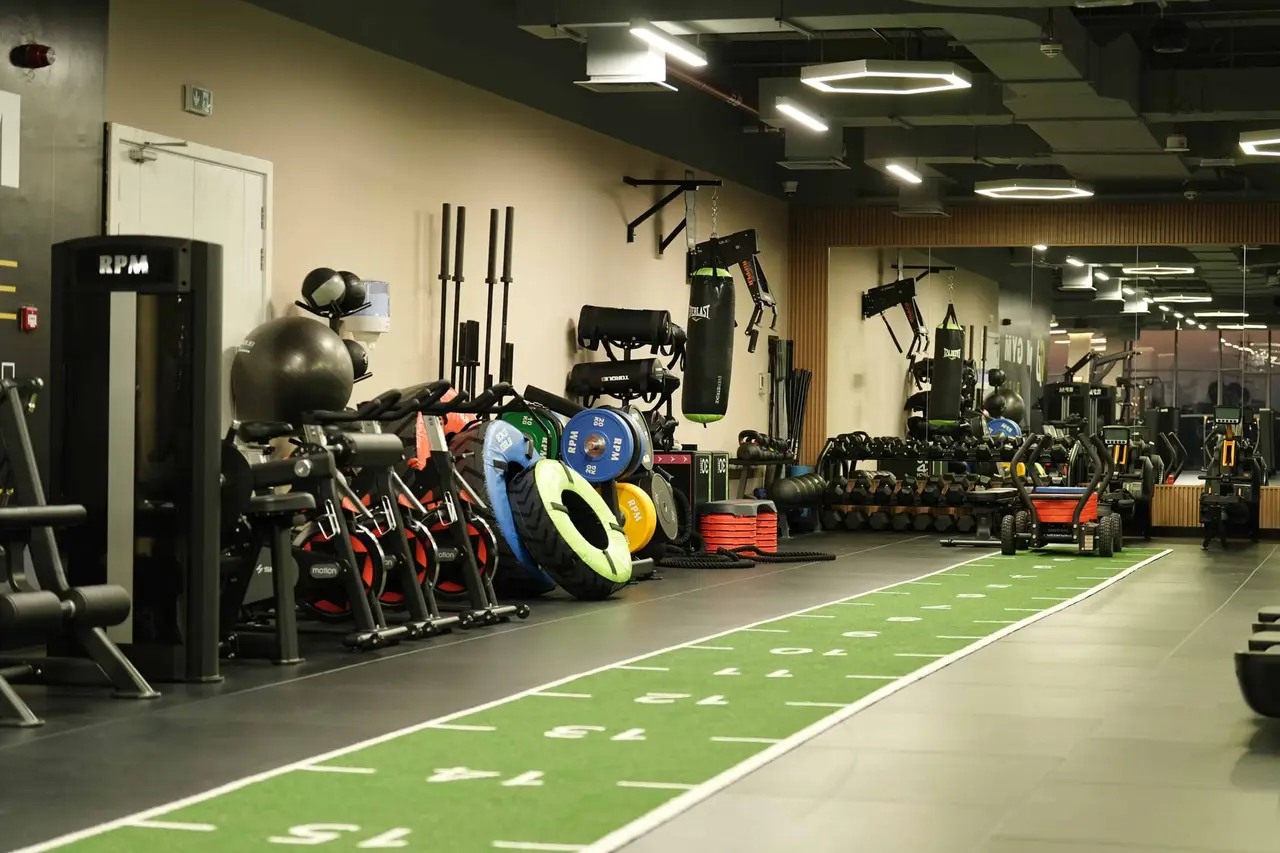
Everything this exercise needs appears in RPM's photos of the Al Manhal floor: a dumbbell rack and kettlebells in the functional training area, and rack uprights and cable towers to steady yourself on during the supported version. If you want someone to watch your hips from behind while the balance comes, a personal training session is the quickest way to get it right.
Questions, answered.
What muscles does the single-leg Romanian deadlift work?
The hamstrings and glutes of the standing leg do the hinge. The side of the hip and the inner thigh hold the pelvis level, the foot and ankle balance you, and the trunk and grip keep the weight still.
Single-leg RDL or regular RDL: which should I do?
They do different jobs. The two-leg Romanian deadlift moves far more weight and builds hinge strength; the single-leg version trains each side alone and adds balance with light loads. A common plan puts the two-leg lift first in the session and the single-leg version after it, or alternates them across the week.
Dumbbell or kettlebell for single-leg RDLs?
Either works. A kettlebell's handle sits above the weight, so it hangs neatly beside the shin; dumbbells are easier to find in small steps and to hold in pairs. A barbell is possible but awkward to balance on one leg, so most people keep it for the kickstand version.
Single-leg RDL or Bulgarian split squat?
Both train one leg at a time, but they are different patterns. The split squat is a squat that works the quads and glutes; the single-leg RDL is a hinge for the hamstrings and glutes. They complement each other, and many leg days include one of each.
What can I do instead of a single-leg RDL?
The kickstand RDL is the closest substitute when balance is the issue. Otherwise a two-leg dumbbell Romanian deadlift, a back extension or a cable pull-through trains the same hinge.
Are the Romanian and the straight-leg deadlift the same?
Not quite. In the Romanian deadlift the knees stay softly bent and the weight stays against the legs; a straight-leg or stiff-leg deadlift keeps the knees straighter and usually starts from the floor. The single-leg version is a Romanian deadlift, so keep that small knee bend.