What the sissy squat trains
In an ordinary squat the hips and knees bend together, and the glutes share the work. In a sissy squat the hips stay straight while the knees bend as far as they will go, so almost all the effort falls on the quadriceps, the four muscles on the front of the thigh. Keeping the hip open matters for one of them in particular. The rectus femoris also crosses the hip, and with the hip straight it is stretched at that end while it works at the knee, a position a normal squat does not put it in. Your body leans further back as you descend, so the load on the quads grows with depth even though you are lifting nothing but yourself.
The trunk and the front of the hip work hard to hold the straight line, and the calves keep you up on the balls of your feet. It suits people who already squat and want more direct quad work, and anyone who needs a quad exercise without a machine. It asks a lot of the knees, which bend deeply under load and travel far past the toes, so build the range gradually. The quad exercises page shows where it sits among the squats, presses and machines.
Effort and a burning feeling in the front of the thigh are expected; pain in the knee joint is not. If you feel pain in or around the kneecap during or after a set, stop and have it checked by a doctor or physiotherapist before you continue.
Sissy squat vs leg extension vs front squat
The sissy squat sits between the other two: it isolates the quads like the machine, but you balance and move your whole body as in a squat.
| Compared on | Sissy squat | Leg extension | Front squat |
|---|---|---|---|
| What bends | The knees; the hips stay straight | The knees; the hips stay bent in the seat | Hips, knees and ankles together |
| Main muscles | Quads, with the trunk holding the line | Quads | Quads, glutes and inner thighs, with the upper back holding the bar |
| The load | Your body, heavier the further you lean | A weight stack | A barbell on the front of the shoulders |
| How to progress | Range, then a slower lowering, then a plate at the chest | Add weight a step at a time | Add weight to the bar |
| Where it goes | After the main lift, or when no machine is available | After the main lift | As the main lift of the session |
If a leg extension machine is available, it is the easier way to build the quads step by step, because you add load in measured increments. The sissy squat earns its place when there is no machine or when you train at home. Neither replaces the front squat or another compound squat, which trains more muscle and lets you load the legs far more heavily, so think of the sissy squat as an accessory. If deep knee bending is uncomfortable for you, the leg extension set to a shorter range, or a goblet squat, is the better pick.
Setting up
- Find something sturdy to hold at about hip to chest height: the upright of a squat rack nobody is using, a wall bar, or a door frame at home.
- Stand side-on to it, close enough to hold it with one hand without leaning, with your feet about hip width apart.
- Rise onto the balls of your feet. If your calves tire before your quads, stand with your heels on a small plate instead, which still lets the knees travel forward.
- Squeeze your glutes and tuck your pelvis slightly under, as if drawing your tailbone down. That locks the hips straight for the whole rep.
- Some gyms have a sissy squat bench, which holds your feet and lower legs in place so you need no hand support; ask on your tour whether there is one on the floor.
How to do a rep
- Take a breath and brace. Your knees, hips and shoulders form one line.
- Push your knees forward and down while your upper body leans back, so the whole line pivots at the knees. Nothing bends at the hip.
- Lower over about three seconds, as far as you can control. At first that may be a short way; with practice your knees travel well past your toes and the backs of your thighs come close to your calves.
- Pause for a moment at the bottom without relaxing.
- Drive your knees back and press through the balls of your feet to return to the start, with the hips straight all the way up.
Your hand is there for balance, not to pull you up; if you find yourself hauling on the support, shorten the range. Breathe out as you rise. Sissy squats fall apart quickly once the quads are tired, so end the set as soon as the line from knee to shoulder breaks.
Common sissy squat mistakes
| Mistake | What it looks like | The fix |
|---|---|---|
| Sitting back into a squat | The hips fold and your backside moves back towards your heels | Squeeze the glutes, keep the hips straight and lower less |
| Heels flat on the floor | The knees cannot travel and you tip backwards | Rise onto the balls of the feet, or stand on a small plate |
| Too deep too soon | The end of each rep collapses and the knees feel strained | Work in the range you control and add depth over weeks |
| Pulling with the arm | The support hand does the lifting | Hold on with your fingertips, for balance only |
| Arching the lower back | The ribs flare and the belly pushes forward | Tuck the pelvis and brace before each rep |
| Dropping and bouncing | You fall into the bottom and spring out of it | Three seconds down, a short pause, then rise |
Easier and harder versions
Progress the sissy squat in this order: range first, then control, then load.
Two-hand supported sissy squat
Hold the support with both hands in front of you and lean back only a little. It takes most of the balance out of the movement, so you can learn the knees-forward, hips-straight pattern, and add a little depth each week.
Partial-range sissy squat
Choose a depth you can control, stop there on every rep, and only go lower once every rep is smooth. Partial reps also make a sensible way to finish a set once full reps are no longer clean.
Reverse Nordic
The kneeling cousin of the sissy squat. Kneel tall on a mat, then lean back from the knees with the hips straight, and return. The range is shorter and you are closer to the floor, which makes it a common stepping stone to the standing version.
Weighted sissy squat
Once you can lower all the way slowly, hold a weight plate against your chest with your other arm. Add load in small steps: the lever is long, so a little weight feels like a lot.
Sissy squat with no support
Arms forward for balance and nothing to hold. It is the hardest version and asks for strong quads and good balance; you do not need to reach it to get value from the exercise.
For the same muscles with a load you can set, the leg extension and the hack squat are the machine options, and a wall sit works the quads without any movement at the knee.
Sets, reps and where it fits
| Goal | Sets × reps | How hard |
|---|---|---|
| Learning the pattern | 2 × 6–8 | Two hands on the support, partial range, well short of fatigue |
| Building the quads | 3 × 8–15 | One or two reps left, three seconds down |
| Finisher after squats | 1–2 × 10–20 | Close to failure, hips still straight |
Rest about a minute to a minute and a half. The quads are often sore after the first sessions, because of the stretch on the way down, so start with two sets.
Put sissy squats after your main squat or press, once or twice a week, or use them in place of leg extensions when no machine is available. On a day with heavy front squats, keep them to one or two sets. Add range before you add load, and count a smooth, slow rep at a new depth as progress in itself.
Sissy squats at RPM
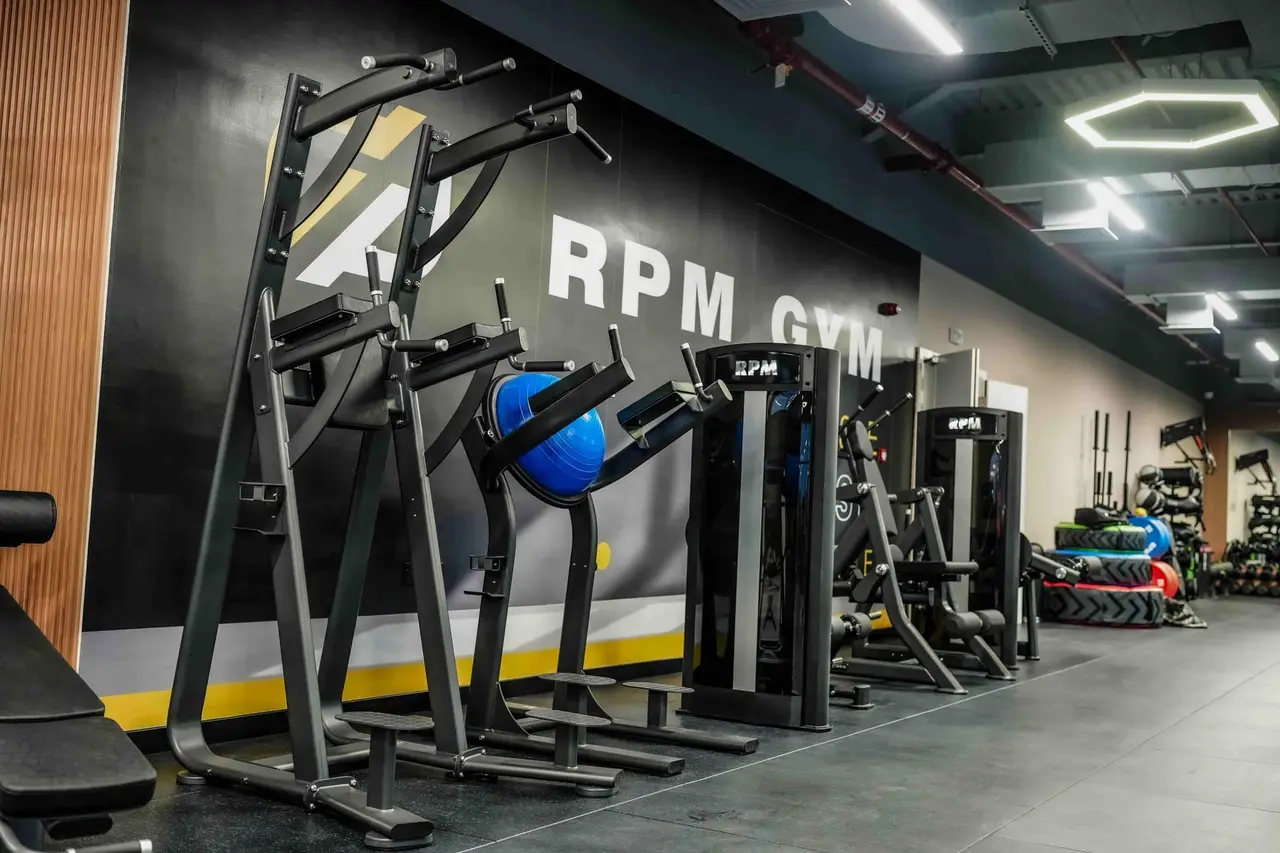
A sissy squat needs only your bodyweight and something sturdy to hold. RPM's floor photos show squat racks, whose uprights make a hand support when a rack is not in use, and colour bumper plates for the weighted version. A dedicated sissy squat bench is not in the photos, so ask about one on your free guided tour. For a quad programme that combines squats, machines and accessories like this one, see personal training.
Questions, answered.
What muscles does the sissy squat work?
Mainly the quadriceps, including the rectus femoris, which works here with the hip open. The trunk and the front of the hip hold the straight line, and the calves keep you on the balls of your feet.
Are sissy squats bad for your knees?
There is no single answer. The knees bend deeply and travel well past the toes, and many people train it comfortably by building range slowly. If it causes pain in or around the knee, stop and ask a doctor or physiotherapist which quad exercises suit you.
Sissy squat or leg extension: which should I do?
The leg extension is easier to load and progress, so it is usually the first choice when a machine is available. The sissy squat needs no machine and also trains balance and trunk control. Both isolate the quads; the leg extension page covers the machine.
Can beginners do sissy squats?
A beginner can practise the two-hand supported version over a short range, but most people get more from learning the goblet squat and the leg extension first, then adding sissy squats once their quads and knees are used to training.