Where leg day fits in your week
This is a workout to do today, not a guide to how the legs work. The leg exercises hub covers what each muscle does and lists every movement; this page gives you one complete lower-body session in two versions, with the order, sets, reps and rest filled in.
Most people do it once or twice a week. In a four-day upper/lower week it takes two of the days, alternating with the upper body gym workout, as in the 4-day gym workout plan. With two leg days, do one version on each. Keep at least two days between leg sessions, and skip hard running or cycling intervals the day before: tired legs squat badly. The rest of the single sessions and weekly plans are in the workout plans library.
Why the order is squat, hinge, single leg, then the rest
Each slot in the session has a job, and the order follows how demanding each one is.
- Squat pattern first. A squat or leg press trains the quads and glutes with the heaviest loads of the day and needs the most concentration, so it gets you at your freshest.
- Hinge second. A Romanian deadlift or a cable pull-through works the hamstrings and glutes through the hips. It comes before the single-leg work so your lower back is not already tired from holding position.
- Single leg third. Lunges and split squats make each side do its own work and show up any difference between your legs. They are hard on balance, which is why they follow the heavy lifts rather than come before them.
- Hamstrings, calves and trunk last. Exercises for one muscle at a time can still be done well when you are tired, and they fill the gaps the big lifts leave.
Version 1: barbell and dumbbells
A squat rack, a barbell, dumbbells and a flat bench. Build up to your first working set of squats with two or three lighter sets. New to the barbell? Put a goblet squat in the first slot for the first month or two.
| Exercise | Sets | Reps | Rest | Notes |
|---|---|---|---|---|
| Back squat | 4 | 5–8 | 2–3 min | Main lift |
| Romanian deadlift | 3 | 8–12 | 2 min | The hinge and the hamstring work |
| Lunges | 3 | 8 each leg | 90 sec | Reverse lunge, dumbbells at your sides |
| Hip thrust | 2 | 10–12 | 90 sec | Upper back against a flat bench |
| Calf raise | 3 | 12–15 | 45 sec | One leg at a time, holding a dumbbell |
| Suitcase carry, one heavy dumbbell | 3 | 30 sec each side | 60 sec | Walk tall without leaning |
Eighteen working sets. The Romanian deadlift covers two slots here, the hinge and the hamstrings, because free weights offer few practical ways to bend the knee against a load. For a day built on dumbbells alone, see the dumbbell leg exercises.
Version 2: machines
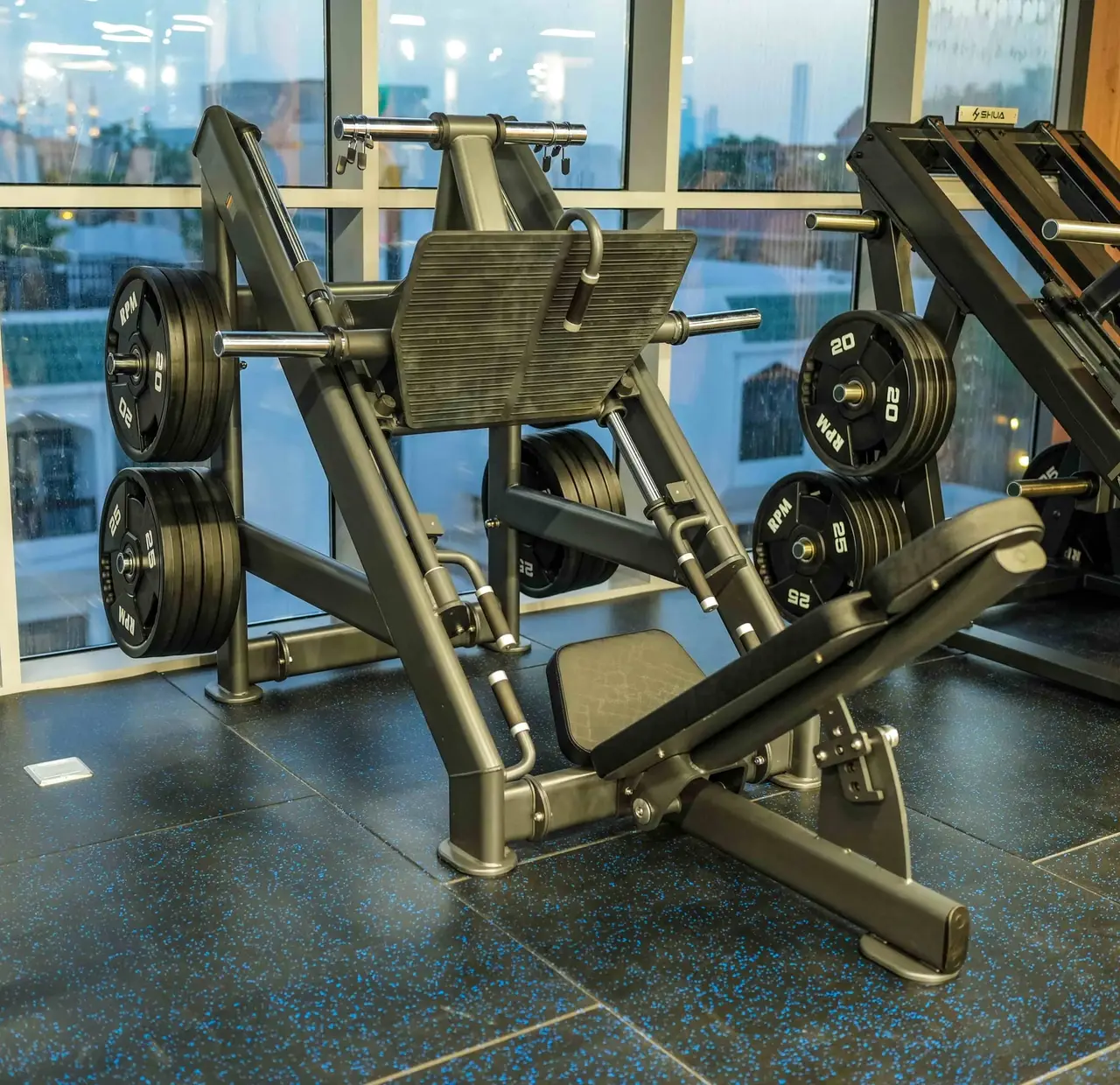
Built around the plate-loaded leg press and the cable towers, with a leg curl and a leg extension added. Rests are shorter than in Version 1 because the machine holds you in position. Neither the leg curl nor the leg extension is in RPM's photos, so each of those rows names a swap that is.
| Exercise | Sets | Reps | Rest | Notes |
|---|---|---|---|---|
| Leg press | 4 | 10–12 | 2 min | Main lift; feet in the middle of the platform |
| Cable pull-through | 3 | 12–15 | 90 sec | The hinge: rope on the low pulley, hips back |
| Bulgarian split squat | 3 | 8–10 each leg | 90 sec | Dumbbells: no machine trains one leg as well |
| Leg curl | 3 | 10–12 | 60 sec | Not in RPM's photos: dumbbell Romanian deadlift |
| Leg extension | 2 | 12–15 | 60 sec | Not in RPM's photos: leg press, feet low on the platform |
| Calf raise | 3 | 15–20 | 45 sec | Calf machine if there is one; otherwise on the leg press |
| Pallof press | 2 | 10 each side | 45 sec | Cable at chest height |
Twenty sets, but the machine work moves quickly. If someone is on the leg press when you arrive, start with the split squats and come back to it. Comparing machines? The hack squat vs leg press page explains how those two differ.
Beginner and intermediate versions
In your first two or three months
Start with Version 2, two sets of every exercise at the top of each rep range, and stop with three reps still in reserve while you learn the movements. One leg day a week is enough at first; add a second once the soreness after each session has settled. When you move to Version 1, keep the goblet squat in place of the back squat until it feels routine.
Once you have trained for a year or so
Run both versions each week, three or four days apart: Version 1 as the heavier day, with squats at 4 sets of 5 or 6, and Version 2 as the lighter one at the full 10 to 12 reps. Take most sets to one or two reps in reserve, and add a fifth squat set only if you are recovering well. The one-rep max calculator helps you pick squat loads.
Either way, add reps first and weight second. Once all your sets reach the top number, put the smallest plate on and work back up through the range. The American College of Sports Medicine's position stand on progression in resistance training sets out the same rule, and big leg lifts suit it well because they can take small, steady increases for months.
Mistakes that waste a leg day
| Mistake | Why it costs you | Instead |
|---|---|---|
| No ramp-up sets before squats | The first working set feels heavy and depth suffers | Two or three lighter sets every time |
| Squats taken to failure | Form breaks down first on the heaviest lift of the day | Keep two reps in hand on the main lift |
| Dropping the single-leg exercise because it is awkward | One side keeps doing more of the work | Start with the weaker leg and match its reps on the other |
| Rushing the lowering | Less work for the muscle and more chance of losing position | Take about two seconds down on every rep |
| Bouncing the calf raises | The tendon springs the weight up and the calf does little | Pause at the bottom and at the top |
| Hard intervals the day before | You start leg day already tired | Easy cardio only, or do the intervals after lifting |
Sore after leg day: what is normal
Stiff, tender legs a day or two after the first few sessions are expected, especially after lunges and Romanian deadlifts. That delayed soreness is usually at its worst one to two days after training and eases as your body gets used to the work. Walking, easy cycling and normal daily movement help you feel less stiff; there is no need for a special routine, and the soreness itself does not tell you how well you trained.
Pain is different. Sharp pain during a rep, pain in the knee or hip joint rather than in the muscle, swelling, or soreness that is still getting worse after several days are reasons to stop that exercise and get it checked by a doctor or physiotherapist. Do not train through it.
Women, glutes and machines
Lower body workout for women
The session is the same for women and men: muscles respond to the same work, and only the starting loads differ. If you want more glute work, move the hip thrust to second place in Version 1 with three or four sets, or add it after the leg press in Version 2. The glute training guide explains how much weekly glute work to build towards.
Leg day on machines only
Version 2 is nearly there. Swap the Bulgarian split squat for single-leg sets on the leg press and every exercise uses a machine or a cable. The gym machine names page lists each leg machine in English and Arabic.
Leg day with dumbbells only
Use Version 1 with a goblet squat first, a dumbbell Romanian deadlift, reverse lunges and single-leg calf raises. You will run out of load sooner than with a barbell, so slow the lowering and add reps before you go looking for heavier dumbbells. The single-leg strength guide has more one-leg options.
This session at RPM
Version 1 runs on equipment RPM's training-floor photos show: squat racks with barbells and colour bumper plates, flat benches and the dumbbell rack. Version 2 uses the angled plate-loaded leg press and the cable towers. A leg extension, a leg curl, a hack squat and a calf machine are not in those photos, so ask on the free guided tour which of them are on the floor, and what leg equipment the women-only Ladies section has. For a coach to watch your first squats, see personal training.
Sources
Questions, answered.
What should I do on leg day?
One squat or leg press, one hinge, one single-leg exercise, something for the hamstrings, and calves, in that order. Both versions above follow it. Five to seven exercises and 15 to 20 working sets make a full leg day for most people.
How many times a week should I train legs?
Once to start, then twice once leg day stops leaving you sore for days, with at least two days between the sessions. The World Health Organization advises muscle-strengthening activity on two or more days a week, and one leg day plus an upper-body day covers that.
How should I warm up for leg day?
Five minutes of easy cardio, a few bodyweight squats and lunges, then lighter sets of your first exercise, building to your working weight. The warm-up guide has a full routine.
Should I stretch after leg day?
If you like it, yes, but it is optional. Gentle stretches for the hips, hamstrings and calves can feel good after a hard session. They are unlikely to stop next-day soreness, which eases with time and light movement.
How long should leg day take?
About 45 to 60 minutes with the warm-up. Version 1 takes longer because of the rests after squats. If you only have half an hour, do the first three exercises of either version.