What the Nordic curl trains, and why it is so hard
The Nordic curl trains the knee-bending job of the hamstrings, the same job as the leg curl, but in reverse: instead of curling a weight up, you resist your own body falling forward. The load is everything above your knees, and as you lean it moves further from the knee, so the exercise gets harder the lower you go. Most people lose control somewhere in the last third, when the body is closest to the floor. Your glutes and trunk hold the hips straight; if they give way, the hips fold and the hamstrings are let off.
Working a muscle while it lengthens under load is called eccentric training, and the Nordic curl is about as pure an example as the gym offers. That is why it is common in football, rugby and sprint training, and with anyone who wants demanding hamstring work without a machine. It suits people who already train their legs regularly. A complete beginner will usually get more from the leg curl or the Romanian deadlift first; the hamstring exercises page shows how the hinge and the curl share a week.
Nordic curl vs the leg curl machine
| Compared on | Nordic curl | Leg curl machine |
|---|---|---|
| The load | Your own body, fixed | A weight stack you choose |
| The hard part of the rep | The lowering, almost entirely | Both lifting and lowering |
| Making it easier | A shorter range, a band, or pushing off with the hands | Move the pin up the stack |
| Making it harder | More range, a slower lowering, pauses, a weight held at the chest | Add weight a step at a time |
| Suits | Regular trainers, athletes in sprinting sports, training with little kit | Beginners, measured progress, higher-rep work |
The machine is easier to measure: you know what you lifted last week and you add a step. The Nordic curl cannot be made lighter than your bodyweight without help, so progress is judged by how far and how slowly you can lower. Many programmes keep both, using the machine for regular sets of eight to twelve and the Nordic curl for a few slow, hard reps once or twice a week.
What research reports about Nordic curls and hamstring strains
The Nordic curl is known mainly through injury research in team sports. A 2019 review that pooled fifteen studies across several sports reported that athletes whose injury-prevention programmes included the Nordic curl had about half the rate of hamstring injuries of those whose programmes did not. One trial behind that figure followed fifty Danish football teams through a season: players given a ten-week Nordic programme, then a weekly session to keep it up, recorded fifteen acute hamstring injuries against fifty-two in the teams that trained as usual.
Those findings describe groups of athletes on a structured programme over a season, mostly in football. They do not say what will happen to any one person, and the exercise is no substitute for a physiotherapist's care of an existing strain. Training studies add two practical points. A 2020 review found that low weekly volumes built eccentric strength and lengthened the muscle's fibre bundles about as much as high volumes, in programmes of six weeks or more. A 2017 study found that the Nordic curl and a hip-extension exercise both lengthened the fibre bundles of the outer hamstring, while the hip exercise grew that muscle more: a good reason to keep a hinge in your week as well.
If you have hamstring pain, are coming back from a strain or have a knee problem, speak to a doctor or physiotherapist before you start Nordic curls. They can tell you whether the exercise suits you now, and at what level.
Anchoring your heels
Your heels must stay pinned for the whole rep, or you simply tip forward. At a gym, that means one of three things.
- A partner. They kneel behind you and press your lower legs, just above the ankles, into the floor with straight arms and their weight leaning onto you. Ask them to hold hardest at the bottom of the rep, where the pull is greatest.
- Equipment built for it. Some gyms have a Nordic bench or a glute-ham developer, both of which lock the ankles under a padded roller. Ask the team what can anchor your heels.
- Padding under the knees. Kneel on a folded mat or a pad: your knees carry much of your weight on every rep.
Avoid improvised anchors that can roll or lift, such as a loose barbell or light furniture: the pull on them peaks at the bottom of the rep.
How to do a rep
- Kneel tall with your knees hip width apart and your heels anchored. Thighs, hips and torso form one straight line.
- Squeeze your glutes, brace your trunk and hold your hands in front of your chest, palms forward, ready to catch.
- Lean forward from the knees as slowly as you can. Aim for three to five seconds on the way down, keeping the line from knee to shoulder straight, with no bend at the hips.
- When you can no longer hold back the fall, let go into a soft push-up catch.
- Push yourself back up to kneeling with your hands, using your hamstrings as much as you can, and reset before the next rep.
The usual cheat is bending at the hips as you lower, which shortens the lever and hands the work to your glutes and back. If your hips start to fold, end the rep there. Breathe out slowly on the way down rather than holding your breath.
Regressions, progressions and the Nordic curl machine
Because your bodyweight is fixed, you scale the Nordic curl by range and by assistance. Move on only once you own the version before.
Partial-range Nordic
Put a box, a bench or a stack of pads in front of you and lower only until your chest reaches it, then push back up. Lower the target over the weeks. This is the usual starting point: the top of the range is where you can control the lean.
Band-assisted Nordic
Loop a long resistance band round a high point behind you and across your chest under your arms. It takes some of your weight at the bottom, where the exercise is hardest, and a thicker band helps more. Ask the team whether bands are available.
Hand-assisted Nordic
Lower as far as you can, then let your hands push you back up. Over time, use them less, until you can lower all the way under control.
Harder versions
Once you can lower all the way slowly, add a pause partway down, take longer to lower, hold a light plate at your chest, or try to curl yourself back up with your hamstrings instead of pushing off.
The Nordic curl machine, and Nordics at home
A Nordic bench or glute-ham developer holds the ankles for you, and many let you change the angle, which is another way to scale the exercise. At home, a partner is the most reliable anchor; a sofa or bed frame works only if it is heavy enough not to lift at the bottom of the rep.
If the Nordic curl is too much for now, the leg curl trains the same job with a load you choose, and the good morning or the single-leg Romanian deadlift covers the hip side of the hamstrings.
Sets, reps and how often
| Stage | Sets × reps | Notes |
|---|---|---|
| Starting out | 2 × 3–5 | Partial range or band-assisted, once a week |
| Building | 2–3 × 4–6 | Longer range, three to five seconds down, once or twice a week |
| Advanced | 3 × 3–5 | Full range, with pauses or a light plate, once or twice a week |
Rest two to three minutes between sets. Leave two days between Nordic sessions, and keep them out of the day before a sprint session or a match.
Small doses go a long way, which fits the 2020 review's finding that low weekly volumes held up well against high ones. Place the Nordic curl after your main lift or at the end of a lower-body session, and pair it with a hinge such as the Romanian deadlift in the same week. Progress by range first, then by slowing the lowering, and only then by adding load.
Nordic curls at RPM
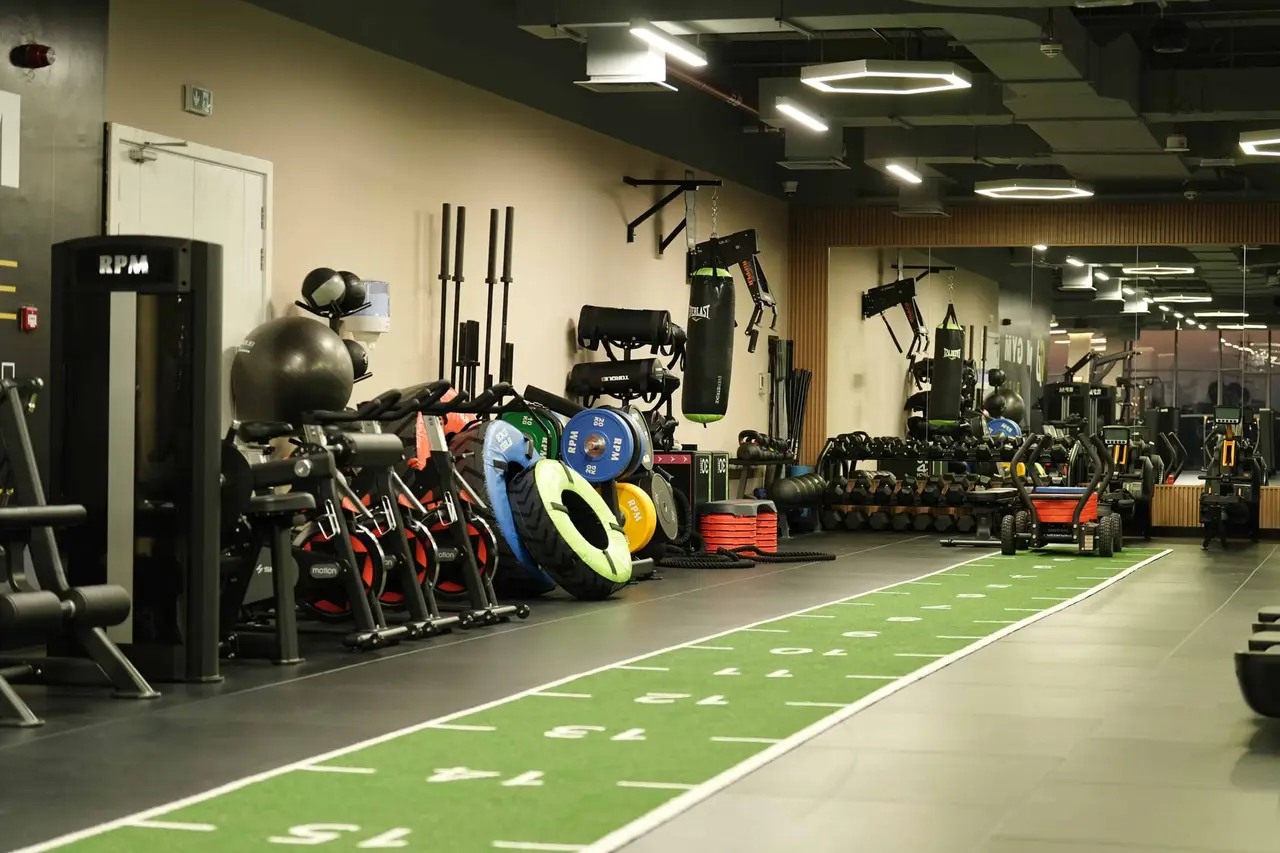
A Nordic curl needs something to hold your heels and padding for your knees. RPM's floor photos do not show a Nordic bench or a glute-ham developer, so ask the team what can anchor your heels on your free guided tour. Training with a partner is the simplest answer, and in a personal training session the coach can hold your heels, set your range and judge when you are ready for more.
Sources
- van Dyk N, Behan FP, Whiteley R. Including the Nordic hamstring exercise in injury prevention programmes halves the rate of hamstring injuries: a systematic review and meta-analysis of 8459 athletes. British Journal of Sports Medicine, 2019
- Petersen J, Thorborg K, Nielsen MB, Budtz-Jørgensen E, Hölmich P. Preventive effect of eccentric training on acute hamstring injuries in men's soccer: a cluster-randomized controlled trial. The American Journal of Sports Medicine, 2011
- Cuthbert M, Ripley N, McMahon JJ, et al. The effect of Nordic hamstring exercise intervention volume on eccentric strength and muscle architecture adaptations: a systematic review and meta-analyses. Sports Medicine, 2020
- Bourne MN, Duhig SJ, Timmins RG, et al. Impact of the Nordic hamstring and hip extension exercises on hamstring architecture and morphology: implications for injury prevention. British Journal of Sports Medicine, 2017
Questions, answered.
What muscles does the Nordic curl work?
Mainly the hamstrings, through their knee-bending job, while they lengthen. The glutes and trunk work to keep the hips straight, and the calves help a little at the knee.
Are Nordic curls better than leg curls?
They do different things well. The Nordic curl is a hard, lowering-focused exercise that needs no machine; the leg curl is easier to learn and to load step by step. Many people use both, and the hamstring exercises page shows how.
Do Nordic curls prevent hamstring injuries?
Research in team sports reports fewer hamstring injuries among athletes whose programmes include them, but that describes groups following a programme over a season, not a promise for any one person. If you have had a strain, ask a physiotherapist when and how to start.
Why are my hamstrings so sore after Nordic curls?
Lowering-focused exercises cause more soreness than lifting ones, especially when they are new. It usually eases within a few days and is much milder after the first couple of weeks. Start with very few reps, and if the soreness comes with sharp pain, swelling or bruising, see a doctor or physiotherapist.