What lifts you off the mat
Lying face down, there is nothing to push from: everything you lift works straight against gravity. The chest and arms rise because the erector spinae, the long muscles either side of the spine, and the deeper multifidus close to the bones extend your back. The legs rise because the glutes and hamstrings extend your hips. The upper back, including the lower part of the trapezius, holds the arms level with your ears. Both ends come up together, so there is no moment to rest during the hold, which is why ten seconds feels longer than it looks.
Two EMG studies, which record muscle activity through sensors on the skin, give a sense of the effort. In a 2008 study of adults aged 21 to 35, the superman was one of three back-extension exercises whose mean activity in the multifidus and the longissimus, one of the erector spinae, ranged from 77% to 82% of a maximal contraction. Arm and leg raises done lying face down or on all fours stayed under 50%. A 2016 study of ten healthy men found that holding the superman for longer increased the total activity recorded over each hold (the area under the EMG curve) in the multifidus and erector spinae, and in the rectus abdominis at the front.
Those numbers describe effort, not results: neither study measured pain, injury or posture. The only load is your own arms, legs and chest, so the superman builds endurance and control in the back of the body rather than much strength or size. It suits beginners, home sessions and warm-ups, and needs nothing but floor space. For strength, the back training guide builds heavier hinges into every week of back work.
Lying down and setting the shape
- Lie face down on a mat with your legs straight, about hip-width apart, and the tops of your feet resting on the floor.
- Stretch your arms forward past your head, shoulder-width apart, palms facing down or thumbs pointing up. If your shoulders are tight, bend the elbows a little or widen the arms into a Y.
- Rest your forehead on the mat so the back of your neck is long. Your eyes stay on the floor for the whole set.
- Press your hip bones gently into the mat and squeeze your glutes a little, so your legs feel long and heavy before they move.
- Breathe out and tighten your stomach lightly. You are not sucking it in; you are giving the lift a firm middle to come from.
Lift, hold, lower
- Breathe in, then as you breathe out raise your arms, head and chest and both legs, all at the same moment.
- Stop when your hands, chest and thighs are a few centimetres clear of the mat: enough to slide a sheet of paper underneath, not so much that you rock on your stomach.
- Reach your fingertips towards the wall in front of you and your toes towards the wall behind. Your knees stay straight and your shoulders stay down, away from your ears.
- Hold for two or three seconds, breathing quietly through your nose.
- Lower over about two seconds, let your whole body settle into the mat, take one breath, and start the next rep.
The cue that fixes most supermans: reach for the walls, not the ceiling. Height is not the measure of a good rep, and chasing it usually means throwing the head back and kicking the legs up, which turns a hold into a swing. The right height is one you can hold still for three seconds.
Superman mistakes and how to fix them
| Mistake | What it looks like | The fix |
|---|---|---|
| Cranking the neck | The chin juts forward so you can watch the mirror | Eyes on the floor a little ahead of your hands; the head rises with the chest |
| Jerking up | The arms and legs fling up, then drop straight back down | Lift over a second, hold, and lower over two |
| Chasing height | The chest and thighs rise high and you rock on your stomach | Stop a few centimetres up and reach longer instead |
| Bending the knees | The feet kick up towards your glutes | Keep the legs straight and lift them from the hips |
| Shrugging | The shoulders creep up around your ears | Draw the shoulders down, or move the arms out into a Y |
| Holding your breath | The face reddens and the hold ends in a gasp | Breathe out as you lift and keep breathing through the hold |
Stop the set if anything hurts. If you have back pain or a back condition, speak to a doctor or physiotherapist before you do the superman.
Arms only, legs only, swimmers and longer holds
The superman scales with three settings: how much of you lifts, how far your arms reach and how long you stay up. Change one at a time, and move on only when the version you are on stays low and still.
Arms only or legs only
Lift just the arms, head and chest while the legs stay down, or just the legs with your forehead resting on your stacked hands. Each half asks less of the back and is easier to keep still. Start here if the full lift wobbles; it also shows you which end of the movement you tend to rush.
Alternating arm and leg
Lift your right arm and left leg together, lower them, then switch. It is the bird dog's diagonal done lying face down. In the 2008 study above, arm and leg raises lying face down recorded clearly less back-muscle activity than the full superman. Use it as the step between the halves and the full lift.
Changing the arm position
Where your hands go changes the lever. Arms by your sides with the palms up is the easiest; hands at your temples with the elbows out, a W shape, sits in the middle; arms straight past your head is the hardest, because their weight is furthest from your spine. Learn the hold with your arms by your sides if the overhead version makes you shrug.
Swimmers
Lift into the superman and stay up, then flutter the opposite arm and leg a few centimetres up and down in turn, like a slow front crawl, for twenty to thirty seconds. Your back and hips never get a rest, so keep the movements small and the breathing steady.
Longer holds
Holding each rep for longer is the simplest progression; in the 2016 study above, longer holds raised the total muscle activity recorded over each hold. Build from two or three seconds towards five to ten, as long as the lift stays low and your neck stays long.
When bodyweight holds stop being a challenge, move the same job onto a bench with the back extension, or put a load on your hips with the glute bridge. If lying face down is uncomfortable, the bird dog trains the back of the body on hands and knees instead. If you are pregnant or have recently given birth, ask your doctor or midwife which exercises suit you.
Reps, holds and where it fits in a week
| Goal | Sets × reps | How hard |
|---|---|---|
| Learning the position | 2 × 6–8, 2-second hold | Arms only or legs only if the full lift wobbles |
| Warm-up before deadlifts or rows | 1–2 × 6, 2–3-second hold | Easy; you should finish fresh |
| Endurance in the back of the body | 2–3 × 8–12, 3–5-second hold | End the set when the lift shrinks or the neck cranks |
| Harder versions | 3 × 20–30 seconds of swimmers, or 3 × 5 with 10-second holds | Steady breathing and a low, still lift |
Rest thirty to sixty seconds between sets.
Supermans at RPM
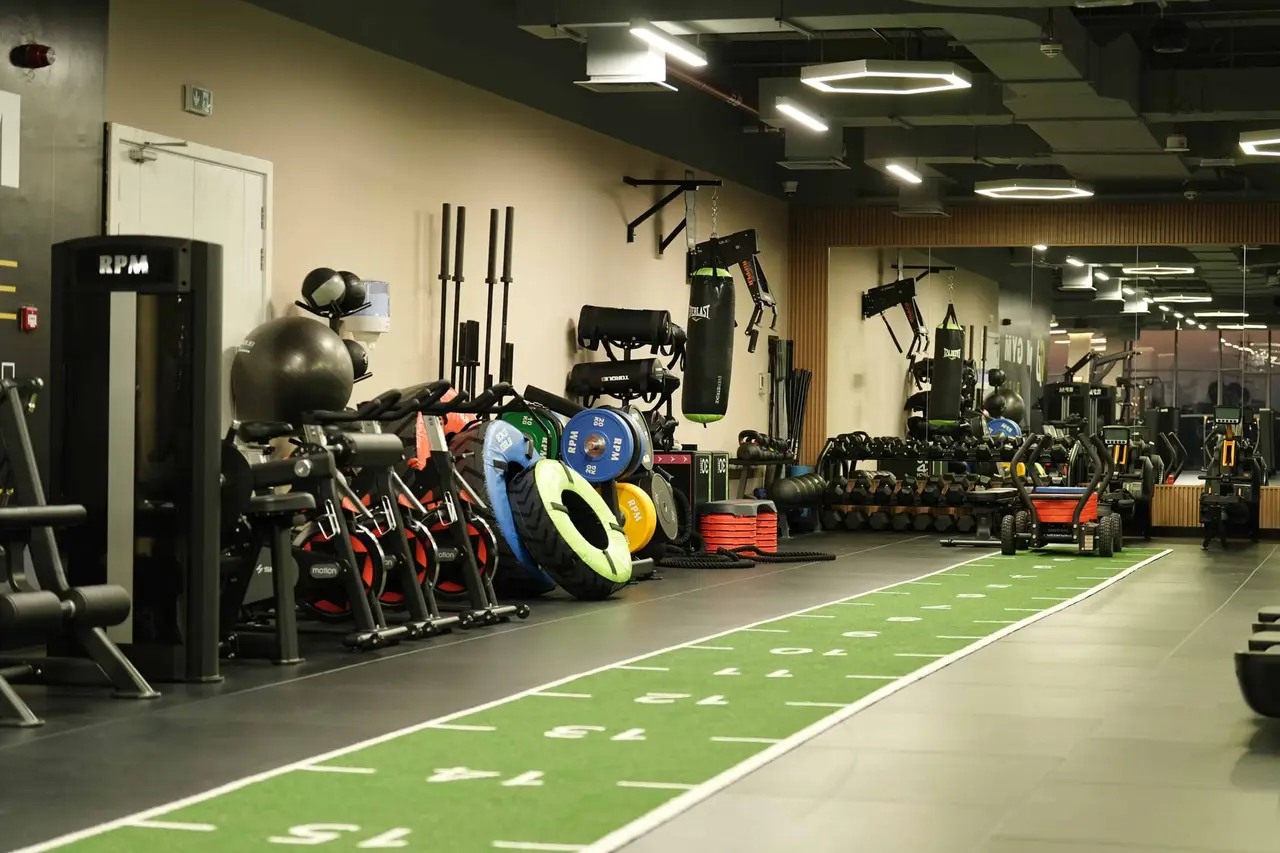
A superman needs a mat and enough floor to lie at full stretch. RPM's floor photos show a turf lane in the functional area; on a free guided tour, ask whether mats are available and where floor work is usually done. A coach standing beside you sees at once whether your head is leading the lift: book a personal training session, or ask for a female personal trainer.
Sources
- Ekstrom RA, Osborn RW, Hauer PL. Surface electromyographic analysis of the low back muscles during rehabilitation exercises. Journal of Orthopaedic and Sports Physical Therapy, 2008
- Kim CR, Park DK, Lee ST, Ryu JS. Electromyographic changes in trunk muscles during graded lumbar stabilization exercises. PM&R, 2016
Questions, answered.
What muscles does the superman exercise work?
Mainly the muscles along your spine, which lift your chest. The glutes and hamstrings lift your legs, the upper back holds your arms up, and the abdominal muscles keep the middle steady.
How long should you hold a superman?
Start with two or three seconds per rep and build towards five to ten while the lift stays low and still. Several clean holds do more than one long hold that ends with your head thrown back.
Superman or bird dog: which should I do?
They do different jobs. The superman lifts both arms and both legs lying face down and asks more of the back muscles; the bird dog lifts one arm and the opposite leg on hands and knees and adds balance and resistance to twisting. Many people use the bird dog to warm up and the superman as the harder hold.
Superman or back extension?
Both extend the back and hips. The back extension is done on a bench with your heels held under rollers, moves through a bigger range and takes a plate once bodyweight is easy; the superman needs only floor space and is a short hold. Use the superman to learn the position, and the bench when you want to add load.
Superman or plank?
The plank holds you up on your forearms and toes and works mostly the front of the trunk; the superman lies on the floor and works mostly the back. They pair well in the same short core block.
Why is it called the superman?
With your arms stretched out in front and your legs lifted behind, you look like the comic-book hero in flight. Some coaches call it a floor back extension instead.