What balancing on two points asks of your trunk
On hands and knees you have four points of support and nothing to resist. Lift one arm and the opposite leg and you are balanced on a diagonal, one hand and one knee. Two forces then try to move your trunk. The unsupported side wants to drop and turn, so the hip of the lifted leg tips up towards the ceiling, and the weight of the outstretched leg pulls your lower back towards a sag. The bird dog is the job of refusing both, slowly and at very low load.
The long muscles either side of the spine, the erector spinae with the smaller multifidus beneath them, hold the back level, while the obliques and the deep abdominal wall stop the rotation. The glute of the reaching leg keeps that hip straight, and both shoulders work. Compared with the dead bug, done lying on your back, the back of the body does more and balance becomes part of the exercise.
Because the load is tiny, the bird dog builds little strength or muscle. Its value is control: keeping the pelvis still while a limb moves, which a lunge, a one-arm press or a run also ask of your trunk. It suits beginners and anyone who wants slow trunk work with no equipment, and it makes a good warm-up before squats or deadlifts. The core training guide places it among the exercises that resist twisting.
Setting up on all fours
- Kneel on a mat with your hands flat under your shoulders and your knees under your hips, about hip-width apart. Spread your fingers and press the floor away.
- Let your back settle into its natural shape, neither arched up like a cat nor sagging. If a partner laid a light stick along your spine, it would touch the back of your head, the middle of your upper back and your tailbone.
- Rest the tops of your feet on the mat, or tuck your toes under if that feels steadier. Keep your eyes on the floor just ahead of your hands, so your neck stays long.
- Breathe out and tighten your stomach lightly: firm enough to feel, nowhere near the brace you would use for a heavy squat.
- Test the base: lift one hand an inch. If your hips shift sideways, widen your knees a little and brace again.
The reach, step by step
- Slide your right leg straight back along the mat, then lift it until your heel is about level with your hip. Push the heel towards the wall behind you, toes pointing at the floor.
- At the same time, reach your left arm forward to shoulder height, thumb pointing up, as if reaching for something just beyond your fingertips.
- Hold for two or three seconds, or one slow breath out. Both hip bones still point at the floor, and your back is in the shape it started in.
- Bring the hand and the knee back down under control, touching the mat lightly rather than dropping onto it.
- Reach the other diagonal, left leg with right arm. Count the sides separately and give both the same number of reps.
The cue that fixes most bird dogs is long, not high. The leg stops at hip height and the arm at shoulder height; lifting either one higher only arches your back. Picture a glass of water balanced on your lower back that must not spill, and take about two seconds to reach, a hold, and two seconds to come back.
Bird dog mistakes and their fixes
| Mistake | What it looks like | The fix |
|---|---|---|
| Leg lifted too high | The heel rises above the hip and the lower back dips | Stop at hip height and push the heel back, not up |
| Hip rolling open | The hip of the lifted leg turns up towards the ceiling | Keep both hip bones pointing at the floor; reach less far until they do |
| Weight lurching sideways | The whole body drifts over the supporting knee as the limbs lift | Brace before you move, then lift the arm and leg together and slowly |
| Sinking into the supporting shoulder | The chest drops and that shoulder blade pinches in | Keep pushing the floor away with the hand that stays down |
| Flicking the limbs | The arm and leg shoot out and back in under a second | Two seconds out, a hold, two seconds back |
| Looking up | The chin lifts to watch the mirror and the neck creases | Eyes on the floor just ahead of your hands |
A hip that rolls open on every rep means the reach is longer than you can control for now. Stop the set if anything hurts, and if you have back pain, speak to a doctor or physiotherapist before you train the bird dog.
From single-limb reaches to the hovering bird dog
The bird dog is easy to scale. Fewer moving limbs make it easier; a longer hold, a light load or lifting the knees off the floor make it harder. Move one step at a time, and only when the version you are on keeps level hips on both sides.
Single-limb bird dog
Move one limb at a time while the other three stay down: reach one arm forward and return it, or slide one leg back and lift it to hip height. You are balanced on three points instead of two, which takes most of the wobble out. Start here if the full version shifts your hips, and use it as a warm-up on a day your trunk feels tired.
Elbow-to-knee bird dog
From the full reach, draw the elbow and the opposite knee together under your body, then reach long again without touching down. The back rounds a little as they meet and lengthens as you reach, so the trunk controls both directions while you stay on two points. Keep it slow; it is a balance drill, not a crunch.
Weighted or banded bird dog
Hold a light dumbbell in the reaching hand, or loop a resistance band around the reaching foot and the opposite hand so it stretches as you reach. Either way the trunk works harder to keep you square. Start lighter than you expect: a weight held at arm's length feels far heavier than it is.
Hovering bird dog
Tuck your toes and lift your knees an inch off the floor, so you start in a low bear position with your back flat. Reach the arm and the opposite leg from there and switch sides without letting the knees touch down. The supporting hand and foot now carry much more of your weight and the front of the trunk joins in, which makes it a big step up and the stepping stone to crawling drills.
If kneeling bothers your knees, fold the mat under them, or train the same anti-rotation job standing with a Pallof press at a cable tower. A plank covers the front of the trunk, and the glute bridge gives the hip-extension part of the movement a real load.
Reps, holds and where it goes in a session
| Goal | Sets × reps | How hard |
|---|---|---|
| Learning the position | 2 × 5 each side, 3-second hold | Level hips on every rep; single-limb if needed |
| Warm-up before squats or deadlifts | 1–2 × 6 each side | Easy and smooth; you should not feel tired after it |
| Building trunk control | 3 × 8 each side, 5–8-second hold | End the set when the hips start to roll |
| Harder versions | 3 × 5 each side | Hovering knees or a light weight, hips still level |
Rest thirty to forty-five seconds between sets. Finish one side before the other, or alternate every rep; alternating gives each side less rest.
Progress the hold first, up to about ten seconds a rep, then the tempo, then the harder versions. Because it barely tires you, the bird dog fits in a warm-up, between sets of a lower-body lift, or in a short core block with a dead bug and a side plank, which between them cover arching, twisting and leaning. Two or three times a week suits most people. For strength in the back of the body, heavier hinges such as the Romanian deadlift do the work the bird dog cannot.
Bird dogs at RPM
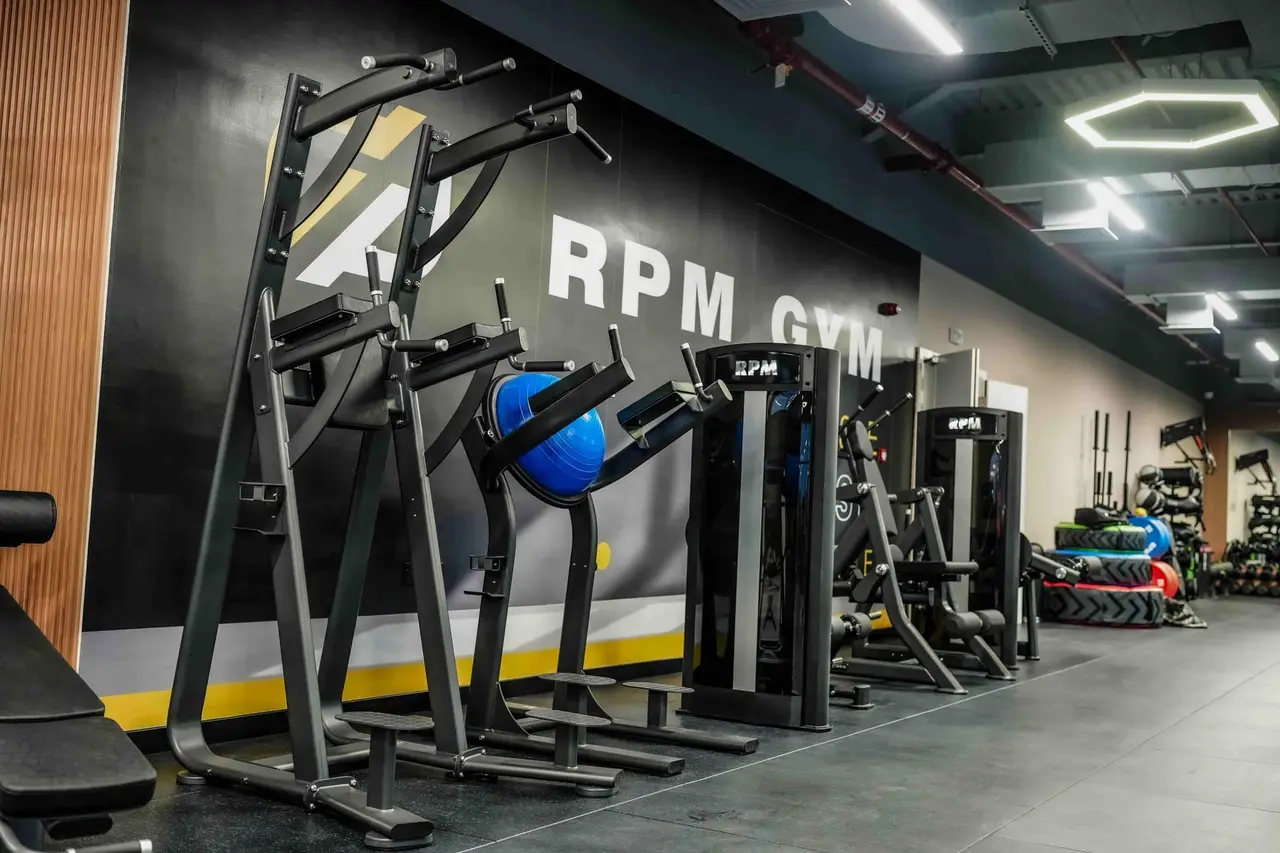
All a bird dog needs is a mat and room to reach out in both directions, so it fits in either section. RPM's floor photos show a turf lane in the functional area and a dumbbell rack for the weighted version; on a free guided tour, ask whether mats and resistance bands are available. A coach watching from the side shows you quickly whether your hips really stay level: book a personal training session, or ask for a female personal trainer.
Questions, answered.
What muscles does the bird dog work?
The muscles along your spine and the deep abdominal wall hold your back level, the obliques stop your hips turning, and the glute of the lifted leg keeps that hip straight. The shoulders work on both sides: one holds you up, the other keeps the arm in line.
How long should you hold a bird dog?
Start with two or three seconds at full reach and build to about ten, as long as your hips stay level. Several short holds in good shape do more than one long, wobbly one.
Bird dog or plank: which should I do?
Both, if you have time. The plank is a still hold that resists sagging; the bird dog adds balance and asks the trunk to resist twisting at very low load. Many people put the bird dog in the warm-up and the plank in the core block.
Is the bird dog the same as the superman exercise?
No. In the superman you lie face down and lift both arms and both legs at once, arching your back. The bird dog stays on hands and knees with the back level and lifts only one arm and the opposite leg.
Why is it called the bird dog?
The position is said to resemble a gun dog pointing at a bird, its body stretched long towards the target. In Arabic the name is often translated literally, as the bird and the dog.