What 5×5 is, and who it suits
Five by five means five work sets of five reps on each main lift, all at one weight after the warm-up. Each session has three barbell lifts, and the weight goes up whenever you complete the work, so you always know what the next session asks of you.
It suits someone who has learned the barbell lifts and now wants them heavier: a late beginner, or someone back after a long break. The American College of Sports Medicine's position stand suggests that newcomers to resistance training start with loads they could lift 8 to 12 times, and keeps heavy work of 1 to 6 reps, with three to five minutes' rest, for lifters with about six months of steady training. If you have never trained, spend a month or two on the 3-day gym workout plan first.
Pick something else if muscle size matters more to you than the weight on the bar (the muscle building gym program gives each muscle more sets) or if you cannot use a barbell. If a lift causes pain, speak to a doctor or physiotherapist before you load it. Every other plan is in the workout plans library.
Two sessions on three days a week
Leave a rest day between sessions, for example Sunday, Tuesday and Thursday, or Monday, Wednesday and Saturday. The sessions alternate, so each week starts with the one the last week did not finish on.
| Week | First day | Second day | Third day |
|---|---|---|---|
| 1 | Session A | Session B | Session A |
| 2 | Session B | Session A | Session B |
The squat is in both sessions, so you squat three times a week. The bench press and overhead press take turns, and so do the row and the deadlift.
Warm up with five minutes on a bike or cross-trainer, then a set with the empty bar and two or three heavier sets with fewer reps each. Later lifts need only one or two build-up sets. The warm-up set calculator lays out a ramp for any working weight.
Session A: squat, bench press, row
Three lifts in this order, then an optional plank. While the weights are light, two or three minutes between sets is plenty; as they climb, take the three to five minutes the ACSM position stand gives for heavy sets of 1 to 6 reps.
| Exercise | Sets | Reps | Rest | Notes |
|---|---|---|---|---|
| Back squat | 5 | 5 | 3–5 min | Same weight on all five sets |
| Bench press | 5 | 5 | 3–5 min | Rack safety arms set just below chest height |
| Bent over row | 5 | 5 | 2–3 min | Torso angle fixed; bar to the lower ribs |
| Plank | 2 | 30–45 sec | 60 sec | Optional |
Five sets of five is 25 work reps per lift. Warm-up sets do not count towards them.
Session B: squat, overhead press, deadlift
The squat again, one jump heavier than last time, then the standing press and a single heavy set of deadlifts. The pulldown is optional and gives session B a pull for the back.
| Exercise | Sets | Reps | Rest | Notes |
|---|---|---|---|---|
| Back squat | 5 | 5 | 3–5 min | One jump up from the last session |
| Overhead press | 5 | 5 | 3–5 min | Standing, glutes tight, no leaning back |
| Deadlift | 1 | 5 | One work set after the build-up sets | |
| Lat pulldown | 3 | 8–10 | 90 sec | Optional: session B has no row |
The deadlift gets one work set because it comes after five sets of squats and is trained on fewer days. If your back is still tired from the squats, add weight to the deadlift more slowly rather than adding sets. If a lift hurts, stop it and have it checked by a doctor or physiotherapist.
Choosing your starting weights
Start lighter than feels sensible: the plan works only while each session is within reach. On the first day, the last set of each lift should look like the first, with three or four reps still in hand.
| Your starting point | First-session weight | Why |
|---|---|---|
| New to the barbell lifts | The empty bar; for the deadlift, the bar with the lightest plates that lift it to normal height | The first weeks are technique practice with a growing load |
| Lifted before, with a recent set of five | About half of that weight | Several weeks of clean jumps before it gets hard |
| Know only a heavier or lighter set | A little under half of your estimated one-rep max | Estimates from 3 to 10 reps are rough, so err light |
The 1RM calculator estimates your one-rep max from a recent set, and the plate calculator works out what to load on each side. Use the same bar for a lift every session so your log stays comparable; the barbell guide covers bar types and loading.
When to add weight, and how much
The rule: if you completed all five sets of five with the form you started with, add weight next time; if you missed reps, keep the weight. ACSM's position stand advises raising a load by between 2 and 10 per cent once you can do one or two reps more than the target. 5×5 adds weight as soon as you hit the target, which works while the weights are light and is why stalls arrive.
| Lift | Usual jump each time it is trained | What to expect |
|---|---|---|
| Squat | 2.5 kg | Trained every session, so it climbs fastest |
| Deadlift | 5 kg for the first few weeks, then 2.5 kg | One set every other session leaves room for bigger early jumps |
| Bench press and row | 2.5 kg | Slower than the squat, since each is trained every other session |
| Overhead press | The smallest step the plates allow | Usually the first lift to stall |
A 2.5 kg jump is a small share of a 100 kg squat and a large one of a 30 kg press, which is why the upper-body lifts slow down first; small change plates help there. The 5x5 weight progression calculator projects where a fixed jump takes you; use it as a guide, not a target.
Log the weight and the reps of every set: 5, 5, 5, 4, 4 is a miss, not a pass. Keeping a gym training log shows a simple layout.
When a lift stalls
Sooner or later a weight will not go for all 25 reps. One miss is not a stall; apply the same rules every time, lift by lift.
| What happened | What to do next time |
|---|---|
| All 25 reps, form unchanged | Add the usual jump |
| Missed one or more reps | Same weight again |
| The same weight missed three sessions in a row | Take about a tenth off that lift (a reset) and climb back with the usual jumps |
| Reset twice and stuck near the same weight again | Change the scheme to three sets of five, still adding weight each time |
| Stuck on three sets of five as well | Add weight once a week instead of every session, or move to a plan with heavier and lighter days |
Reset only the lift that stalled, so the others keep moving. The 4-day gym workout plan is one plan with heavy and lighter days to move on to. When several lifts stall together, check the causes outside the plan as well: breaking a strength training plateau works through them in order.
Lighter weeks
Resets already build in a few lighter sessions, but a planned lighter week helps when the bar slows on every lift.
- When: after six to ten weeks of steady jumps, after resetting two or more lifts in one week, or after time away.
- How: the same two sessions, two or three sets of five per lift, at the weight you lifted about two weeks earlier.
- Then: return to the weights you left off with, not the next jump. In busy stretches, and in Ramadan for anyone fasting, hold your weights rather than chase new ones.
Beginner and intermediate versions
If you are newer to lifting
Start every lift with the empty bar and leave the optional pulldown for later. If even the empty bar is hard to control on the squat or press, learn the movements with goblet squats and dumbbell presses on a full-body plan first.
If you have lifted for a year or more
A jump every session may stall within weeks. Add weight once a week instead, or make one squat day heavy (five sets of five) and the other lighter (two sets of five at about a tenth less).
This plan at RPM
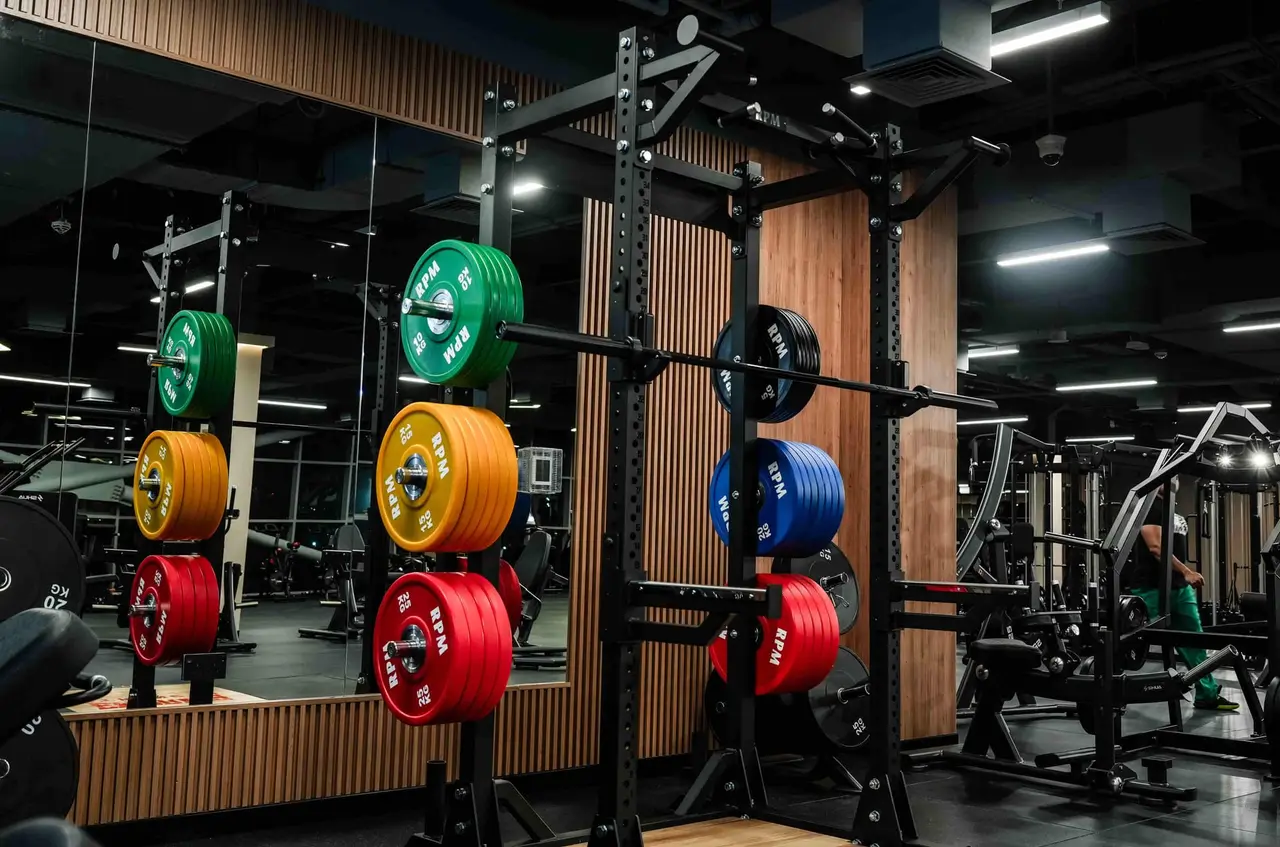
Both sessions run on kit that RPM's floor photos show: squat racks with barbells and colour bumper plates, flat benches, and the cable towers with their pulldown seat for the optional pulldown. The photos do not show small change plates or a lifting platform, so ask on a free guided tour what the smallest plates are and where deadlifts are done. If you train in the women-only Ladies section, ask which equipment it currently holds. To have a coach set your starting weights and check your squat depth, ask about personal training.
Sources
Questions, answered.
Is 5x5 good for beginners?
It suits beginners who have learned the lifts. If you have never trained, ACSM's advice is lighter loads for 8 to 12 reps at first, so start with the empty bar or a full-body plan.
Does a 5x5 workout build muscle?
Some, especially in the first months, because the weights rise quickly. It is not built for size, though. For hypertrophy, ACSM's position stand puts the emphasis on loads for 6 to 12 reps and more sets, which is how the muscle building gym program is written.
How long should I run a 5x5 program?
For as long as the weights keep rising with clean form. Many people get several months from it before resets stop working; the stall table above tells you when to change the scheme.
Can I do 5x5 with dumbbells?
You can, but dumbbells go up in bigger steps, so a jump every session soon outpaces you. With dumbbells, use double progression instead: build from sets of five towards sets of eight on one pair, then move to the next pair and start again at five. The barbell is what makes small, regular jumps possible.
How long does a 5x5 session take?
About 45 to 75 minutes. Three lifts sound quick, but the build-up sets and rests of three to five minutes on heavy days take most of the time.