What this program is built to do
This is a hypertrophy program for lifters with at least six months of steady training who want more muscle and can give the gym four days. It shares the upper/lower rhythm of the 4-day gym workout plan, but trades its heavy, low-rep compound work for more machine, cable and dumbbell exercises at 8 to 15 reps, so every set can be pushed hard without a long grind under a bar. If you train three days or fewer, start with another plan from the workout library.
Two ideas carry the program, and the guide to training for muscle size explains both in full. Volume: Schoenfeld and colleagues' 2017 meta-analysis found that more weekly sets per muscle tend to bring more growth, up to a point, and roughly 10 to 20 hard sets a week is a common working range. Effort: a set only counts if it ends close to failure, which here means one or two reps left. The ACSM position stand fills in the rest for hypertrophy work: multiple sets, moderate loads and one to two minutes' rest.
No program can set the pace of growth; that depends on your starting point, sleep, food and age. What this one can do is make sure the training is not what holds you back.
The week
Two upper and two lower days, with no session repeated in a week. With a Saturday and Sunday weekend, Monday, Tuesday, Thursday and Friday leave the weekend clear; Saturday, Sunday, Tuesday and Wednesday work just as well.
| Day | Session | Leads with |
|---|---|---|
| Monday | Upper A | Chest and upper back |
| Tuesday | Lower A | Quads |
| Wednesday | Rest or easy cardio | — |
| Thursday | Upper B | Shoulders and lats |
| Friday | Lower B | Glutes and hamstrings |
| Saturday and Sunday | Rest | — |
Every muscle is trained in two sessions a week, three days apart.
To warm up, cycle easily for five minutes, then do two lighter build-up sets of the first exercise and one of the second. The guide on how to warm up has more detail. Most sessions take 55 to 75 minutes; on upper days, superset the arm exercises if you are short of time.
Upper days
Upper A — chest and upper back
Two presses and two rows, then a chest isolation exercise and the arms. The first press is the heaviest work of the day; everything after it is about feeling the target muscle do the work.
| Exercise | Sets | Reps | Rest | Notes |
|---|---|---|---|---|
| Dumbbell bench press | 3 | 8–10 | 2 min | First and heaviest |
| Seated cable row | 3 | 10–12 | 90 sec | Pause with the handle at your ribs |
| Incline dumbbell press | 3 | 10–12 | 90 sec | No adjustable bench? Low-to-high cable fly |
| Dumbbell row | 3 | 10–12 each side | 90 sec | |
| Cable crossover | 2 | 12–15 | 60 sec | |
| Tricep pushdown | 3 | 10–12 | 60 sec | Superset with the next exercise |
| Bicep curl | 3 | 10–12 | 60 sec | Cable or EZ bar |
From week 4, take the last set of each isolation exercise to the point where one more clean rep would not come.
Upper B — shoulders, lats and arms
Vertical pressing and pulling this time, a machine press for the chest and more shoulder work. If the session runs long, pair the curls and the extensions as a superset.
| Exercise | Sets | Reps | Rest | Notes |
|---|---|---|---|---|
| Shoulder press | 3 | 8–10 | 2 min | Seated, dumbbells |
| Lat pulldown | 3 | 10–12 | 90 sec | |
| Chest press machine | 3 | 10–12 | 90 sec | Not confirmed at RPM: barbell bench press |
| Straight arm pulldown | 2 | 12–15 | 60 sec | |
| Lateral raise | 4 | 12–15 | 60 sec | One arm at a time on a cable |
| Rear delt fly | 3 | 12–15 | 60 sec | Cables crossed, or dumbbells |
| Hammer curl | 3 | 10–12 | 60 sec | Superset with the next exercise |
| Overhead tricep extension | 3 | 10–12 | 60 sec | Rope on a cable |
Rest times are a minimum, not a target: if the next set would lose reps, rest longer.
Lower days
Lower A — quads first
A machine squat pattern, a single-leg exercise and a quad isolation, then a hinge for the hamstrings and two short finishers.
| Exercise | Sets | Reps | Rest | Notes |
|---|---|---|---|---|
| Leg press | 4 | 10–12 | 2 min | Lower only as far as your lower back stays on the pad |
| Step-ups | 3 | 10 each leg | 90 sec | Bench height; drive through the front heel |
| Leg extension | 3 | 12–15 | 60 sec | Not confirmed at RPM: slow goblet squat, heels raised |
| Romanian deadlift | 3 | 10–12 | 2 min | Dumbbells |
| Calf raise | 3 | 12–15 | 60 sec | On the leg press |
| Cable crunch | 3 | 12–15 | 60 sec |
If a knee or your back hurts during a movement, stop it and get it checked by a doctor or physiotherapist rather than pushing through.
Lower B — glutes and hamstrings first
A loaded hip extension, a knee-bending hamstring exercise and walking lunges, then single-leg and cable work to finish.
| Exercise | Sets | Reps | Rest | Notes |
|---|---|---|---|---|
| Hip thrust | 4 | 8–12 | 2 min | Barbell, upper back on a flat bench |
| Leg curl | 4 | 10–12 | 90 sec | Not confirmed at RPM: two more sets of slow Romanian deadlifts |
| Lunges | 3 | 10–12 each leg | 90 sec | Walking, dumbbells |
| Single leg romanian deadlift | 3 | 10 each side | 60 sec | |
| Cable kickback | 3 | 12–15 each leg | 60 sec | |
| Calf raise | 3 | 12–15 | 60 sec | Standing on one leg, dumbbell in hand |
| Pallof press | 3 | 10 each side | 45 sec |
Lower B is the longest session. If time runs out, drop the kickbacks before anything else.
Weekly sets per muscle
A set counts as hard when it ends with about two reps or fewer left; warm-up sets do not count. Each set below is counted once, for the muscle it is in the session to train. Presses also work the triceps, rows the biceps and lunges the glutes, so the real totals for those muscles run a little higher.
Hard sets per muscle per week, by session, with the target for week 8.
| Muscle | Upper A | Lower A | Upper B | Lower B | Weeks 1–3 | Week 8 |
|---|---|---|---|---|---|---|
| Chest | 8 | — | 3 | — | 11 | 14–15 |
| Back (lats and upper back) | 6 | — | 5 | — | 11 | 14–15 |
| Shoulders (front, side, rear) | — | — | 10 | — | 10 | 13–14 |
| Biceps | 3 | — | 3 | — | 6 | 8 |
| Triceps | 3 | — | 3 | — | 6 | 8 |
| Quads | — | 7 | — | 3 | 10 | 14 |
| Glutes | — | 3 | — | 7 | 10 | 14 |
| Hamstrings | — | 3 | — | 7 | 10 | 14 |
| Calves | — | 3 | — | 3 | 6 | 8 |
| Abs and trunk | — | 3 | — | 3 | 6 | 6 |
Shoulders combine the press, lateral raises and rear-delt flyes. Arms get fewer direct sets because every row and press trains them too, and calves and abs stay modest; add sets there only if they lag. The hypertrophy volume calculator suggests a weekly range for your training experience.
Between weeks 4 and 8, add about one set per muscle per week, to an exercise that is still progressing, until you reach the week-8 column. Skip the addition for any muscle whose reps dropped last session or that is still sore when its next session comes round. Not every muscle has to reach the top of its range: stop adding while progress keeps coming at the volume you have.
Effort, progression and the 12-week block
Use double progression on every exercise: stay at one weight until all sets reach the top of the rep range, then take the smallest step up and start again at the bottom. On cables and machines that step is often one plate on the stack; on dumbbells it is the next pair, which can mean a few sessions at the bottom of the range.
| Weeks | Sets | Reps left at the end of a set | Focus |
|---|---|---|---|
| 1–3 | The weeks 1–3 column | Two | Find your loads and log every set |
| 4–8 | About one more set per muscle each week, up to the week-8 column | One or two; the last set of each isolation exercise close to none | Reps first, then load |
| 9–11 | Hold the week-8 sets | One or two | Keep adding load and reps; take two sets off any muscle that stops recovering |
| 12 | About half the sets at the same loads | Three or more | Deload, then compare your log with week 1 |
Start the next block from the weeks 1–3 sets with heavier loads, and swap only the exercises that stalled for three weeks or that you never feel in the target muscle.
The lighter week is not wasted. Fatigue builds quietly across a block, and a week at half the sets often lets the numbers move again in the next one. If you need it early, take it, and restart the climb from where you were.
Adjust it for your situation
As a lean bulk workout plan
The training stays exactly as written. A lean bulk is a food decision: eating a little more than you need while keeping the gain in body fat small. That side is covered in muscle gain and bulking, and a registered dietitian can set the amounts with you, especially if you have a medical condition. Check your weekly sets against your experience with the hypertrophy volume calculator.
For men over 40
Use the same program. What many lifters in their forties change is the warm-up and the spacing: two or three build-up sets before each of the first two exercises, an extra minute's rest on the first lift, and, if recovery feels slow, training every other day so the four sessions take eight days instead of seven. Start at the weeks 1–3 sets and earn each addition.
If one muscle lags behind
Give it two extra sets a week for a whole block and hold everything else, or move its exercise to the start of its session. A coach running the block can make these calls from your log; personal training for muscle gain explains how a coached block works.
This program at RPM
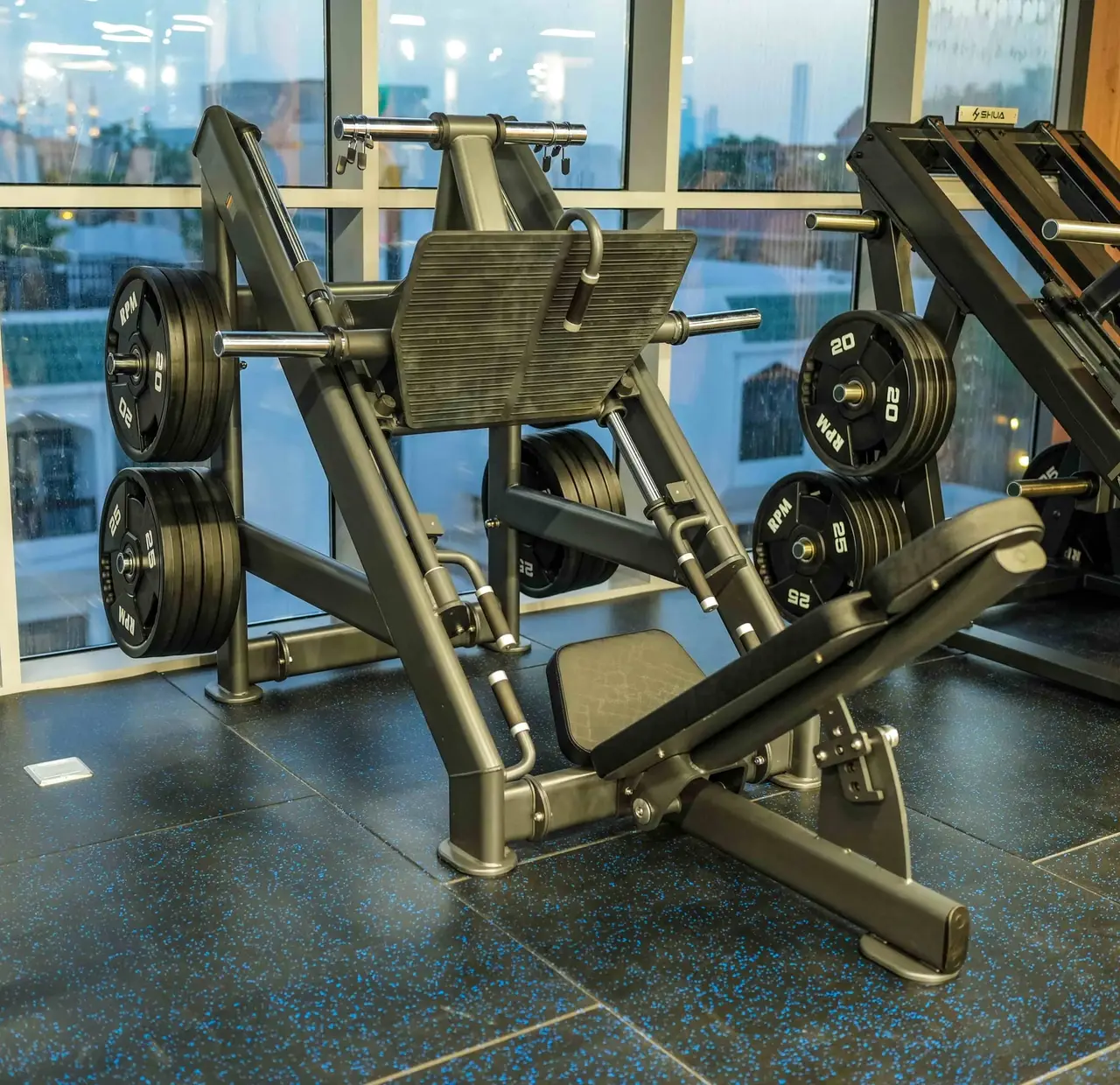
Most of the program runs on equipment RPM's floor photos show: the cable towers with their pulldown seat, the plate-loaded leg press, the dumbbell rack, EZ bars, and barbells with flat benches for the hip thrusts. A leg extension, a leg curl, a chest press machine and an adjustable bench are not confirmed, so ask about them on the free guided tour and use the swaps in the session notes until you know. If you want a coach to run the block with you, see personal training.
Sources
- Schoenfeld BJ, Ogborn D, Krieger JW. Dose-response relationship between weekly resistance training volume and increases in muscle mass: a systematic review and meta-analysis. Journal of Sports Sciences, 2017
- American College of Sports Medicine, position stand: Progression models in resistance training for healthy adults (2009)
Questions, answered.
How many sets per muscle per week should I do for hypertrophy?
Roughly 10 to 20 hard sets a week is a common working range, and this program starts near the bottom of it. Schoenfeld's 2017 meta-analysis found that more weekly sets tend to bring more growth, up to a point, so the climb is gradual and stops where you stop recovering. The hypertrophy volume calculator suggests a range for you.
Can I run this program on three days a week?
Not as written: dropping a day removes a quarter of the weekly sets. With three days, the 3-day gym workout plan trains each muscle more often with full-body sessions; with five, the 5-day gym workout plan adds push, pull and legs days to an upper/lower pair.
Is this program suitable for women?
Yes. The sessions, sets and progression work the same way for anyone, and Lower B already gives the glutes and hamstrings a session of their own. The gym workout plan for women is written around the questions women ask most.
How long should I run this program?
One 12-week block, then start again with heavier loads, keeping the exercises that are still progressing. Many lifters run several blocks back to back before they need a different program. Judge each block by your log: rising reps and loads show the training is moving, whatever the mirror says that week.
What if my gym has no leg curl or leg extension machine?
Use the swaps in the session notes: a slow goblet squat with raised heels for the leg extension, and extra Romanian deadlift sets for the leg curl. They load the muscles differently, so use the machines if you can find them. Cable and dumbbell versions of most other exercises are in the exercise library.