Who a four-day week suits
Four sessions are the usual next step once three full-body days stop moving your lifts every week. Splitting the body into upper and lower halves means each session covers fewer muscles, so it can give them more sets and longer rests. The ACSM position stand sets out this progression: two or three full-body days for novices, and split routines such as upper and lower days for intermediate lifters who need more work per muscle.
Each half of the body is trained twice a week, and this plan mixes heavy strength work (4 to 8 reps on the main lifts) with lighter volume (8 to 15 reps). If you are still choosing where to train, training four days a week covers what a gym needs for this kind of week; this page is the plan itself, part of RPM's workout plans. Newer lifters usually do better on the 3-day gym workout plan for their first few months.
Laying out the four days
Never put two upper days or two lower days back to back. An upper day followed by a lower day is fine, because yesterday's muscles rest while today's work.
| Layout | Upper 1 | Lower 1 | Upper 2 | Lower 2 |
|---|---|---|---|---|
| Two on, one off, two on | Monday | Tuesday | Thursday | Friday |
| Saturday–Sunday weekend, Sunday start | Sunday | Monday | Wednesday | Thursday |
| Every other day (rolling) | Day 1 | Day 3 | Day 5 | Day 7 |
Put Upper 1 and Lower 1, the heavier pair, where you are freshest in the week. The rolling layout takes eight days per cycle, so your training days move through the week; it suits shift work.
The upper/lower split tool fits the same structure to your days and equipment. Open each session with a few easy minutes of cardio and a ramp of lighter sets on the first exercise; the warm-up guide covers the details.
The two upper sessions
Upper 1 is built on barbells and lower reps. Upper 2 switches to dumbbells and cables at higher reps, which gives your shoulders and elbows a different angle and adds sets without more heavy loading.
Upper 1: heavy
The bench press and barbell row carry the load today. The overhead press and pulldown follow at moderate reps, then two short arm exercises. Take full rests on the opening pair; they are the lifts you will add weight to most often.
| Exercise | Sets | Reps | Rest | Notes |
|---|---|---|---|---|
| Bench press | 4 | 4–6 | 3 min | Main lift |
| Bent over row | 4 | 6–8 | 2 min | |
| Overhead press | 3 | 6–8 | 2 min | Standing |
| Lat pulldown | 3 | 8–10 | 90 sec | |
| Skull crusher | 2 | 8–12 | 60 sec | EZ bar |
| Bicep curl | 2 | 8–12 | 60 sec | EZ bar or dumbbells |
Ask for a spot on heavy bench press sets. If you train alone, stop with two reps in reserve rather than one.
Upper 2: volume
Lighter loads and more reps, mostly dumbbells and cables. If time is tight, superset the face pull with the triceps extension and the session still fits into about 50 minutes.
| Exercise | Sets | Reps | Rest | Notes |
|---|---|---|---|---|
| Dumbbell bench press | 3 | 8–12 | 2 min | First lift of the day |
| Seated cable row | 3 | 10–12 | 90 sec | |
| Arnold press | 3 | 10–12 | 90 sec | |
| Face pull | 3 | 12–15 | 60 sec | |
| Overhead tricep extension | 2 | 10–15 | 60 sec | Cable or dumbbell |
| Hammer curl | 2 | 10–15 | 60 sec |
A set of 10 to 15 should still be hard: the last two reps slow down even though the weight is moderate.
The two lower sessions
Each lower day has one heavy main lift and lighter work for the other pattern, so the squat and the deadlift each get one heavy session a week without both landing on the same day.
Lower 1: squat-led
Squat heavy, then a Romanian deadlift kept moderate so your hamstrings and back are fresh again for Lower 2, then single-leg work, calves and the trunk.
| Exercise | Sets | Reps | Rest | Notes |
|---|---|---|---|---|
| Back squat | 4 | 4–6 | 3 min | Main lift |
| Romanian deadlift | 3 | 8–10 | 2 min | Moderate: stop 2–3 reps short |
| Bulgarian split squat | 3 | 8–10 each leg | 90 sec | |
| Calf raise | 3 | 10–15 | 60 sec | On the leg press or holding dumbbells |
| Plank | 3 | 30–45 sec | 45 sec |
Every rack taken? Start with the split squats and come back to the squat when one opens up.
Lower 2: deadlift-led
Deadlift heavy for a few sets, then volume for the quads and glutes from the leg press, hip thrust and lunges.
| Exercise | Sets | Reps | Rest | Notes |
|---|---|---|---|---|
| Deadlift | 3 | 4–6 | 3 min | Main lift |
| Leg press | 3 | 10–12 | 2 min | |
| Hip thrust | 3 | 8–12 | 90 sec | Upper back on a flat bench |
| Lunges | 2 | 10–12 each leg | 90 sec | Walking or in place |
| Dead bug | 3 | 8 each side | 45 sec |
A lift that hurts sharply, or leaves pain that is still there the next day, comes out of the session until a doctor or physiotherapist has looked at it.
Heavy days, volume days and when to add weight
On heavy work (Upper 1, the squat and the deadlift) stop each set with about two reps in reserve: heavy enough to build strength, with enough margin that the last rep looks like the first. Volume work, meaning Upper 2 and every accessory, can go to one rep in reserve, because missing the last rep of a cable row costs you nothing.
Add weight exercise by exercise with double progression: build reps within the range, then make a small load jump once every set reaches the top. Heavy lifts climb slowly, often one small step every week or two, while accessories can sit on one weight for weeks as the reps rise. The 1RM calculator helps you pick starting loads for the heavy sets.
| Weeks | Heavy sets | Volume sets | Reps in reserve |
|---|---|---|---|
| 1–2 | 3 sets per main lift, at loads you could lift about 8 times | 2 per exercise | 3 |
| 3–6 | 4 sets as written; add load when all reach the top of the range | As written; reps first, then load | 2 heavy, 1–2 volume |
| 7–10 | Same sets, keep pushing the load | One extra set on the first two exercises of Upper 2 | 2 heavy, 1 volume |
| 11 | Same sets at the heaviest loads of the block | As written | 1–2 |
| 12 | Lighter week: two sets of each main lift at your week-8 loads | Two easy sets each | 4 or more |
After week 12, repeat from week 3 with your new loads. Change the accessories between blocks if you like, but keep the four main lifts so you can see your progress.
Versions for muscle, strength or fat loss
The four sessions stay; the emphasis moves.
For more muscle
Keep the heavy days and add one set to every volume exercise from week 5; in the 2017 Schoenfeld review, more weekly sets per muscle tended to mean more growth, up to a point. If you want a four-day plan built entirely around muscle growth, with more machine and cable work, higher reps and weekly sets counted per muscle, the muscle building gym program is that plan.
For strength
Run the bench press, squat and deadlift at 5 sets of 3 to 5 with three minutes' rest, put the Upper 2 dumbbell press at 4 sets of 6 to 8, and trim every accessory to two sets. Strength comes mainly from the main lifts, so protect their rest and their place at the start of each session.
For fat loss
Keep all four sessions and the heavy loads; walk, cycle or use a cross-trainer at an easy pace on the rest days. Eating less is what drives fat loss; heavy lifting helps you keep the muscle and strength you have while you do it. The weight loss workout plan slots the cardio in for you.
PHUL, body-part splits and why this plan uses upper and lower days
Two other four-day layouts come up again and again. Both work; here is how they compare with this plan.
What is PHUL?
PHUL stands for power hypertrophy upper lower: two power days (upper and lower, low reps) and two hypertrophy days (upper and lower, higher reps). This plan is close to it, and its two upper days match PHUL's. The difference is on the lower days. PHUL puts the heavy squat and heavy deadlift on one power day and makes the other lower day all volume; here each lower day has one heavy lift, which keeps both sessions to about an hour.
What about a 4-day body-part split?
Each day trains its own group: chest and triceps, back and biceps, legs, then shoulders. Every muscle gets one long, hard session a week. It suits people who enjoy concentrating on one area, but most lifters progress more steadily when each muscle is trained twice a week, which is why this plan uses upper and lower days. If you prefer the body-part layout, the chest and triceps workout and back and biceps workout are ready-made days for it.
Can I use more machines?
Yes, for the accessories. Keep the four barbell main lifts and swap anything after them for a machine or cable version in the same rep range. The guide to combining machines and free weights has a sample four-day week built that way, if you would like an alternative layout.
Running the four days at RPM
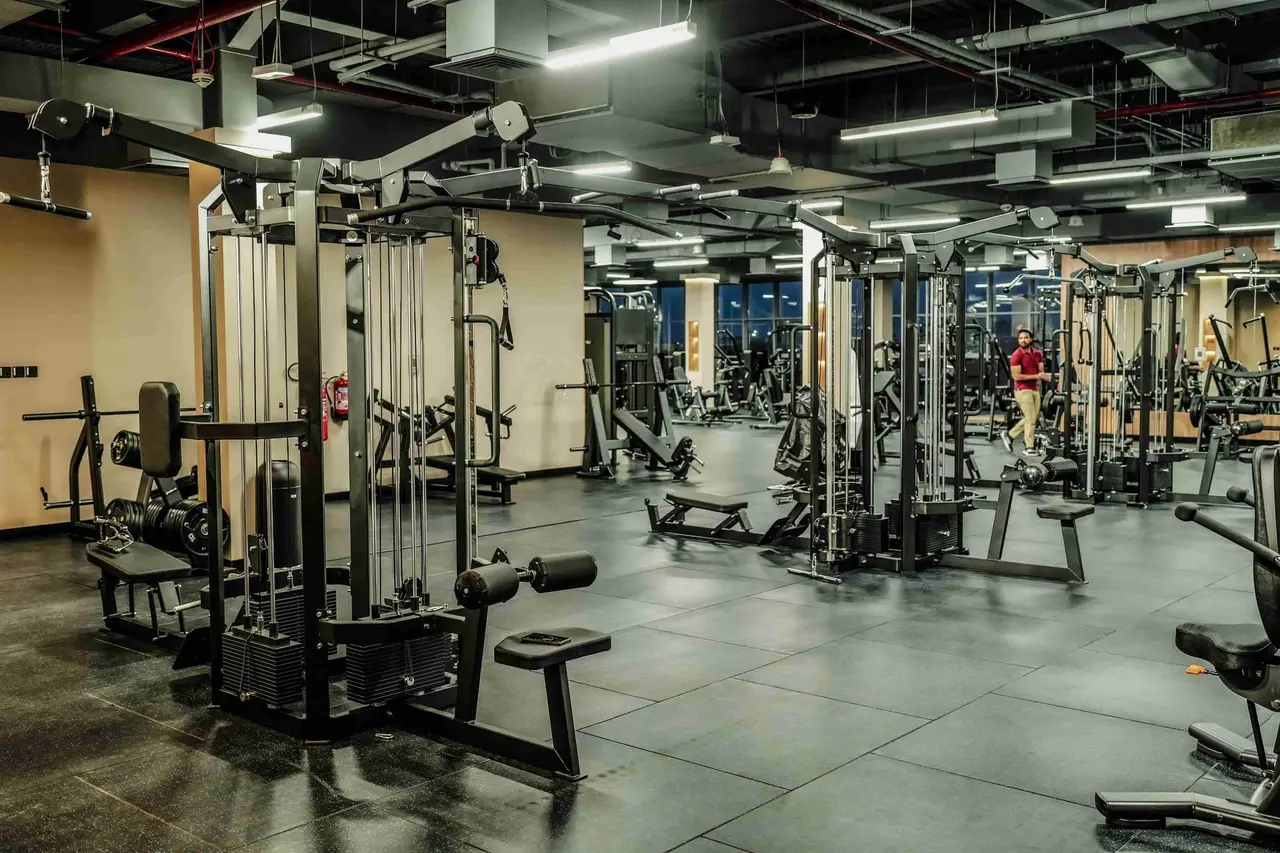
Every exercise above uses equipment that appears in RPM's own floor photos: squat racks with barbells and colour bumper plates for the four main lifts and the barbell row, flat benches, the dumbbell rack and EZ bars, the cable towers for the pulldown, cable row, face pull and triceps work, and the plate-loaded leg press. Book a free guided tour at the hour you plan to train, and if you want someone to check your technique on the heavy days, personal training is the option to ask about.
Sources
- American College of Sports Medicine, position stand: Progression models in resistance training for healthy adults (2009)
- Schoenfeld BJ, Ogborn D, Krieger JW. Dose-response relationship between weekly resistance training volume and increases in muscle mass: a systematic review and meta-analysis. Journal of Sports Sciences, 2017
Questions, answered.
Is a 4 day split good for muscle growth?
Yes. Four sessions let each muscle be trained twice a week with more sets per session than full-body days can hold, and the volume day and accessories here cover most of the growth work. Progress still comes from adding sets and load over months; the split just makes that easier to fit in.
Is this 4 day gym workout routine OK for beginners?
It is written for people with a few months of lifting behind them. Complete beginners usually progress faster on three full-body days; start with the beginner workout plan or the 3-day plan, and move here once your lifts stop rising every week.
Is a 4 day split different for women?
No. The sessions, rep ranges and progression are the same for women and men; choose loads you can lift with good form and progress at your own pace. The gym workout plan for women covers the questions women ask most about starting out.
Can I do this 4 day workout plan with dumbbells only?
Most of it. Use the dumbbell bench press on both upper days, one-arm dumbbell rows for the barbell row, a seated dumbbell shoulder press, goblet or split squats for the squat and dumbbell Romanian deadlifts for the deadlift. The heavy days get lighter, so slow the lowering phase and work at the top of each rep range.
Can I train full body four days a week instead?
You can, but four full-body sessions mean shorter sessions and less rest for each muscle between them. Upper and lower days spread the same work with fewer exercises per session, which most people find easier to recover from and to progress on.