The answer in brief
A crunch and a sit-up start the same way: the rectus abdominis, the long muscle down the front of the stomach, curls your ribs towards your pelvis and peels your head and shoulders off the mat. The crunch stops there. The sit-up keeps going, and because the trunk cannot curl much further, the hip flexors at the front of your hips take over and pull the curled torso up towards your thighs. So the real question is not which one works the abs more, but whether you want that second half.
Both bend the trunk forwards, which is one of several jobs your trunk does. The core training guide shows where a bending exercise sits beside holds, carries and the big lifts, and the crunch vs plank comparison sets bending against bracing.
Side by side
| What differs | Crunch | Sit-up |
|---|---|---|
| Where the rep ends | Shoulder blades just clear of the floor | Sitting upright, chest towards the thighs |
| Joints that move | The spine only | The spine, then the hips |
| Main movers | Rectus abdominis, the front of the stomach | The abdominals and obliques for the curl, then the iliopsoas and rectus femoris |
| What tires first | The stomach | Often the fronts of the hips |
| Feet | Loose on the floor; hooking them brings in the hips | Loose to learn, anchored for more reps or on a decline |
| Lower back | Stays on the mat | Leaves the mat as you rise, returns first on the way down |
| Ways to load it | A plate on the chest, a decline bench, a cable stack | A plate on the chest, a decline bench |
Where each rep stops, and who takes over
The rectus abdominis runs from the lower ribs to the pubic bone, so all it can do is draw those two points together. Once your shoulder blades are off the floor it has done most of that. Lifting higher means bending at the hips, and no stomach muscle crosses the hip joint. The muscles that do are the iliopsoas, deep in the hip, and the rectus femoris, the one quad muscle that crosses the hip as well as the knee. In a sit-up they lift your whole curled trunk, while the abdominals keep working to hold the curve rather than to make it.
That has a practical consequence. The sit-up's extra range adds hip work, not much more stomach work. If you want more from the abdominals, the answer is a harder crunch: slower, with the arms overhead, with a plate or on a cable. If you want hip flexors that are strong through a long range, as runners, combat-sport athletes and anyone facing a sit-up test do, the second half is exactly what you are after.
Anchored feet and swinging arms: how the hips take over
Most ways of making either exercise easier hand the job to the hip flexors. Hook your feet under a pad or have a partner hold them, and the hip flexors get something to pull against, so you rise further with less effort from the stomach. That is useful in a sit-up once you can do it unanchored, and on a decline bench, where the feet have to be held. In a crunch it defeats the purpose, so leave the feet loose.
- Throwing the arms forwards flings you upright in a sit-up and turns a crunch into a jerk. Cross them on your chest instead.
- Pulling on the head is the commonest crunch fault and turns up in tired sit-ups too. Rest your fingertips at your temples or ears, and never lace your fingers.
- Rising in one stiff piece, back flat, means the hips are doing it all. Curl first, then sit.
- Dropping on the way down wastes the easiest place to work harder: take about three seconds to roll down from a sit-up, and two or three to lower a crunch.
A quick check while you learn: rest a hand on the crease at the front of one hip. In a good crunch it stays quiet. In a sit-up you will feel it tighten at about halfway, the moment the hips take over.
Reasons to stop at the shoulder blades
- The abdominal muscles are the goal and you want little else involved.
- You cannot yet do a full sit-up with control: the crunch is its first half, and the place to start.
- You feel sit-ups mostly in the fronts of your hips and want your stomach to do the work.
- You want to load the movement in small, measurable steps, ending on the cable crunch.
Reasons to sit all the way up
- A fitness test counts sit-ups, so you need to practise its version under its rules.
- You want hip flexors that are strong through a full range, for running, kicking or lifting the legs in a hanging leg raise.
- You like conditioning workouts built on full-range reps, such as butterfly sit-ups.
- You already crunch and want a longer, harder movement that needs no kit.
Making each one harder
| Step | Crunch | Sit-up |
|---|---|---|
| 1 | Arms crossed, a small curl with a one-second pause | Lowerings only: sit up with a push from your hands, take three to five seconds down |
| 2 | Fingertips at the temples | Full reps, feet anchored, arms reaching past the knees |
| 3 | Arms reaching back beside the ears | Feet loose, arms crossed on the chest |
| 4 | A light plate on the chest, or a gentle decline | Butterfly sit-up, or a shallow decline bench |
| 5 | Cable crunch or ab crunch machine, with the stack setting the load | A light plate on the chest, on the floor or the decline |
Move up a step when all your sets reach the top of your rep range with every rep controlled. A new step usually means a few reps fewer.
Log the step with the reps: twenty unloaded crunches and twelve with a plate are different exercises.
How much fits in a core block
For most people one bending exercise per core block is enough, so pick one of the two for each session rather than stacking them. Two or three sets, after your main lifts, two or three times a week, covers it; there is no need to train either daily.
| Goal | Exercise and dose | Rest |
|---|---|---|
| Abdominal muscle | Crunch, 3 × 12–20 slow reps, or a loaded crunch, 3 × 8–15 | 30–60 seconds |
| General core strength | Sit-up, 3 × 10–15 controlled reps | About a minute |
| Fitness test | Timed sets in the test's own format, with an occasional full practice test | Full rest between sets |
| Short on time | Crunch one session, sit-up the next, with a plank or a carry beside it | As needed |
Test preparation is the one case for doing both in a week: crunches for the stomach on one day, test-style sit-ups on another.
Crunches and sit-ups at RPM
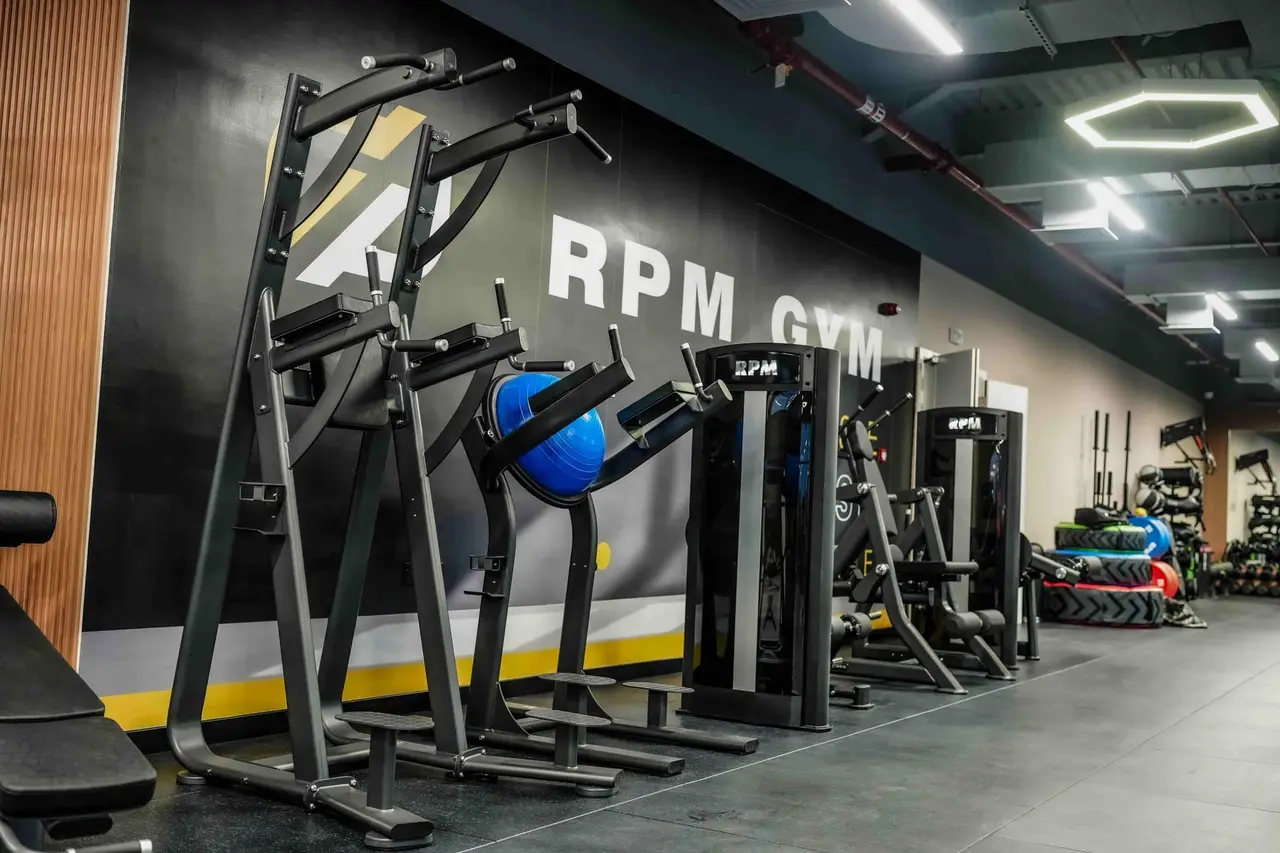
Both need only a mat and a clear patch of floor. RPM's floor photos show flat benches, colour bumper plates for loaded reps and multi-station cable towers for the cable crunch. A decline bench with foot rollers and an ab crunch machine are not shown, so ask about them on your free guided tour. If you are training for a fitness test, a personal training session can turn its rules into a plan.
Questions, answered.
Do sit-ups work the abs more than crunches?
Not by much. The abdominals do the same curl at the start of both and keep working to hold it in a sit-up, but the extra range is moved by the hip flexors. A sit-up works more muscle in total; a crunch keeps more of the effort in the stomach.
Will crunches or sit-ups flatten my stomach?
Neither chooses where fat comes off. Both strengthen the muscles underneath; how flat your stomach looks depends on your body fat overall, which changes through what you eat and how active you are.
Should I hold my feet down?
For crunches, no: it lets the hip flexors pull you up. For sit-ups, learn without an anchor if you can, then anchor when you want more reps, when a test allows it, or on a decline bench.
Can I do crunches and sit-ups in the same workout?
You can, but they overlap, since a sit-up already contains a crunch. One of them plus an exercise that holds the trunk still, such as the plank or the dead bug, covers more ground in the same time.
Which is better for a fitness test?
Whatever the test counts. If it counts sit-ups, train sit-ups with its hand position, foot hold and range, and keep crunches as extra stomach work on other days.
What if either one hurts my back or neck?
Stop, and speak to a doctor or physiotherapist first rather than swapping exercises on your own. If you are pregnant or postnatal, or have been told you have abdominal separation, ask your doctor or midwife which exercises suit you.