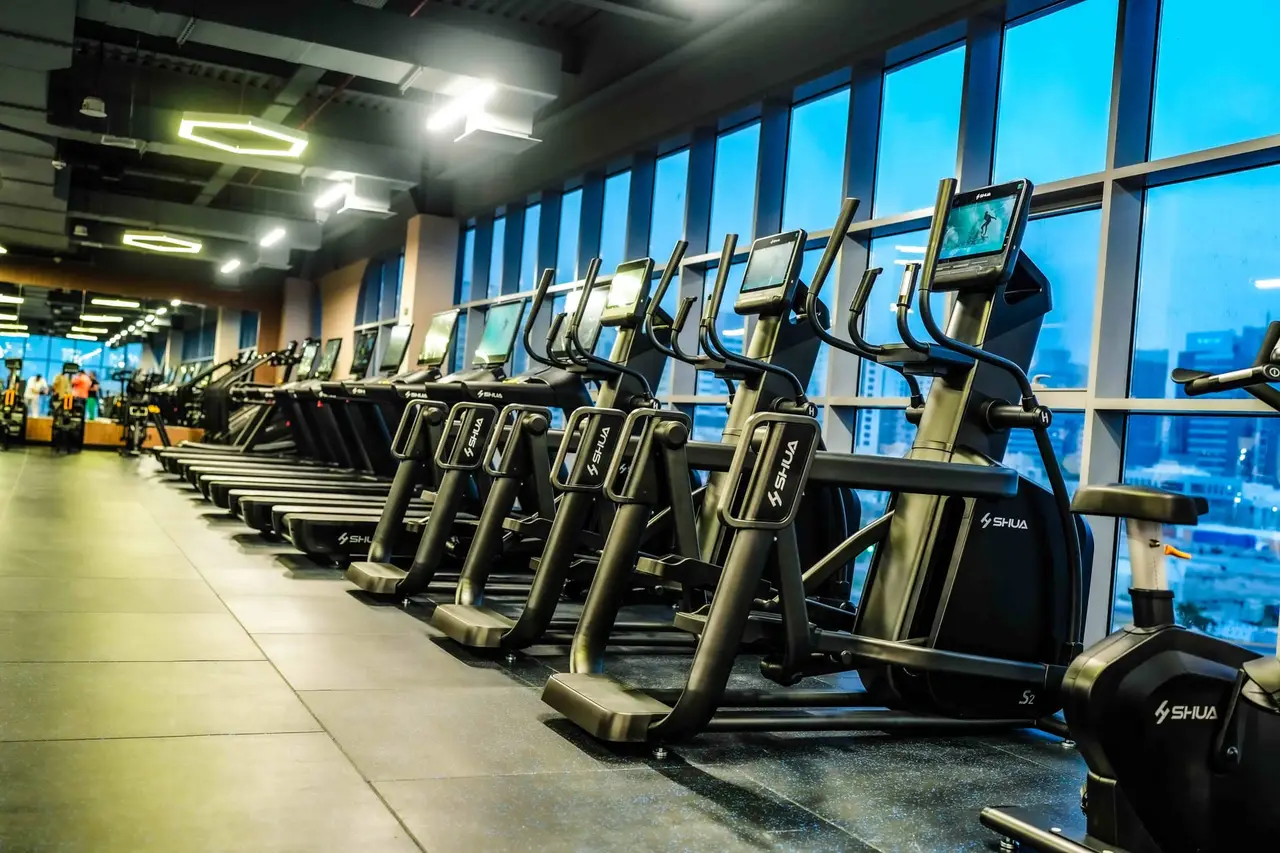
The real difference: who carries your weight
On both machines your feet stay on the pedals throughout, so neither has the landing that running puts into every stride. What separates them is where your weight goes. On the elliptical, or cross-trainer, you stand: your legs hold you up the whole time, your hips straighten behind you as on a walk, and the moving handles let your arms push and pull. On an exercise bike the saddle carries you: your legs push the pedals without supporting your bodyweight, the upper body stays still and there is nothing to balance.
So the choice is standing and weight-bearing, with the arms available, against seated and legs-only. For set-up and technique, see the elliptical guide and the exercise bike guide. To match a machine to a goal such as fat loss or a running race, the cardio machines guide goes goal by goal, and RPM's photos of its cardio area show both machines.
Elliptical and bike in one table
| Elliptical (cross-trainer) | Exercise bike | |
|---|---|---|
| Position | Standing upright, feet on two pedals that trace an oval | Seated on a saddle, upright, or leaning forward on a spin bike |
| Who carries your weight | Your legs, for the whole session | The saddle |
| Arms | Push and pull the moving handles, or hold the fixed ones | Rest on the handlebars |
| Main muscles | Thighs and glutes, with the chest, back and arms joining in through the handles | Thighs and glutes, with the calves helping; the upper body does very little |
| Balance and coordination | A little: a few minutes to find the rhythm | Almost none once the saddle is set |
| How you change the effort | Resistance and stride speed, plus a ramp on some models | Resistance and cadence, changed in seconds |
| What it carries over to | General fitness for walking and running, but not the running stride | Riding outdoors and spin classes |
| The usual trap | Resistance so low that the stride bounces | A saddle set too low |
Intervals and long steady sessions
For short, hard intervals the bike is the simpler tool. You stay seated, so your position holds when you are breathing hard, and the resistance goes from easy to hard and back in seconds; a spin bike's heavy flywheel adds standing climbs. The elliptical does intervals too, with the arms adding to the effort, but a very fast stride tends to bounce, so make the hard minutes harder with resistance rather than speed.
For long, steady sessions the picture flips. On the elliptical the work is shared between arms and legs and you stay upright, and switching between the moving and fixed handles changes the feel without stopping. On the bike, long rides are often limited by the saddle before the heart and lungs, so set it carefully, and on a spin bike stand up out of it for a minute now and then.
On a sore or tired day
The day after heavy squats or lunges, many people use easy cardio to get moving. The bike fits this well: at a very light resistance your legs turn over without holding your bodyweight. The elliptical works too, but you carry yourself on tired legs, so keep the resistance low and the session short. On a low-energy day the bike also needs fewer decisions: sit, set a light resistance and ride at a pace you could talk at.
Soreness after a hard session is common. If a knee, hip or your back hurts on either machine, stop and have it checked by a doctor or physiotherapist rather than switching machines and carrying on.
Heavier beginners, runners, cyclists and lifters
| If you are… | Lean towards | Why |
|---|---|---|
| A heavier beginner | Either: the bike if standing for long tires you, the elliptical if a fast walk is uncomfortable but standing is fine | Both have no landing; check the user weight limit on the frame |
| A runner on an easy day | The elliptical, or the bike after a long run | The elliptical is the closer of the two to running; the bike takes your bodyweight off your legs |
| A cyclist | The bike | It is your sport's movement; the elliptical adds variety |
| In a heavy block of leg training | The bike | Light spinning sits well alongside squats and deadlifts |
| Wanting the upper body in your cardio | The elliptical | Of the two, only it works the arms |
| Unsteady on your feet, or back after a long break | The bike | It asks almost nothing of your balance |
The treadmill vs bike guide explains why the bike is the usual partner for heavy leg training.
HYROX and other race goals
Neither machine appears in a HYROX race, which alternates running with stations that include a SkiErg and a rower; HYROX at RPM explains the format and the HYROX training plan builds towards it. What the two machines add is fitness around the running. The elliptical gives extra aerobic time on your feet without more landings, for an easy day between runs. The bike gives hard intervals that add no running, for a week when your legs are already busy with runs, sled work and lunges.
For a running race, practise on your feet; elliptical vs treadmill covers where the cross-trainer fits around that. For a cycling event or a triathlon, the bike is the specific choice.
Using both, in a week or in one session
One way to give each machine its job
A common split is by job: intervals on the bike, longer steady sessions on the elliptical and an easy spin after leg training.
| Day | Session | How it should feel |
|---|---|---|
| Day 1 | Lower-body strength, then 10 minutes of easy spinning on the bike | Barely working on the bike |
| Day 2 | Elliptical: 30–40 minutes at one steady resistance, driving the moving handles | Talking in full sentences |
| Day 3 | Upper-body strength | As planned |
| Day 4 | Bike: a 10-minute warm-up, then 8 rounds of 1 minute hard and 1 minute easy | Hard but repeatable, the easy minutes truly easy |
| Day 5 | Both, one after the other: 20 minutes on the elliptical, then 15 on the bike at the same effort | Steady throughout |
Heart rate at the same effort can differ between the two machines, so set zones for each with the heart rate zone calculator, or judge effort out of ten.
Within one session, the bike makes an easy warm-up because it asks nothing of your balance, and the elliptical can then carry the main block. Reverse the order on days when you want the hard part seated.
Cross-trainers and exercise bikes at RPM
RPM's floor photos show an upright exercise bike on the cardio row, next to the treadmills and cross-trainers by the windows, and a row of spin bikes in the functional area, so you can try standing and seated cardio in one visit. Recumbent bikes and air bikes do not appear in those photos, so ask on a free guided tour whether either is on the floor; the air bike page explains that fan bike, whose handles move with the pedals. Women can ask on the same tour which cardio machines the women-only Ladies section currently holds. A coach in a personal training session can fit both machines around your strength days.
Questions, answered.
Is the elliptical or the exercise bike better for weight loss?
Neither machine decides that: your weight changes with the activity and eating that add up over weeks. Pick the one you will come back to three times a week. If standing for half an hour is hard at first, start on the bike and add elliptical sessions as your fitness grows.
Which burns more calories, the elliptical or the bike?
It depends on how hard and how long you work. Standing with your arms driving uses more muscle, but a hard bike session is still harder than an easy elliptical one. Console figures come from different formulas, so do not compare them across machines; the calories burned calculator gives a personal estimate.
Elliptical or bike if my knees complain?
Neither has a landing. On the bike the saddle takes your bodyweight and its height sets how far each knee bends; on the elliptical the knees bend under your own weight on every stride. If a knee hurts on either, stop and have it checked by a doctor or physiotherapist.
Elliptical or spin bike?
A spin bike is a road-style exercise bike with a heavy flywheel, built for hard intervals and standing climbs and often used in classes. The elliptical suits longer, steady sessions on your feet. RPM's floor photos show both; ask on your tour how busy the spin bikes usually are at the hour you train.
Is the elliptical or the bike easier for beginners?
Both are easy to start on, the bike slightly more so because there is no rhythm to learn. Begin with 10 to 20 easy minutes, two or three times a week, and add time before resistance.