What the Cossack squat trains
Each side is two jobs at once. The bent leg squats: its quads and glutes lower you and push you back up, and its adductors work hard because the hip is both wide and deeply bent. The straight leg is being lengthened: the adductors along its inner thigh and the hamstrings behind it stretch as you sink, and they control the descent rather than simply hanging. Few exercises load the inner thighs through such a long range, which is why the movement turns up in warm-ups, in mobility work and as strength work for the adductors.
Its name is usually traced to the low, side-to-side squats of Cossack folk dancing, and it sits between a mobility drill and a leg exercise. With bodyweight it opens a lower-body warm-up; with a kettlebell it becomes single-leg strength work for intermediate lifters. The inner thigh exercises guide shows where it fits among the other adductor movements.
Expect a strong stretch along the inner thigh of the straight leg. A sharp or pinching pain in the groin, hip or knee is different: stop the set, and if you already have pain there, speak to a doctor or physiotherapist before you train this movement.
Before you sink: stance, feet and how deep is deep
- Stand with your feet about twice shoulder width apart. A wider stance makes the straight leg's stretch bigger and the squat shallower; a narrower one turns it into a deeper single-leg squat. Adjust by a few centimetres until the shift feels smooth.
- Turn both feet out slightly, as you would for a wide squat. The foot you sink over stays flat for the whole rep.
- Decide what the straight leg does. In the classic version its heel stays down and the toes point up as you sink; in the easier version the whole foot stays flat with the toes turned out. Learn the easier one first if the classic version tips you backwards.
- Choose a support for the first sessions: hold a rack upright or a sturdy post with both hands, or hold a light kettlebell out in front as a counterweight. Either lets you sit deeper with a tall chest.
- Set your depth target: as low as you can go with the bent leg's heel flat and your back long. For many people that starts a little above parallel; the full bottom position, hips just above the heel, can take months.
How to do one side, then the other
- Shift your weight towards one foot and start to bend that knee, pushing your hips back and down as if sitting onto that heel.
- Let the other leg straighten as you go, its kneecap pointing at the ceiling, or forwards in the flat-foot version, rather than rolling in.
- Sink until the bent leg's heel is about to lift or your lower back starts to round, and hold for a breath. The bent knee travels forward and out over the toes.
- Push the floor away through the whole bent foot and slide your hips back to the middle. Either stand up between sides or stay low and travel across, which is harder.
- Repeat on the other side. One side is one rep; count each side and keep them equal.
Move slowly. The Cossack squat rewards control at the bottom far more than speed, and a two- or three-second descent keeps your weight where it belongs, over the heel and middle of the bent foot. Keep breathing: holding your breath through a long, slow set is common and makes it harder to relax into depth.
Faults that block depth
| Mistake | What it looks like | The fix |
|---|---|---|
| Bent heel lifting | Your weight rolls onto the toes of the squatting foot near the bottom | Stop higher, turn that foot out a touch more, or raise the heel on a thin plate while ankle mobility catches up |
| Squatting in the middle | Both knees bend and the hips stay between the feet | Shift the hips fully over one foot before you sink |
| Bent knee caving in | The knee drops towards the big toe | Push the knee out over the middle toes; a slightly narrower stance can help |
| Chest collapsing | The trunk folds forward and the lower back rounds | Hold a counterweight out in front and keep to the depth you control |
| Straight leg rolling in | The long leg's knee and foot turn towards the floor | Keep that kneecap facing up or forward; it should stretch, not collapse |
| Dropping into the bottom | You fall the last part of the way and bounce out | Take two or three seconds down and pause before you rise |
A progression from assisted to loaded
| Stage | How to do it | Move on when |
|---|---|---|
| Assisted | Hold a rack upright or post with both hands and sink as low as the heel allows | Five slow reps a side with no wobble |
| Counterweight | Hold a light kettlebell at arm's length in front of your chest | You reach the same depth with a tall chest |
| Goblet | Hold the kettlebell by the sides of the handle against your chest | Eight controlled reps a side, heel flat |
| Paused goblet | Hold the bottom for two seconds on every rep | Then add weight in small steps |
Kettlebells suit the movement because the handle lets you hold the weight out in front or tight to the chest, but a single dumbbell held upright at the chest works the same way. The kettlebell basics guide covers what else you can do with one bell.
Cossack squat vs lateral lunge and sumo squat
Cossack squat vs lateral lunge
In a lateral lunge you step out and back on every rep, usually to a thigh about parallel, with the trailing foot flat. The Cossack squat keeps the feet planted, goes much deeper on the bent leg and turns the straight leg's toes up, so the stretch and the mobility demand are both bigger. Use the lateral lunge to load the pattern and the Cossack squat to own the end of the range.
Cossack squat vs sumo squat
The sumo squat uses the same wide stance but bends both legs together, so it takes far more load and works the inner thighs on both sides at once. The Cossack squat works one side at a time, through a longer range, with a lighter weight.
A mobility drill or a strength exercise?
Both, depending on the dose. Five slow bodyweight reps a side before squats is mobility work; three loaded sets of eight with a pause at the bottom is strength work for the adductors and the squatting leg.
Who it suits, and who should choose something else
- It suits lifters and athletes who want strength at the end of their hip range, people whose squats are limited by stiff hips, and anyone whose sport moves side to side.
- Choose the lateral lunge or the sumo squat first if you cannot get below a quarter squat on one leg without the heel lifting: they train the same muscles in a shorter range.
- For heavier inner-thigh work, a hip adduction machine or a wide-stance squat takes far more load than a Cossack squat.
- For a deep squat on two legs, the goblet squat is the simpler place to start.
Sets, reps and dosing
| Goal | Sets × reps | How hard |
|---|---|---|
| Warm-up and mobility | 1–2 × 5 each side | Bodyweight or assisted, slow, in a comfortable range |
| Building range | 2–3 × 6 each side | Counterweight, with a two-second pause at the bottom |
| Strength | 3 × 6–10 each side | Goblet kettlebell, one or two reps left, heel flat on every rep |
Rest about a minute between rounds. Two or three sessions a week suit range work; once or twice is enough for loaded sets.
Progress depth before load, and load before speed. Add depth over the weeks by holding the bottom for longer, then add weight in small steps once both sides reach the same depth. Inner-thigh soreness after the first sessions is common, because few exercises take the adductors this far into a stretch, so start with fewer sets than you think you need.
Cossack squats at RPM
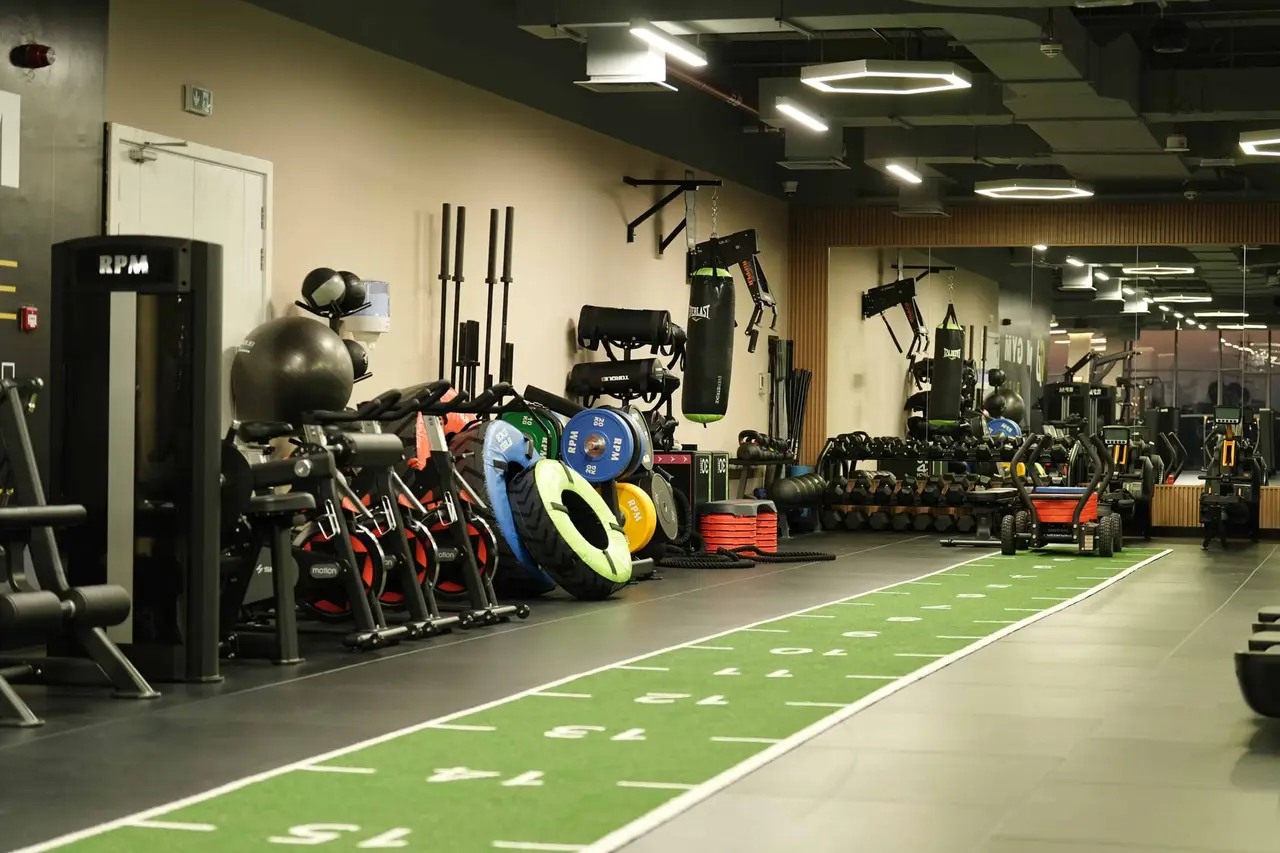
RPM's photos show kettlebells and a dumbbell rack in the functional zone, with open floor around the turf lane, which covers every version on this page, and the squat racks in the floor photos give you an upright to hold for the assisted version. A hip adduction machine is not in those photos, so ask about one on your free guided tour. To have your depth and foot position checked, book a personal training session.
Questions, answered.
What muscles does the Cossack squat work?
The inner thighs of both legs, the quads and glutes of the bent leg, and the hamstrings of the straight leg as they lengthen. The trunk keeps you upright and the muscles at the side of the hip steady the pelvis.
Why can't I go deep in a Cossack squat?
Usually one of three limits: the ankle of the bent leg, which lifts the heel; the inner thigh of the straight leg, which pulls you back up; or the hip of the bent leg, which tips the chest forward. A counterweight, a thin plate under the heel and slow, paused reps all help, and range builds over weeks.
Should the straight leg's toes point up?
In the classic version, yes: the heel stays down and the toes point up, which makes the stretch bigger. Keeping the foot flat with the toes turned out is an easier version and a sensible place to start.
Can beginners do Cossack squats?
With support, yes. Hold an upright, use a partial range and build depth slowly. Loaded Cossack squats are an intermediate exercise.