The five inner thigh muscles and their jobs
The adductor group fills the inside of the thigh, between the quads and the hamstrings. All five muscles start on the pelvis, around the pubic bone and the sitting bone. Four attach along the inside of the thigh bone; the fifth, the long, thin gracilis, runs past the knee to the shin. The adductor magnus is by far the largest, and its rear part works almost like an extra hamstring. The adductor longus, adductor brevis and small pectineus sit higher and further forward, close to the groin.
Their shared job is adduction, drawing the leg in towards the middle of the body, as when you squeeze your knees together. The adductor magnus also extends the hip, so it works hard to drive you up from the bottom of a deep squat or lunge. And in running and quick changes of direction, the group works with the muscles on the outside of the hip to control the pelvis and keep the knee over the foot. Good inner-thigh training covers all three: the squeeze, the deep hip extension and that side-to-side control.
This is the inner-thigh hub of the exercise library, part of the wider leg exercises guide; the hip adduction machine page teaches the main isolation exercise step by step.
What trains the inner thighs
| Job | Movements that load it | Worth knowing |
|---|---|---|
| Squeezing the legs together | Hip adduction machine, cable adduction with an ankle strap, Copenhagen plank | The only movements where the squeeze is the main job |
| Standing up from a deep hip bend | Deep back, goblet and sumo squats, lunges, the sumo deadlift, a wide-stance leg press | Depth matters: the adductor magnus works hardest near the bottom |
| Moving and holding side to side | Lateral lunge, Cossack squat, lateral step-up | Trains the long, stretched position and control, one leg at a time |
The library covers these in detail. For deep hip work, the sumo squat widens the stance to give the inner thighs a bigger share, the goblet squat and back squat load them through full depth, and the sumo deadlift pulls from the floor in a wide stance. For side-to-side work, the lateral lunge steps out and sits into one hip, while the Cossack squat stays wide and shifts from side to side through a deeper range.
Squat depth makes a measurable difference. In a 10-week study, 17 young men squatted twice a week, either to full depth or to a half squat. The front of the thigh grew by a similar amount in both groups, but the adductors grew more than twice as much with full squats, and so did the glutes. Squats that stop well above parallel leave much of that work undone.
Squeezing without the machine: Copenhagen planks and cables
The adduction machine is the easiest way to load the squeeze, but not every gym floor has one. These options run from easiest to hardest.
- Side-lying adduction: lie on one side, plant the top foot in front of the bottom knee and lift the bottom leg a few centimetres. A bodyweight start that works at home too.
- Cable adduction: an ankle strap on a low pulley, the working leg nearest the stack, a hand on the frame. Let the leg drift out under control, then sweep it across in front of the standing leg.
- Copenhagen plank, short lever: on your side, the inside of your top knee on a flat bench, propped on your forearm, lift your hips until your body is straight. The bottom leg hangs unsupported, so the top leg's inner thigh holds you up.
- Copenhagen plank, long lever: the same plank with the bench under your ankle. Move to it once the short version is steady for about 30 seconds a side; slow lifts of the bottom leg make it harder again.
The inner and outer thigh machine
Many gyms combine adduction and abduction in one seat, often called the inner and outer thigh machine. On the inner setting the pads sit inside your knees and you squeeze them together, which trains the adductors. On the outer setting you push the pads apart, which trains the side of the hip, mainly the gluteus medius, not the inner thigh; the hip abduction machine page covers that one. Either way the machine is a supplement: it isolates the squeeze, which suits beginners and sports with a lot of kicking and cutting, but it does not train the deep hip extension of squats and lunges, so keep one of those in your week.
How much, and how often
Count what you already do first: deep squats, lunges, split squats and the leg press all work the adductors near the bottom of the movement. On top of that, about four to eight hard sets a week of direct inner-thigh work, over two sessions, is a sensible starting range, at the lower end if it is new to you. A hard set ends with one or two good reps left; the hypertrophy volume calculator adds up direct and indirect sets.
Most people use about 10 to 15 controlled reps on the machine or cable, 6 to 10 a side in lateral lunges and Cossack squats, and holds of 10 to 30 seconds in Copenhagen planks. Progress the range before the load: a slightly wider machine start, a deeper side lunge, a longer Copenhagen lever. New direct work often leaves the inner thighs sore for days, so begin with one or two sets and build up over a few weeks.
Two sample sessions
Session A: free weights and the floor
A short inner-thigh block for a leg day, from the sumo squat, lateral lunge and Cossack squat pages, finished with a Copenhagen plank.
| Exercise | Sets × reps | Coaching note |
|---|---|---|
| Sumo squat, dumbbell or kettlebell | 3 × 8–12 | Knees over toes, full depth |
| Lateral lunge | 3 × 8 each side | Heel of the bent leg stays down |
| Cossack squat, bodyweight or a light counterweight | 2 × 6 each side | Only as deep as you can control |
| Copenhagen plank, short lever | 2 × 15–20 seconds each side | Hips high, body in a straight line |
Session B: machines and cables after the main lifts
For the end of a leg day built on the leg press or back squat, using the hip adduction machine where there is one, or the cable.
| Exercise | Sets × reps | Coaching note |
|---|---|---|
| Leg press, feet wide and high | 3 × 10–12 | Knees follow the toes |
| Hip adduction machine | 3 × 12–15 | Narrow start, two seconds to open |
| Cable adduction | 2 × 12 each side | Hold the frame, slow return |
Use one session a week, or alternate them over two leg days. Without a machine or ankle strap, swap in side-lying adduction or a longer Copenhagen hold; the workout split calculator helps you pick the day.
Inner thigh fat, toning and the gap between the thighs
No exercise chooses where fat comes off. In a 12-week study, 11 young adults trained one leg only, three times a week, with very long sets on the leg press. Their total fat mass went down, but the fat on the trained leg did not change; the loss came from the arms and trunk. The inner thigh is no exception: training builds the muscle, while fat comes off the whole body, through food and overall activity, in an order you cannot choose.
What training does change is the muscle under the skin, which can make the thigh look firmer as overall body fat falls. The space between the thighs depends mostly on the width of the pelvis and the angle of the thigh bones, so training cannot create it. For body composition, plan for the whole body; personal training can help.
The groin: soreness, sharp pain and when to stop
The adductors attach close to the groin, so that is where most inner-thigh discomfort is felt. A dull ache in the muscle for a day or two after new work is normal. Sharp pain in the groin during a rep, pain near the pubic bone, or pain that is still there when you walk the next day is not: stop, and see a doctor or physiotherapist rather than training through it.
Footballers and other field and court players often add adductor work such as the Copenhagen plank; the footballers' gym guide shows how it fits around matches. If you are pregnant or have recently given birth, ask your doctor or midwife before adding inner-thigh exercises, and with pelvic floor symptoms ask a doctor or physiotherapist first.
Inner thigh training mistakes
- Only the machine. It trains the squeeze and leaves the deep-hip job to whatever squats you happen to do; pair it with a squat or lunge pattern.
- Shallow squats. Stopping well above parallel cuts out the range where the adductor magnus works hardest.
- Forcing the stretch. On the machine and in the Cossack squat, a wider range comes from weeks of practice, not from the first set.
- Fast openings. Letting a machine or cable pull your legs apart quickly puts a sudden stretch on the groin; take two to three seconds on the way out.
Training the inner thighs at RPM
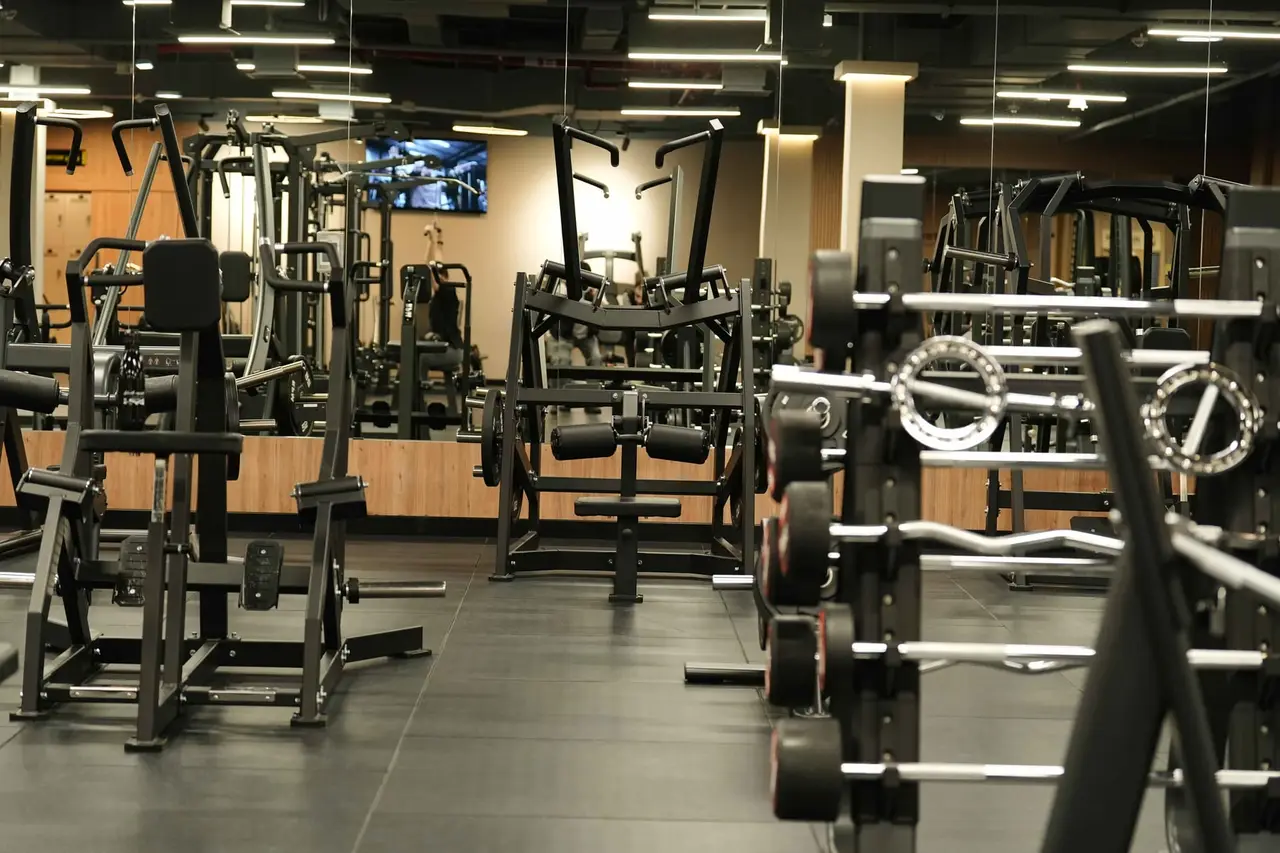
RPM's floor photos show a dumbbell rack, kettlebells, squat racks with barbells and colour bumper plates, flat benches, multi-station cable towers and an angled plate-loaded leg press on the training floor in Al Manhal, which covers every free-weight, bench and leg press option here. A hip adduction machine, a combined inner and outer thigh machine and an ankle strap for the cables are not in those photos, so ask on your free guided tour what is on the floor. For a plan built around your legs, see personal training or ask for a female personal trainer.
Sources
- Kubo K, Ikebukuro T, Yata H. Effects of squat training with different depths on lower limb muscle volumes. European Journal of Applied Physiology, 2019
- Ramírez-Campillo R, Andrade DC, Campos-Jara C, et al. Regional fat changes induced by localized muscle endurance resistance training. Journal of Strength and Conditioning Research, 2013
Questions, answered.
What exercises work the inner thighs at the gym?
The hip adduction machine and cable adduction for the squeeze; deep squats, sumo squats and the sumo deadlift for the deep hip work; and lateral lunges and Cossack squats for side-to-side strength. One from the first group and one from the others covers the muscle.
Which gym machine trains the inner thighs?
The hip adduction machine, often called the adductor machine; the hip adduction machine page shows how to set it up. Many gyms combine it with the abduction machine in one seat, the inner and outer thigh machine: one setting squeezes in, the other pushes out.
Do squats work the inner thighs?
Yes, especially deep and wide-stance squats: the adductor magnus helps stand you up from the bottom, and in a 10-week study full squats grew the adductors more than half squats did. Squats do not train the squeeze itself, which the machine and the Copenhagen plank cover.
Can inner thigh exercises get rid of inner thigh fat?
No. They build and strengthen the muscle, but fat comes off the whole body in an order you cannot choose. If fat loss is the goal, combine leg training with an overall plan for food and activity.