What dumbbells do well and badly for the legs
The legs are the strongest muscles in the body, and that is the problem dumbbells have to solve. A barbell squat or a leg press can load more than you could ever hold in your hands; with dumbbells, your grip, your shoulders and the heaviest pair on the rack all set a ceiling. A goblet squat stops getting harder once the dumbbell is too heavy to hold at your chest, and a two-dumbbell Romanian deadlift often ends because your hands give out before your hamstrings do.
What dumbbells do well is single-leg work. When one leg does the job, a pair that is light for a squat becomes hard for a split squat, so the ceiling moves back out of the way. Dumbbells also need no rack and no set-up, work anywhere on the floor, and make it easy to choose gentler versions such as a reverse lunge or a low step-up. The weak spots are the back of the knee and the inner thigh: there is no clean dumbbell version of a leg curl, and the adductors get their work from wide and sideways stances rather than a dedicated exercise.
This page is for sessions where dumbbells are the only tool, by choice, at home or on a crowded day. The leg exercises guide covers leg training as a whole, machines and barbells included, and how many sets each muscle needs a week; everything here uses a set of dumbbells and, now and then, a bench.
Choosing your dumbbells
You need more than one pair. Two-leg hinges and squats take the heaviest dumbbells you can hold; split squats and lunges take a moderate pair; single-leg Romanian deadlifts and calf raises often start lighter still. Pick a starting weight for each movement by reps, not by the number on the handle: it is right when the set ends with good form and about two reps left. For the goblet squat you hold one dumbbell upright against your chest, cupping the top end in both hands, so a single heavy dumbbell can do the job of a pair.
- Grip goes first on heavy Romanian deadlifts. Lifting straps are a reasonable fix; so is switching to the single-leg version, which needs about half the weight.
- Dumbbells hanging at your sides keep the torso upright and suit lunges and step-ups. A single dumbbell at the chest is easier to balance for squats and split squats when you are new.
- At the light end, the step from one pair to the next is a big jump compared with the weight itself. The progression section below covers what to do when the next pair is too heavy.
The movements, by the job they do
Sort dumbbell leg exercises by job and a complete session assembles itself: one from each group covers the whole leg. Pages in the library are linked; the rest are described here.
- Squats, for the quads, glutes and inner thighs: the goblet squat, the sumo squat with one dumbbell hanging between wide feet, and the wall sit with a dumbbell resting on your thighs, for a hard hold without movement. Raising the heels on a small step makes the goblet squat more quad-heavy.
- Single-leg squats and lunges, for the quads and glutes: the Bulgarian split squat with the back foot on a bench, the reverse and walking lunge, the step-up onto a bench or box, and the lateral lunge, which stretches the inner thigh as you sit into one side.
- Hinges, for the hamstrings and glutes: the Romanian deadlift with a dumbbell in each hand, and the single-leg Romanian deadlift, which gives the hamstrings heavy work with a fraction of the weight.
- Glutes at the top of the range: the hip thrust with a dumbbell across the hips and the upper back on a bench, and the single-leg glute bridge on the floor.
- Calves: the calf raise, one leg at a time on a step, a dumbbell in the hand on the same side and the other hand on a wall.
- The hamstrings at the knee: a dumbbell leg curl, lying face down on a bench with a dumbbell held between the feet. It works but is awkward to load, so most people rely on the hinges above and keep it as a light finisher.
Two dumbbell leg days
Day A: squat and split squat
Quads first, with the goblet squat while you are fresh, then single-leg work and a hinge. Dumbbells and a bench only.
| Exercise | Sets × reps | Coaching note |
|---|---|---|
| Goblet squat | 3 × 10–15 | Elbows inside the knees at the bottom; three seconds down |
| Bulgarian split squat | 3 × 8–10 each leg | Dumbbells at your sides; start with the weaker leg |
| Dumbbell Romanian deadlift | 3 × 10–12 | Dumbbells slide down the front of the thighs |
| Step-up | 2 × 10 each leg | Drive through the top foot rather than pushing off the bottom one |
| Single-leg calf raise | 3 × 12–15 each leg | Full stretch at the bottom, one-second hold at the top |
Day B: hinge and glutes
The back of the leg leads, starting with the single-leg Romanian deadlift or its two-leg version, with a sideways lunge for the inner thighs.
| Exercise | Sets × reps | Coaching note |
|---|---|---|
| Single-leg or two-leg Romanian deadlift | 3–4 × 8–12 (each leg if single) | Hips square; stop where the back stays flat |
| Reverse lunge | 3 × 10 each leg | Step back far enough for the back knee to drop straight down |
| Dumbbell hip thrust | 3 × 10–15 | Upper back on the bench; one-second squeeze at the top |
| Lateral lunge or sumo squat | 2–3 × 8–10 each side | Sit back into the hip; heels stay down |
| Single-leg calf raise | 2–3 × 15 each leg | Slow, full range |
Each day is roughly 14 to 17 sets. Run them on two days of the week with at least a day between, or use one as the second leg day beside a machine-based one.
On both days the first exercise gets your hardest effort. If you own only one or two pairs, keep the heavier pair for the split squat and the Romanian deadlift, and use slow tempos and pauses to make the goblet squat and lunges hard enough.
Progressing when the next pair is a big jump
Dumbbell leg training stalls in a predictable place: you finish every set at the top of the rep range, and the next pair is too heavy to reach the bottom of it. Before you move up, make the same weight harder. Use one of these at a time.
- More reps. Move from 8–10 to 12–15 before changing the weight; the legs respond well to the higher range.
- Slower lowering. Three or four seconds on the way down at the same weight makes most sets noticeably harder.
- A pause at the bottom. One or two seconds in the deepest position of a split squat or goblet squat removes the bounce.
- One-and-a-half reps. All the way down, halfway up, back down, then all the way up: that counts as one.
- A harder version. Two legs to one, a split squat to a Bulgarian split squat, a low step to a higher box.
- Less rest. Cutting rest from two minutes to one makes later sets harder, though it trains fatigue more than strength.
When the harder version reaches the top of its range, take the next pair and drop back to the bottom of the rep range. A simple log for each exercise makes this easy to see, and the training volume calculator totals your sets across the week.
Mistakes that hold dumbbell leg days back
- One pair for everything. The weight that suits a calf raise is far too light for a Romanian deadlift.
- Endless light goblet squats. If a set takes thirty reps to get hard, it is training endurance more than muscle; move to a single-leg version.
- No hinge. Squats and lunges leave the hamstrings undertrained; every leg day needs a Romanian deadlift in one form or the other.
- Rushing single-leg reps. Speed hides wobbles and short ranges; slow down and start with the weaker leg.
- Letting the grip end the set. If the hands fail first, use straps or the version that needs less weight.
- Pushing through knee pain. Effort in the muscles is expected; sharp or lingering pain in the knee or hip is a reason to stop and have it checked by a doctor or physiotherapist.
Dumbbell leg training at RPM
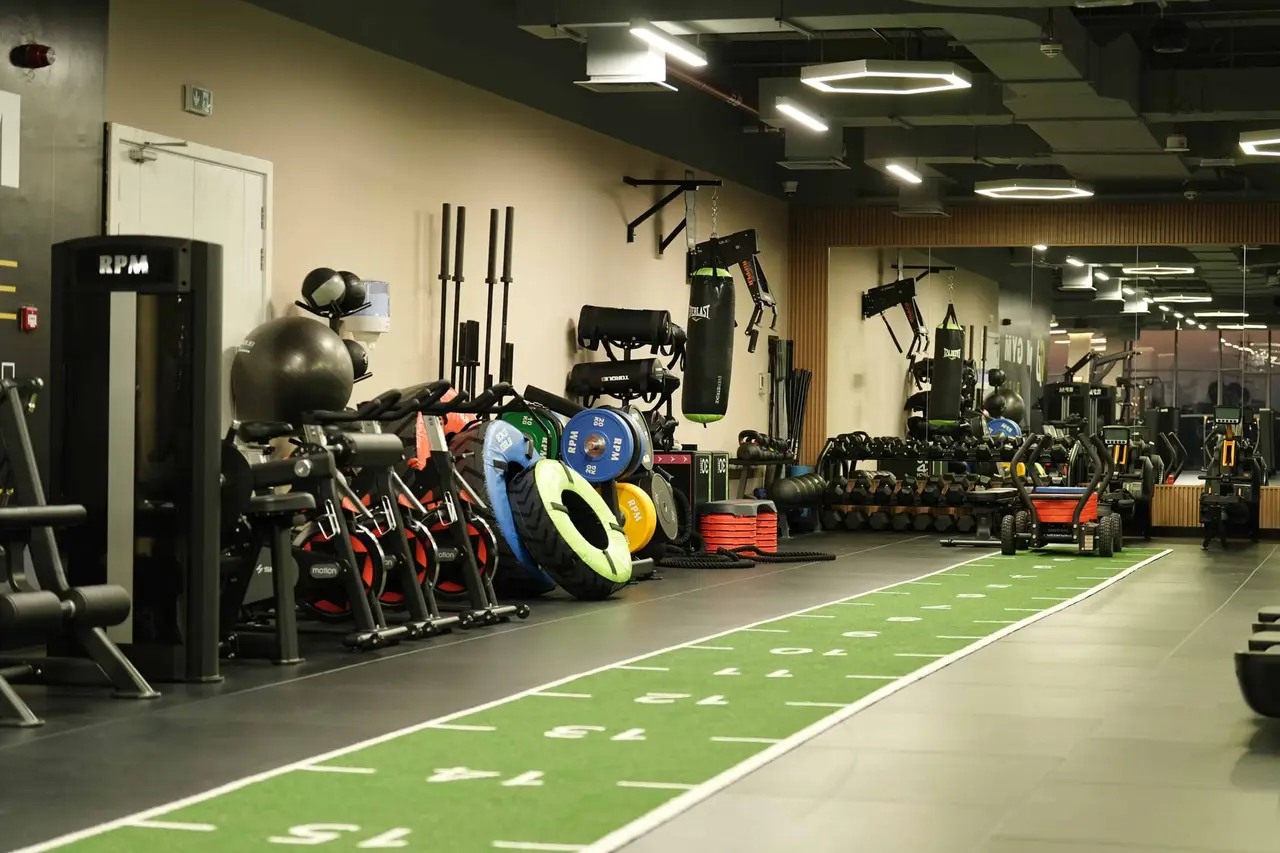
RPM's photos of the Al Manhal floor show a dumbbell rack and kettlebells in the functional training area, flat benches for split squats, step-ups and hip thrusts, and soft plyo boxes that suit step-ups. Adjustable benches are not in the photos, so ask about them on your free tour. When you want more load than dumbbells allow, the leg press and the squat racks are on the same floor, and a coach in a personal training session can fit your dumbbell days into a full plan.
Questions, answered.
Can you build big legs with dumbbells only?
You can build a lot of muscle, especially with single-leg work taken close to failure and progressed over months. The limit appears for stronger lifters, when the heaviest pairs no longer challenge two-leg squats and hinges; at that point a barbell or leg press lets you keep adding load.
Which dumbbell leg exercises are easiest on the knees?
Reverse lunges, step-ups onto a low box, goblet squats to a bench and Romanian deadlifts tend to be the most comfortable. That is a general pattern, not advice for a knee that already hurts: knee pain should be checked by a doctor or physiotherapist before you load it.
Which dumbbell exercises work the hamstrings?
The two-dumbbell Romanian deadlift is the main one, with the single-leg Romanian deadlift close behind. A lying dumbbell leg curl adds knee-bending work; the hamstring guide explains why both kinds matter.
Are dumbbell leg exercises good for runners?
Yes. Split squats, step-ups, single-leg Romanian deadlifts and single-leg calf raises train each leg on its own, as running does. Schedule them away from your hardest runs, and stop sets a couple of reps short of failure in race weeks.
Can I do these dumbbell leg workouts at home?
Yes, with one or two pairs and a sturdy bench or step. Single-leg versions and slow tempos keep a light home set challenging; a gym becomes useful once you need heavier pairs.
Should women and men train legs differently with dumbbells?
No. The movements, sets and progression are the same. Some people want more glute work and add hip thrusts; others want more quad work and raise their heels on goblet squats. That is a choice of emphasis, not of gender.