Why back and biceps share a day
Every row and pulldown bends the elbow against a load, and the biceps is one of the muscles that bends it. A back session is already a biceps session, so the curls at the end add to work the arms have started. Trained together, the two recover together, and the days between are open for pressing, legs or rest without tired arms getting in the way.
The catch is grip and arm fatigue. Curl first and your arms give out on the rows before your back does, so the pulls come first, heaviest to lightest, and the curls last. The back training guide explains what each kind of pull trains and what grip width changes; this page turns that into one session.
Pair it with the chest and triceps workout, a day or two apart, so pushing and pulling get equal time across the week. Once a week is enough when other days also train the back, such as rows on an upper-body day; twice suits anyone on a body-part split who wants more back and arm work. All the other sessions and plans are in the workout plans library.
Vertical pulls, horizontal pulls and the hinge question
The session opens with one of each kind of pull: a heavy row, which brings the arms back towards the body, and a pulldown, which brings them down from overhead. The two lighter pulls that follow split the same way, one for the lats with straight arms and one for the upper back and rear shoulders.
There is no deadlift or Romanian deadlift, and that is deliberate. The bent-over row already loads the lower back for four hard sets; a heavy hinge before it would leave less for the rows, and one after them would be done tired. The hinge sits on leg day, as in the lower body gym workout. If your week has no other hinge, put three sets of Romanian deadlifts first and swap the barbell row for a one-arm dumbbell row, so the lower back is not loaded twice.
Grip changes do some of the work of extra exercises. Use an overhand grip on the barbell row, an underhand grip on the pulldown to bring the biceps in more, and a neutral grip on the hammer curl. Change grip between exercises rather than within a set, and keep each exercise's grip the same from week to week so the loads stay comparable.
Gym version: cables and barbell
Built on a barbell and the cable towers. Warm up with two light sets of the bent-over row, and one light pulldown set when you move to the cable.
| Exercise | Sets | Reps | Rest | Notes |
|---|---|---|---|---|
| Bent over row | 4 | 6–8 | 2–3 min | Main pull; overhand grip |
| Lat pulldown | 3 | 8–10 | 2 min | Underhand, shoulder width: the chin-up pattern |
| Straight arm pulldown | 2 | 12–15 | 60 sec | Arms stay straight; lats only |
| Face pull | 2 | 15–20 | 60 sec | Rope, pulled towards the forehead |
| Preacher curl | 3 | 8–10 | 90 sec | No preacher bench in RPM's photos: strict standing EZ-bar curl |
| Hammer curl | 2 | 12–15 | 60 sec | Rope on the low pulley |
Eleven back sets and five biceps sets, with the rows and pulldowns already working the arms. A pull-up bar is not in RPM's photos either; the underhand pulldown covers that movement, and the lat pulldown vs pull-up page compares the two.
Dumbbell version
Dumbbells and a flat bench only, for a busy floor or a home set-up. A one-arm row lets you handle more weight than a two-arm row, so it comes first.
| Exercise | Sets | Reps | Rest | Notes |
|---|---|---|---|---|
| Dumbbell row | 4 | 8–10 each arm | 90 sec | Knee and hand on the bench |
| Bent over row | 3 | 10–12 | 90 sec | Two dumbbells, palms facing each other |
| Dumbbell pullover | 2 | 12–15 | 60 sec | Across a flat bench: the vertical pull in this version |
| Rear delt fly | 3 | 12–15 | 45 sec | Bent over, light pair |
| Hammer curl | 3 | 8–10 | 60 sec | Heavier than the curl, so it goes first |
| Bicep curl | 2 | 12–15 | 60 sec | Palms up, three seconds down |
Without a cable, the pullover is the nearest a dumbbell gets to a vertical pull, but it is not a full substitute: when you are at a gym, use the pulldown. A T-bar row station is not in RPM's photos; the one-arm dumbbell row or the barbell row does its job. More rows to rotate in are on the dumbbell back exercises page.
Beginner and intermediate versions
Both versions are written for someone with a few months of training. Adjust them like this:
- First two or three months: two sets of each exercise at the top of every rep range, with three reps still in hand. Use the gym version, where the pulldown lets you set the load in small steps, and a plain EZ-bar curl.
- Intermediate: the sets as written, one or two reps in reserve, and a third set on the second curl if your elbows are happy. Training back twice a week? Make one day heavier, with rows at 5 or 6 reps, and the other lighter at 10 to 12.
- Weekly sets: a meta-analysis by Schoenfeld and colleagues found that more weekly sets per muscle tend to bring more growth, up to a point. Around ten back sets a week is a sensible start, and 15 to 20 across two sessions suits trained lifters who recover well.
- Progress: add reps until all your sets are at the top number, then move up one weight step. The American College of Sports Medicine describes the same approach for healthy adults.
Mistakes that waste a back day
| Mistake | Result | Fix |
|---|---|---|
| Curls before rows | Tired arms end the back work early | All the pulls first, curls last |
| Swinging the torso to move the pulldown stack | Momentum moves the weight and the lats do less | A slight lean, then keep the torso still |
| Standing up as the row gets heavy | The row turns into a shrug and the lower back takes over | A lighter bar and a fixed torso angle |
| Short pulls | The shoulder blades barely move, so the upper back does little | Full stretch at the start, elbows past the body at the finish |
| Swinging the curl | The hips lift the weight instead of the biceps | Back against a wall, or a lighter weight |
| Working through lower-back or elbow pain | A minor problem becomes a long one | Stop the exercise and get it checked by a doctor or physiotherapist |
Women, dumbbells only and training at home
Back and biceps workout for women
The same session works for women and men: the exercises are the same and only the starting loads differ. If the pulldown feels heavy at first, start on the lightest setting and add a little at a time. The gym workout plan for women fits back work into a three-day week.
Back and biceps with dumbbells only
Use the dumbbell version. The one gap is a vertical pull: the pullover helps, but if you can reach a cable tower once a week, a few sets of pulldowns fill it.
Back and biceps at home without weights
Hard to do well. Resistance bands give you rows, pulldowns and curls, and a sturdy bar lets you work towards your first pull-up, which the first pull-up guide sets out step by step. For steady progress you will need load you can add to, which is what a gym session gives you.
This session at RPM
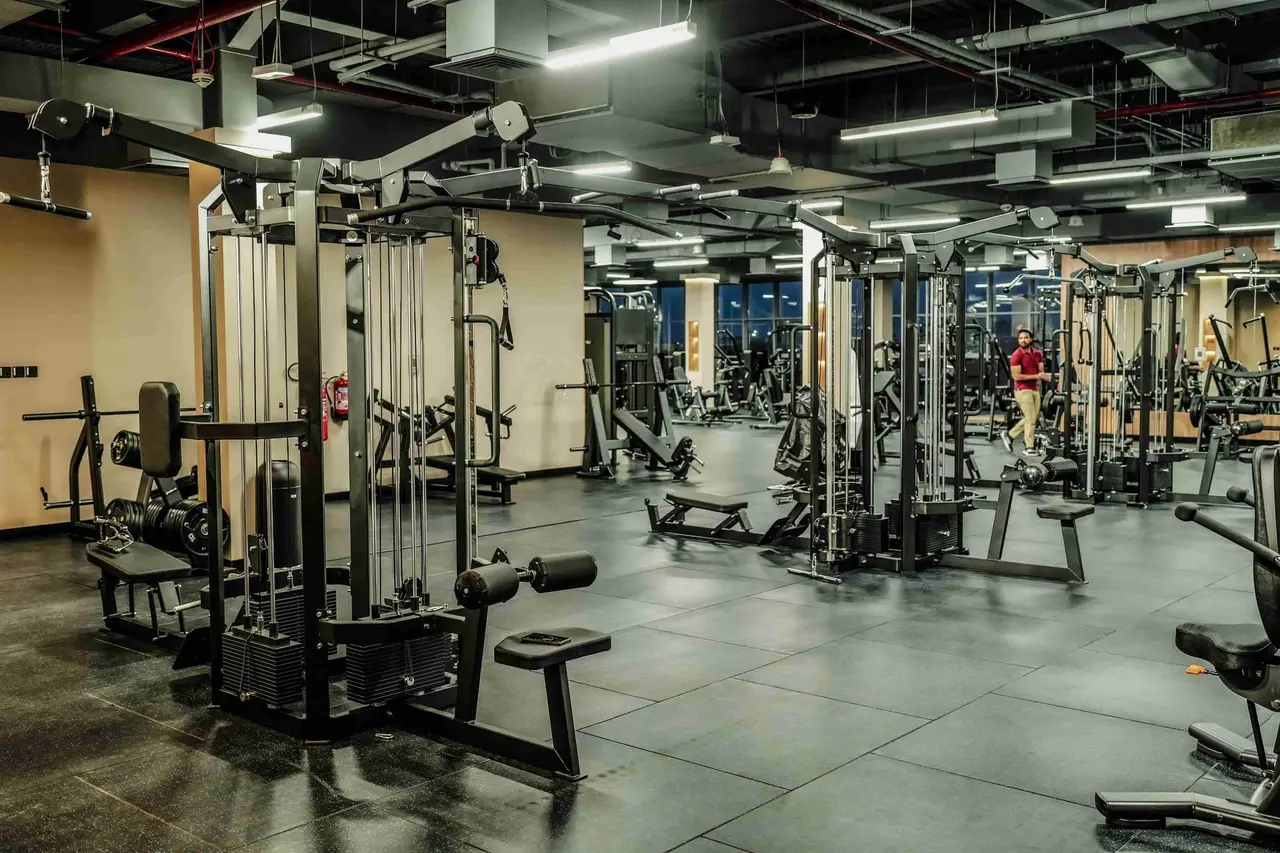
Apart from the preacher curl, everything in both versions uses kit that appears in RPM's floor photos: the cable towers with their pulldown seat, barbells, the rack of fixed barbells with its EZ bars, the dumbbell rack and flat benches. A pull-up bar, a T-bar row station and a preacher bench do not appear, so ask on the free guided tour what is on the floor and which stations sit in the women-only Ladies section. To have your row technique checked, ask about personal training.
Sources
- American College of Sports Medicine, position stand: Progression models in resistance training for healthy adults (2009)
- Schoenfeld BJ, Ogborn D, Krieger JW. Dose-response relationship between weekly resistance training volume and increases in muscle mass: a systematic review and meta-analysis. Journal of Sports Sciences, 2017
Questions, answered.
How many exercises should a back and biceps workout have?
Six works well: two heavy pulls, two lighter ones and two curls. If time is short, keep the first two pulls and one curl.
Back and biceps or back and triceps?
Back with biceps is the usual pairing, because the biceps already work in every pull and recover with the back. Back with triceps, and chest with biceps, also works: each day trains opposing muscles, so one rests while the other works. Choose whichever you will keep doing.
How often should I train back and biceps?
Once or twice a week. Once suits a four- or five-day split where chest, legs and shoulders have their own days; twice suits a six-day push, pull and legs week, like the 6-day gym workout plan.
Is a back and biceps day enough for my arms?
For most people, yes. Five direct sets of curls on top of eleven sets of pulling is a lot of elbow-bending work. If your arms lag after a few months, add two or three sets of curls on another day; the biceps exercises hub has more options.
How long should a back and biceps workout take?
About 45 to 60 minutes with the warm-up. The heavy rows need the longest rests; the cable work and curls move quickly.