What the good morning trains, and why the bar's position matters
The movement is the same hinge as a Romanian deadlift, but the load is in a different place. In an RDL the weight hangs from your hands, close to your legs; in a good morning it sits on your upper back, so as your torso tips forward the bar moves away from your hips. The further it travels, the longer the lever your hamstrings, glutes and spinal muscles have to control. That is why an empty bar can feel heavy at the bottom, and why the lift rewards patience more than load.
Your grip has almost nothing to do, so the set ends when your hips and back tire, not when your hands open. That makes it a useful second hinge for lifters who already squat and Romanian deadlift, and an option when a tiring grip limits your pulling. It suits people who can already hold a flat back in a hinge; if you are still learning that, start with the Romanian deadlift. The hamstring exercises page shows how hinges and curls share the week.
Effort in the lower back is normal here; pain is not. If a set causes sharp pain, pain that runs into a leg, or an ache that lasts into the next day, stop and have it checked by a doctor or physiotherapist before you load the movement again.
Good morning vs Romanian deadlift: what changes
Both lifts are hip hinges for the back of the body. Choosing between them comes down to where you want the load and what usually stops your set.
| Compared on | Good morning | Romanian deadlift |
|---|---|---|
| Where the load sits | On the upper back, moving away from the hips as you lean | In the hands, close to the legs the whole way |
| What usually ends the set | The hamstrings and the muscles along the spine | The hamstrings, or the grip if you skip straps |
| Typical load | Light, often well under your RDL | Moderate to heavy |
| Depth | Torso tipped until it is between halfway down and parallel to the floor | Bar to around mid-shin, with the back still flat |
| Suits | Lifters who already hinge well and want more hip and back work | Anyone learning to hinge, and as a main hamstring lift |
Pick the RDL if you are new to hinging, if you want one main hamstring lift, or if holding a bar on your back bothers your shoulders. Pick the good morning as a second hinge once the RDL is solid, when your grip limits your pulling, or when you want the hips and back to work against a long lever without heavy weight. Many programmes keep the RDL as the main hinge and run the good morning in short blocks.
Setting up in the rack
- Set the bar in a squat rack at about armpit height, as for a back squat, and set the safety arms just below the lowest point the bar will reach when your torso is at its deepest.
- Duck under and place the bar on the meaty part of your upper back, across the top of the shoulder blades, never on the bony bump at the base of your neck.
- Take a grip a little wider than your shoulders and pull the bar down into your back so it cannot roll. Squeezing your shoulder blades together makes a shelf for it.
- Lift it out, take two short steps back and set your feet hip width apart, toes forward or turned slightly out.
- Unlock your knees into a small bend and keep that angle. Start with the empty bar until three sets feel the same from the first rep to the last.
How to do a rep
- Take a deep breath into your belly and brace, as if someone were about to push you.
- Push your hips straight back. Your torso tips forward only because your hips are moving, and your shins stay close to vertical.
- Keep the bar over the middle of your foot. If you feel your weight drift onto your toes, your hips are not going back far enough.
- Stop when your hamstrings are fully stretched or the moment your back starts to round. For most people the torso ends up between halfway down and parallel to the floor.
- Drive your hips forward to stand, squeezing your glutes, and breathe out near the top. Reset your brace before the next rep.
Lower over about three seconds and never bounce. Keep your chin slightly tucked and your eyes on the floor a little ahead. If you lose position, bend your knees, stand up as if from a squat and rack the bar, or lower it onto the safety arms: unlike a deadlift, it cannot simply be put down in front of you.
Common good morning mistakes
| Mistake | What it looks like | The fix |
|---|---|---|
| Squatting instead of hinging | The knees push forward, the hips drop and the bar sinks straight down | Fix the knee bend at the start and send the hips back, not down |
| Upper back caving in | The shoulders roll forward and the bar creeps towards your neck | Pull the bar into your back and keep the shoulder blades squeezed |
| Loading it like a squat | The weight is close to your squat and every rep gets shorter | Use a fraction of your RDL weight and earn each increase |
| Forcing the torso flat | The lower back rounds so the chest can reach parallel | Stop at the depth your hamstrings allow; it improves over weeks of practice |
| Weight on the toes | You rock forward at the bottom and your heels feel light | Push the hips further back and keep the bar over mid-foot |
Dumbbell, band, seated and Smith machine versions
The hinge stays the same in every version. What changes is how the load reaches your back and how far it can be increased.
Good morning with a dumbbell or plate
Hold one dumbbell upright against your chest, or hug a weight plate, and hinge exactly as with a bar. The load sits a little lower, so the lever is shorter, and there is no rack to set up. It suits learning the movement, training at home, and shoulders that dislike a bar on the back.
Banded good morning
Stand on a long resistance band and loop the other end across your upper back. The band is slackest at the bottom and tightest when you stand, so it eases off where the hinge is hardest. It makes a good warm-up before squats or deadlifts, but it is hard to load progressively.
Seated good morning
Sit at the end of a bench, feet wide and a bar on your back, and fold forward from the hips with a flat back. With the knees bent, the hamstrings are slack and do less, so the spinal muscles and hips carry more of the work. Keep it light.
Smith machine good morning
The bar runs in a fixed track, so balance is taken care of and you can concentrate on the hinge. The catch is that the track sets the bar path for you: stand too far forward or back and it pulls you out of position, so check the bar sits over mid-foot at the bottom of the rep. Ask on your tour whether a Smith machine is on the floor; the Smith machine page explains how it works.
If the racks are busy, a back extension trains the same muscles with your body as the load, and a kettlebell swing trains the hinge at speed. For the knee side of the hamstrings, add a curl: the leg curl machine or the Nordic curl.
Sets, reps and where it fits
| Goal | Sets × reps | How hard |
|---|---|---|
| Learning the hinge with a bar | 2–3 × 10 | Empty or light bar; stop well before your form changes |
| Hip and back strength | 3 × 6–8 | Two or three reps left, every rep at the same depth |
| Hamstring size | 3 × 8–12 | One or two reps left, three seconds on the way down |
Rest about two minutes between sets. For most people, sets of six or more at a moderate weight are the useful range.
Do them after your main squat or deadlift, once a week for most people. The day after heavy deadlifts, keep them light or leave them out: your lower back is already tired. Add weight in small steps, only when every rep reaches the same depth with a flat back. The back squat uses the same bar position, so the set-up will feel familiar.
Good mornings at RPM
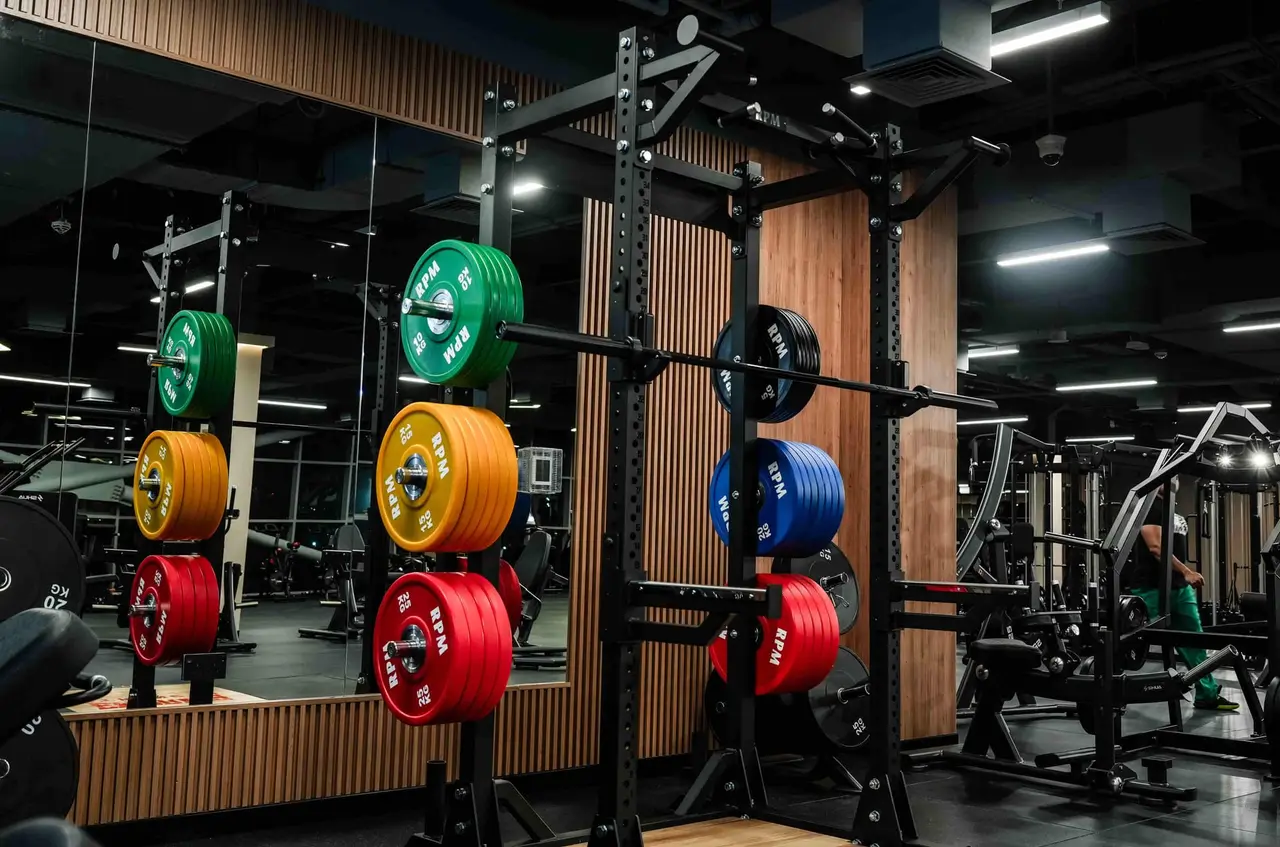
RPM's floor photos show squat racks with barbells and colour bumper plates, and a dumbbell rack, so the barbell and dumbbell versions are covered on the training floor. Resistance bands and a Smith machine are not in the photos, so ask about them on your free guided tour. The barbell guide explains the bars and plates, and a personal training session gets your hinge checked before the bar goes on your back.
Questions, answered.
What muscles does the good morning work?
The hamstrings, the glutes and the muscles along the spine, with the upper back holding the bar in place and the trunk bracing throughout.
Good morning or Romanian deadlift: which should I do?
Learn the Romanian deadlift first: it is easier to set up and to load. Add the good morning as a second hinge once the RDL feels solid, especially if your grip gives out before your hamstrings do.
Are good mornings bad for your back?
There is no single answer. The lift loads the muscles along the spine on purpose, and many people train it comfortably with light weights and strict form. If you have back pain or a past back injury, ask a doctor or physiotherapist which hinges suit you before you start.
Why is it called a good morning?
Because the movement looks like a bow, the kind of greeting you might give someone in the morning. It has nothing to do with the time of day you train.