The answer in brief
Both lifts push a barbell to straight arms; what changes is the direction relative to your body. On the bench press you lie on your back and drive the bar away from your chest, a horizontal press in which the chest is the prime mover. On the overhead press you stand and drive the bar from your collarbones to above your head, a vertical press in which the shoulders lead and your trunk, glutes and legs keep you upright. The triceps and the front of the shoulder work hard in both, which is why the two lifts compete for recovery when they share a session.
So they are not stand-ins for each other, the way a barbell and a dumbbell version of one press are. The chest training guide places the bench in a full chest week, and the shoulder exercise guide does the same for overhead work.
Side by side
| What differs | Bench press | Overhead press |
|---|---|---|
| Direction of the press | Forward from the chest: a horizontal press | Upward from the shoulders: a vertical press |
| Prime mover | Chest | Front and side shoulders |
| Triceps | Finish the top half of the rep | Straighten the elbows at lockout |
| What holds you still | The bench, your upper back and leg drive | Your trunk, glutes and legs, with nothing behind you |
| Shoulder range needed | Moderate: the bar stops at your chest | Arms fully overhead without arching the lower back |
| Typical load | The heavier of the two for nearly everyone | Much lighter, and it climbs in smaller steps |
| A rep you cannot finish | The bar can pin you: set safety arms or use a spotter | Lower the bar to the front of your shoulders and re-rack it |
Same muscles, different shares
The chest's job in a press is to drive the upper arm forward. A horizontal press lines that action up with the bar's path, so the chest does most of the work and the front shoulder assists. Turn the press upright and the arm travels past your face to above your head, a range the chest contributes less to: the front deltoid takes over, the side deltoid joins as the arms pass shoulder height, and the trapezius and serratus rotate the shoulder blades up so the arm can finish overhead.
A 2020 study of 30 trained adults, pressing on a bench set from flat to sixty degrees, shows the trend. Front-shoulder activity was highest at sixty degrees, and beyond forty-five degrees the shoulder did significantly more while the chest's performance fell; the middle and lower chest were most active flat. Triceps activity was similar at every angle. The study stopped short of a fully upright press, but the direction holds: the more vertical the press, the larger the shoulder's share.
In practice, the overhead press will not replace a flat or incline press for a bigger chest, and the bench does little for the side of the shoulder, which the overhead press and lateral raises cover.
Does one press build the other?
Partly. The triceps and the front shoulder work hard in both, so getting stronger at one usually nudges the other up, especially in your first year or two of lifting. But a heavy press is also a skill, and the groove, the set-up and the sticking point are specific to each lift. A big bench does not teach you to brace standing under a bar; a strong overhead press does not teach you to pin your shoulder blades to a bench.
So if one lift has a number you care about, train it directly at least once a week and let the other play a supporting role; the bench press vs chest press machine comparison shows the same pattern. Where the overlap helps, and where it stops:
- Triceps strength finishes both lifts, so close-grip bench pressing and triceps work help each of them.
- The front shoulder gets heavy work from both, so a week that holds both rarely needs extra front raises.
- Bracing under a standing bar, and the bench's touch point and leg drive, only improve by doing that lift.
Ordering them across a week
Because both presses tire the triceps and front shoulders, whichever comes second in a session pays for it. Put the lift that matters most first, and if you train upper body twice a week, let the other lead its own day, ideally with a day or more between the two hard sessions.
| Your priority | Day A | Day B |
|---|---|---|
| Both equally | Bench press 4 × 5–8, then overhead press 2–3 × 8–10, lighter | Overhead press 4 × 4–6, then dumbbell bench press 3 × 8–12 |
| The bench | Bench press 4 × 3–6, heavy | Paused bench press 3 × 6–8, then overhead press 3 × 6–8 |
| The overhead press | Overhead press 4 × 3–6, then incline dumbbell press 3 × 8–10 | Bench press 3 × 6–8, then overhead press 3 × 8, lighter |
Stop each set with one or two reps in hand. With one push day a week, lead with one press and swap the order every four to six weeks. Pair every press with a pull: a row after the bench and a lat pulldown after the overhead press, as the back training guide sets out.
If both lifts stall at once, look at recovery before technique: two hard presses a week, with dips and triceps work on top, can be more front-shoulder and triceps work than you are recovering from.
When your arms don't reach overhead
The overhead press needs something the bench does not: straight arms above your head with the ribs down and the lower back neutral. If the only way to get the bar overhead is to lean back, the lift has become a standing incline press, with the arch doing what your shoulders cannot. A simple check: stand with heels, bottom and upper back against a wall and raise your straight arms in front of you and up. If your thumbs reach the wall without your lower back peeling away, you have the range. If not, press within the range you have:
- The bench press, flat or on a low incline where the benches adjust: the bar stops at your chest, so overhead range does not limit it.
- The landmine press, pressed up and forward on an angle with less overhead range. Ask whether a landmine attachment is available.
- A seated dumbbell shoulder press, palms turned slightly in, through the range you control, while a coach checks where your range runs out and retests the overhead press later.
Stiffness is a coaching question; pain is not. If reaching or pressing overhead hurts, speak to a doctor or physiotherapist first.
Which press to lead with
Lead with the bench press if…
you want a bigger chest, the heaviest pressing numbers or a lift you might test in powerlifting, or overhead pressing is not yet comfortable for you.
Lead with the overhead press if…
you want stronger shoulders, a press that trains your trunk to stay rigid on your feet or a base for the push press, and your arms already reach straight overhead without arching.
Pressing both ways at RPM
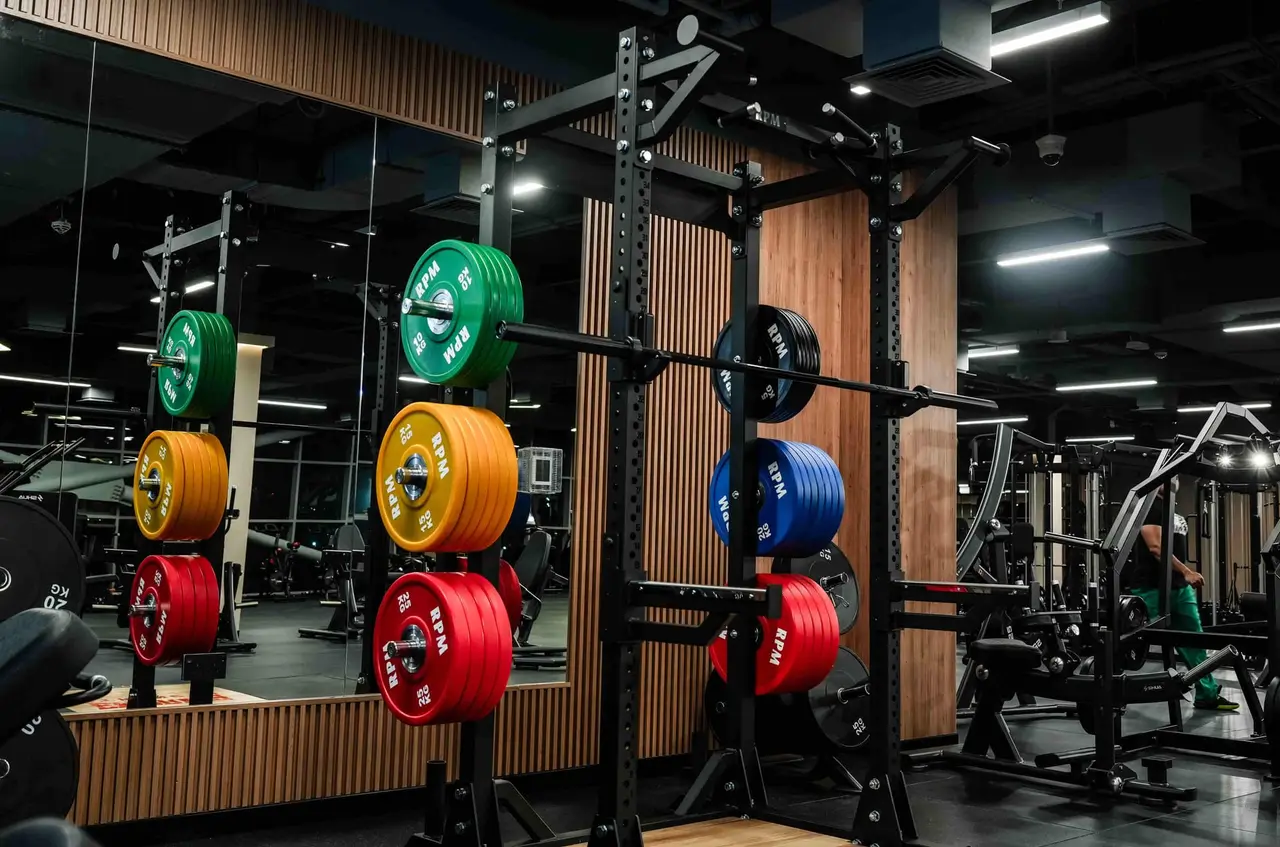
RPM's floor photos show squat racks with barbells and colour bumper plates, flat benches and a dumbbell rack on the training floor in Al Manhal, which covers a standing overhead press and dumbbell pressing. Whether a flat bench fits inside a rack with the safety arms set for benching, which benches incline, and whether a landmine attachment is on hand are all worth asking on your free tour. A personal training session can check your overhead range and your bench set-up before either bar gets heavy.
Sources
Questions, answered.
Is the overhead press harder than the bench press?
It moves far less weight for almost everyone, because the shoulders are smaller than the chest and nothing behind you shares the load. That makes it slower to progress, not a lesser lift. Compare each press only with its own log.
Can the overhead press replace the bench press?
Not for the chest, which it leaves mostly untrained. If you drop the bench, keep another horizontal press, such as the dumbbell bench press or push-ups.
Can the bench press replace the overhead press?
For general fitness it covers much of the pressing work. You give up the side shoulder's share and the standing brace; lateral raises and a landmine press fill most of that gap.
Should I do the bench press and overhead press on the same day?
You can. Do the one you most want to improve first and the second lighter or for fewer sets, since the triceps and front shoulders will be tired.
Where does the incline bench press fit between them?
Halfway. As the bench rises, the front shoulder takes more of the work, until a steep incline is mostly a shoulder press. The incline vs flat bench comparison covers the angles.