The answer in brief
The two rows train the same pulling muscles, the lats and the upper back, with the biceps and rear shoulders helping. What differs is what holds you in place. In the bent-over row nothing does except you: hips back, torso close to parallel with the floor, and your hamstrings, glutes and the muscles beside your spine holding that angle while both arms pull one bar. In the dumbbell row, one hand and one knee on a flat bench hold your torso, and one arm pulls at a time.
So the real question is whether you want the hinge to be part of the exercise. If you do, the barbell row trains it; if the hinge is what gives out first, the bench row removes it. The back training guide uses horizontal pulls of both kinds next to a vertical pull.
Side by side
| What differs | Bent-over row | Dumbbell row |
|---|---|---|
| What supports your torso | Nothing: your hips, hamstrings and back hold the hinge | A flat bench, under one hand and one knee |
| Arms | Both together, on one bar | One at a time |
| Main muscles | Upper back and lats | Lats and upper back |
| Also working | Biceps, rear shoulders, hamstrings and lower back | Biceps, rear shoulders and the trunk, resisting rotation |
| Range at the top | Ends when the bar meets your stomach | The elbow can travel past your torso |
| What usually limits the load | Holding the hinge | Your back and grip, one side at a time |
| Loading steps | Small plates on each side | Fixed jumps from one dumbbell to the next |
| Fatigue it leaves | Lower back and hamstrings, as well as the back | Mostly the back and biceps |
| Time per set | One set covers both sides | Twice as long: one side, then the other |
What the hinge adds, and what it costs
Holding a hinge under load is training in its own right: the muscles along the spine, the glutes and the hamstrings work without moving for every second of the set. That is why the barbell row sits naturally in programmes built around squats and deadlifts, where the back has to keep its shape under a bar.
The cost shows up in two places. First, the hinge often fails before the back does: as the set goes on, the torso rises and the row drifts into a shrug, so the weight you can row strictly is set by your trunk rather than your lats. Second, it adds lower-back fatigue to a week that may already hold deadlifts, Romanian deadlifts and squats. When those lifts are heavy, a bench-supported row lets you keep pulling hard without stacking more on the same muscles.
A 2009 study of seven healthy men, cited on the bent-over row page, compared three rows and found the standing bent-over row placed the largest load on the lower spine of the three. A bench-supported dumbbell row was not one of them, so the study does not rank it; the bench is simply the reason the dumbbell row asks so little of the hinge.
One arm at a time: range and evening out your sides
With one hand braced on the bench, the dumbbell travels beside your torso rather than into it, so the working elbow can finish behind your body and the shoulder blade can draw fully in. At the bottom, the shoulder can sink towards the floor for a longer stretch. In a barbell row the bar stops at your stomach and both shoulders move as one, so the range is shorter at both ends.
Working one side at a time also exposes any difference between them, where a barbell lets the stronger side quietly do more. Count the reps on your weaker arm and stop the stronger arm at the same number. The price is time: every dumbbell set is really two sets, which adds up in a short session.
Which row suits your situation
You are new to rowing
Start with the dumbbell row. The bench holds your position, so you can learn to feel your back working without learning a hinge at the same time. Add the barbell row once you can hold a flat back in a Romanian deadlift.
You want a strength row to track over months
The barbell row, loaded in small plate steps, with a strict, unchanging torso angle as your standard for a good rep.
Deadlifts are heavy this week, or your lower back is tired
The dumbbell row, or another supported row such as the chest-supported row or the seated cable row. If your lower back hurts rather than feels tired, speak to a doctor or physiotherapist first.
One side is clearly weaker
The dumbbell row, so each arm has to do its own share.
Every bench is taken
The barbell row needs only a bar and some floor, or do the dumbbell version as a tripod row with your other hand on a rack or your thigh.
Putting both in a back week
The two complement each other: one heavy, two-armed and hinged, the other supported, one-armed and longer in range. Pair each with a vertical pull such as the lat pulldown, and keep the barbell row off the day after heavy deadlifts, when the muscles that hold your hinge are already tired.
| Plan | Session A | Session B |
|---|---|---|
| Two back sessions | Bent-over row 4 × 6–8, then lat pulldown 3 × 8–12 | Dumbbell row 3 × 10–12 each arm, then a pulldown or pull-ups, 3 sets |
| Deadlifts in the same week | Deadlift, then dumbbell row 3 × 8–12 each arm | Bent-over row 3–4 × 6–8, then lat pulldown 3 × 8–12 |
| One back session | Bent-over row 3 × 6–8, then dumbbell row 2 × 10–12 each arm | Swap which row comes first every four to six weeks |
Rest two to three minutes after barbell sets and about a minute after both sides of a dumbbell set. Count both rows as horizontal pulls when you balance your pulling sets against your presses.
If both rows are in one session, do the barbell row first: it needs your trunk fresh, while the dumbbell row still works well once the hinge muscles are tired. Log the two separately, since a dumbbell row with the torso supported often allows more weight per arm than half of your barbell row, and the numbers are not meant to match.
Where to row at RPM
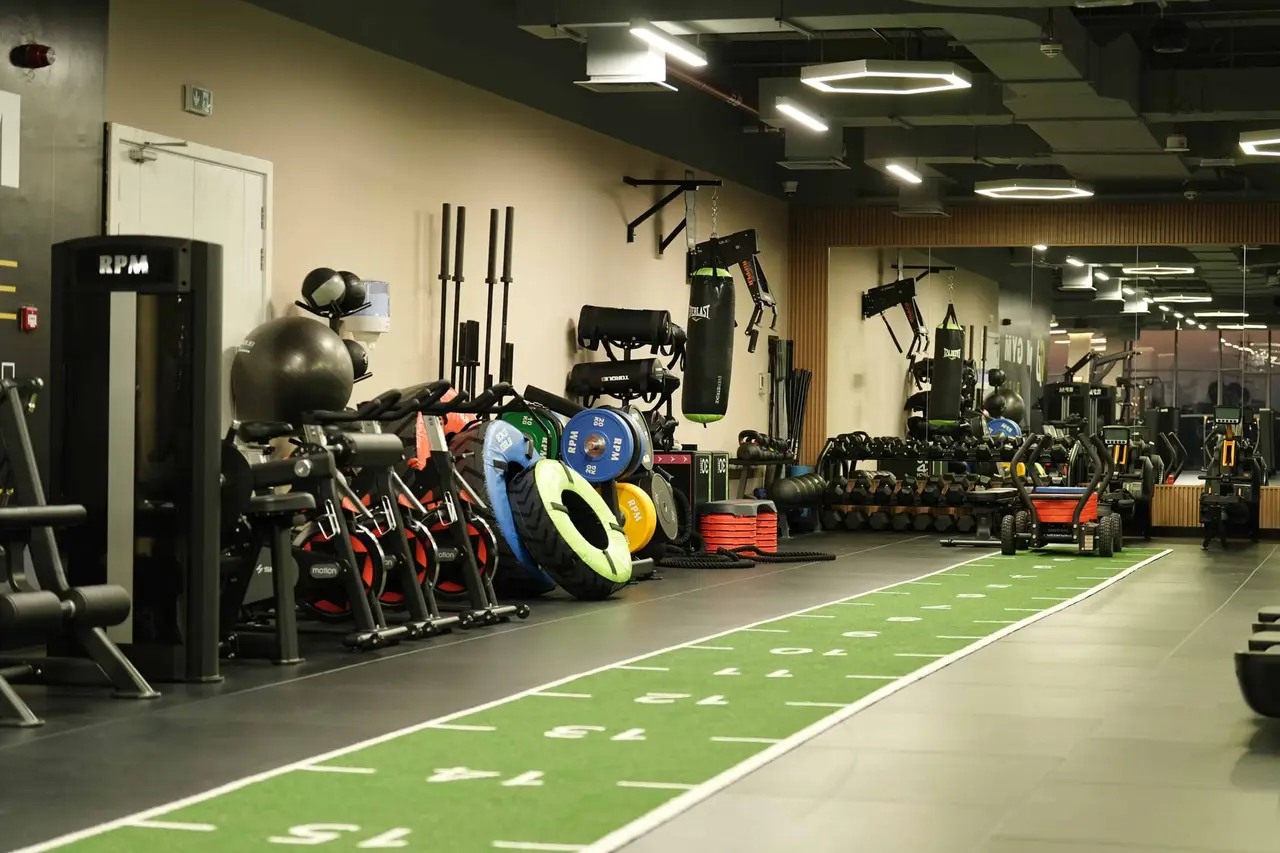
RPM's floor photos show squat racks with barbells and colour bumper plates, a rack of fixed-weight barbells, a dumbbell rack and flat benches on the training floor in Al Manhal, so both rows are covered. Whether a bench sets to an incline for a chest-supported row, or whether there is a T-bar row station, is a question for your free tour. To have your hinge and your one-arm pull checked from the side, book a personal training session.
Sources
Questions, answered.
Is the barbell row or the dumbbell row better for a bigger back?
Both train the lats and upper back well. The barbell row lets you load both sides heavily; the dumbbell row gives each side a longer pull. For size, a row you can do strictly and progress steadily matters more than which one it is, and a week can hold both.
Can I do a bent-over row with dumbbells?
Yes: hinge as you would for the barbell row and pull two dumbbells together. It keeps the hinge but lets your wrists turn and each arm find its own path. It is a different exercise from the bench-supported one-arm row compared here.
Which row asks less of the lower back?
The dumbbell row, because the bench holds your torso and there is no hinge to maintain. If your back hurts, speak to a doctor or physiotherapist before you row from either position.
Why does my dumbbell row feel stronger than half my barbell row?
Because the bench takes the hinge away: with your torso supported, your back can pull more than it can while also holding you up. Track each row in its own log.
Where does the seated cable row fit?
It is a third option, supported like the dumbbell row but two-armed, with the cable keeping tension through the pull. The lat pulldown vs seated cable row comparison shows how it pairs with a vertical pull.