Why the cable suits the back, and where it falls short
Dumbbells and barbells resist you only straight down, which is why the free-weight back pages in this library keep meeting the same gap: no vertical pull without a pull-up bar. A cable's pulley can sit overhead, at chest height or at the floor, so one station gives you pulldowns, rows from three heights and pullovers, on a pin you move in small steps. The stack also keeps pulling at the start of every rep, when the lats and upper back are at their longest, and most pulls work one arm at a time, so the hand travels further than a bar allows.
The limits are real. On heavy rows the stack drags you off the seat before your back gives out. Most cable pulls are seated or upright, so the muscles beside the spine do little, and a cable-only plan leaves out the hinge. The back training guide sets out the weekly plan with any equipment; this page assumes the cable is your main tool.
Six pulls, grouped by the line of the cable
Every cable back exercise follows one of four lines of pull, and a complete session takes something from at least three of them.
- From overhead: the lat pulldown, with a long bar, a close neutral handle or one D-handle. It is the cable's answer to the pull-up, and usually the heaviest back exercise on the station.
- Horizontal: the seated cable row with both hands, and the single-arm cable row at a pulley near chest height, covered step by step below.
- Straight arms, for the lats: the straight-arm pulldown, sweeping a bar from the top pulley to your thighs, and the lying cable pullover, lying on a flat bench with your head towards the bottom pulley and drawing a bar from behind your head to over your chest. Some gyms call the standing version a cable pullover too; the lying one is heaviest with the arms overhead and the lats fully stretched, the standing one near the hips.
- Upper back and rear shoulders: the face pull, a rope at about forehead height, finishing with the hands beside the ears.
Two extras earn a place when time allows: the half-kneeling high row, pulling from a high pulley down towards the lower chest, halfway between a pulldown and a row, and the cable shrug at a low pulley for the upper traps. For the hips and the muscles along the lower spine, the nearest cable option is the cable pull-through.
The single-arm cable row, step by step
Rowing one side at a time is the pull a cable does that little else copies: the handle starts well in front of the shoulder and finishes behind the ribs while the trunk works to stay square. In a 2015 study of 15 resistance-trained men, one-arm rows, including the seated cable row, brought more activity in the external oblique at the side of the waist than two-arm rows, which brought more in the muscles along the lower spine. It was one session of muscle-activity readings, not a training study, but it describes the trade: one arm adds trunk work, two arms let the back take more load.
- Set the pulley at lower-chest height with a D-handle. Face the column, take the handle in your right hand and step back until the stack lifts.
- Stand with your left foot forward, or kneel on your right knee with the left foot in front: the opposite leg forward gives you a stable base.
- Let the cable draw your right shoulder forward until the shoulder blade moves round the ribs, while your hips and chest keep facing the stack.
- Draw the shoulder blade back first, then drive the elbow past your ribs towards your back pocket.
- Hold for a count, then return over two to three seconds to the long, reaching start. Do the weaker side first.
Your other hand changes the exercise. On your hip, the trunk has to stop the cable turning you, so the load stays moderate and the obliques work hard. Holding the tower's frame, you can row noticeably heavier and the back does more. Write down which one you did.
Setting each pull: height, handle, focus
| Exercise | Pulley and attachment | Focus |
|---|---|---|
| Lat pulldown | Top pulley at the pulldown seat; long bar or neutral handle | Thighs pinned; elbows down to your back pockets |
| Seated cable row | Low pulley at the row seat; V-handle or wide bar | Torso still; handle to the top of the stomach |
| Single-arm cable row | Lower-chest height; D-handle | Hips square to the stack; elbow past the ribs |
| Straight-arm pulldown | Top pulley; straight bar or rope | Elbows fixed; sweep the hands to the thighs |
| Lying cable pullover | Lowest pulley; straight bar; bench end-on to the column | Ribs down; bar from behind the head to over the chest |
| Face pull | About forehead height; rope | Pull the ends apart; hands finish beside the ears |
| Half-kneeling high row | Top pulley; D-handle or rope | Down and back towards the lower chest |
The lying pullover is the fiddly one: the column must reach the floor, and you take the bar sitting on the end of the bench, then lie back. At a busy hour, the straight-arm pulldown does the same job. The cable machine page covers pulleys and attachments.
Two back sessions on one station
| Exercise | Sets × reps | What to watch |
|---|---|---|
| Lat pulldown | 4 × 8–10 | Heaviest pull of the day; a full stretch at the top |
| Single-arm cable row, other hand on the hip | 3 × 10–12 each arm | Hips stay square to the stack |
| Straight-arm pulldown | 2–3 × 12–15 | Light; the elbows never bend further |
| Face pull | 3 × 15 | A pause at the finish on every rep |
| Exercise | Sets × reps | What to watch |
|---|---|---|
| Seated cable row | 4 × 8–12 | One torso angle for the whole set |
| Single-arm pulldown, half-kneeling | 3 × 10 each arm | Lean slightly towards the working side |
| Lying cable pullover | 3 × 12 | Three seconds down into the stretch |
| Half-kneeling high row, or cable shrug | 2–3 × 12–15 | Chest tall; shoulders down on the row |
Each session is 12 or 13 sets. Run them at least a day apart, and put a hinge such as the Romanian deadlift or the pull-through on a lower-body day.
When the stack runs out, or the next pin is too far
Progress in the usual order: reps to the top of the range on every set, then the next pin. Two snags are particular to the back. Once you lean back to finish a row, or the stack lifts you off the seat, you are fighting your bodyweight, not the pin; switch to single-arm rows with the other hand braced on the frame. On light pulls such as pullovers and face pulls, one plate can be a large jump, so add a three-second lowering, a one-second hold or a fourth set before moving up, or use the small add-on weight some stacks have beside the pin. When most of the pulldown stack goes for clean reps, pull-ups are the usual next step if the gym has a bar; ask on a tour. The hypertrophy volume calculator counts the week's back sets.
Cable back mistakes
- Leaning back to finish. A torso that swings on pulldowns and seated rows hands the work to momentum; set the angle before the first rep and keep it.
- Letting the plates rest. If the stack touches down between reps you are too close, and the back rests exactly where it should be stretched.
- One pulley height for everything. The cable should run along your elbow's path: high for pulldowns, chest height for single-arm rows, low for seated rows and pullovers.
- Skipping the hinge. Cables leave the muscles along the spine under-worked, so a Romanian deadlift or a pull-through belongs in the week. If your back or shoulder hurts during a pull, stop, and speak to a doctor or physiotherapist before you carry on.
Cable back training at RPM
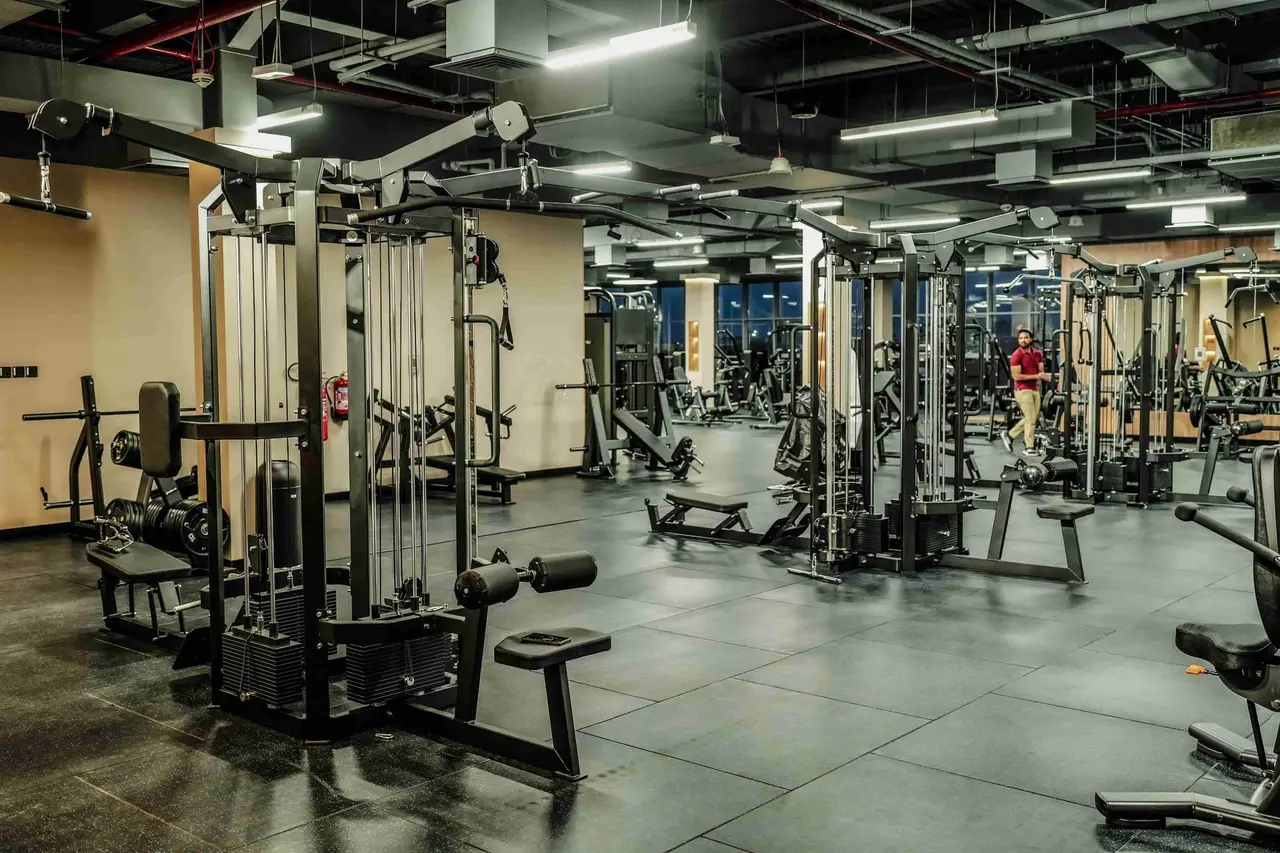
RPM's floor photos of the Al Manhal training floor show multi-station cable towers with pulldown seats and thigh pads, a rope and single handles clipped to the stations, and flat benches nearby, which covers the pulldowns, face pulls and straight-arm work here. The photos cannot show whether a column slides to the floor for single-arm rows and the lying pullover, or which bars and V-handles are on hand, so check on a free guided tour. For the hinge, they show barbells with colour bumper plates and a dumbbell rack. To have a coach set your pulleys and pins, book personal training.
Sources
Questions, answered.
What are the main cable back exercises called?
The lat pulldown (wide, close-grip, underhand or single-arm), seated cable row, single-arm cable row, straight-arm pulldown, lying cable pullover and face pull cover the whole back.
Can you build a strong back with cables only?
For most people, yes, if the pins keep rising. The limits are the top of the stack and the missing hinge: a weekly Romanian deadlift covers the hinge, and pull-ups or a barbell row take over when the stack runs out.
Which cable exercises work the lower back?
Rows and pulldowns load it very little. The cable pull-through makes the muscles along the spine hold your back flat as you hinge, but the stack limits the load, so most programmes add a free-weight Romanian deadlift. If your lower back already hurts, speak to a doctor or physiotherapist first.
Cable or free weights for the back?
Both, if you can. Cables give you the vertical pull, the loaded stretch and single-arm work in small steps; free weights give you heavier rows and the hinge. The barbell back guide and the dumbbell back guide cover that half.
Are cable back exercises good for beginners and for women?
Yes. The pulldown and the seated row are among the first exercises most coaches teach, because the load moves in small steps and nothing needs balancing. The exercises are the same for everyone; only the starting pins differ. Four per session, one from each line of pull, is plenty.