What dumbbells do well for the back, and what they cannot do
Dumbbells suit the back better than they suit most muscles. Each arm rows on its own, so a weaker side has to do its share. The wrists can turn to the palms-facing grip most shoulders prefer. And the elbow can travel further back past the torso than on a barbell row, which brings the lats strongly into the pull. Add a bench and almost any row becomes a supported one, so the lower back stops being the limit.
The gap is the vertical pull. Pulling down from overhead, as in a pull-up or a pulldown, has no real dumbbell equivalent, because a dumbbell only ever pulls straight down. The pullover is the nearest thing, but it is a lighter accessory. The other limit is grip: on heavy rows and Romanian deadlifts your hands may give out before your back, and strong lifters can outgrow the heaviest pair on the rack. In a gym, add a lat pulldown to these sessions; at home, the dumbbell work below still covers most of the back.
The back training guide covers every tool, the research on rows and grip width, and how many sets a week to aim for. This page answers a narrower question: what to do when dumbbells are all you have, or all that is available on the floor at the time.
Choosing the weight when the jumps are big
Dumbbell racks climb in fixed steps, and on a one-arm row a single step can be a large share of the load. These habits keep progress moving:
- Give every exercise its own weight. You can row far more with one arm than you can hold out for a rear-delt fly, and a pullover sits somewhere between.
- Start each new movement with a weight you could lift about twelve times, and judge it by the reps you have left, not the number on the handle.
- Use double progression: stay with a weight until every set reaches the top of the rep range, then move up a step and rebuild from the bottom of the range.
- When the next step is too big, add work without adding load: a three-second lowering, a one-second hold at the top, or one more set.
- If your grip fails before your back on heavy rows or Romanian deadlifts, lifting straps let the back finish the set. Learn each movement without them first.
The movements, grouped by the job they do
Choose at least one from each of the first three groups. The linked pages explain each movement step by step.
- Supported rows, the core of the session: the one-arm dumbbell row, with a knee and a hand on a flat bench, and the chest-supported row, face down on an incline bench. Both take the lower back out of the pull so the upper back and lats can work hard.
- Rows from a hinge: the two-dumbbell bent-over row and the tripod row, with one hand braced on a rack or your thigh. They need no bench and add a trunk challenge; the bent-over row page teaches the hinge, which is the same with a bar.
- The long lat stretch: the dumbbell pullover, along or across a bench, is the closest dumbbell answer to a vertical pull.
- Upper back and rear shoulders: the rear-delt fly, bent over or face down on an incline bench, and the shrug for the upper trapezius.
- Lower back and hips: the dumbbell Romanian deadlift and the single-leg Romanian deadlift, in which the muscles along your spine hold it still while the hamstrings and glutes move the weight.
- Grip and posture: the farmer's carry, walking with a heavy dumbbell in each hand, makes the upper back and grip hold you tall under load. The loaded carry guide builds workouts around it.
Two dumbbell back sessions
Session A: with a flat bench
Supported rows first while you are fresh, then the stretch, then the hinge. Use the chest-supported row if an incline bench is available.
| Exercise | Sets × reps | Coaching note |
|---|---|---|
| One-arm dumbbell row | 3–4 × 8–12 each arm | Heaviest row of the day; chest square to the bench |
| Chest-supported row, or two-dumbbell bent-over row | 3 × 10–12 | Pause with the elbows behind you |
| Dumbbell pullover | 2–3 × 10–12 | Three-second lowering, ribs down |
| Dumbbell Romanian deadlift | 3 × 8–10 | Hips back, dumbbells close to the legs |
| Rear-delt fly | 2 × 12–15 | Light and slow, no swinging |
Session B: no bench needed
For a busy floor or a session at home: everything is done standing or on the floor.
| Exercise | Sets × reps | Coaching note |
|---|---|---|
| Two-dumbbell bent-over row | 3–4 × 8–12 | Torso angle fixed for the whole set |
| Tripod row | 3 × 10 each arm | Other hand on a rack, a box or your thigh |
| Single-leg Romanian deadlift | 3 × 8 each leg | Slow, hips level |
| Floor pullover | 2–3 × 12 | On your back, knees bent |
| Dumbbell shrug | 2–3 × 10–12 | Pause at the top |
| Farmer's carry | 3 walks of about 30 seconds | Tall posture, shoulders down |
Each session is roughly 13 to 17 sets of back work. Do one or both each week with at least a day between them, and fit your pressing and leg work around them. The hypertrophy volume calculator totals your weekly sets.
Common mistakes with dumbbell back work
- Rowing with the arms. If your biceps tire first, think of your hands as hooks and lead with the elbows.
- Twisting to finish one-arm rows. A heavier dumbbell that needs the hips to get it up is not more back work; go down a step.
- Only doing rows. Rows alone leave out the long lat stretch and the lower back, so add a pullover and a hinge.
- Rounding on the hinge. On two-dumbbell rows and Romanian deadlifts your back should look the same on the last rep as on the first. If your lower back aches during or after these, stop and have it checked by a doctor or physiotherapist.
- Jumping weights too soon. With big steps between dumbbells, earn each jump with full sets at the top of the range.
Dumbbell back training at RPM
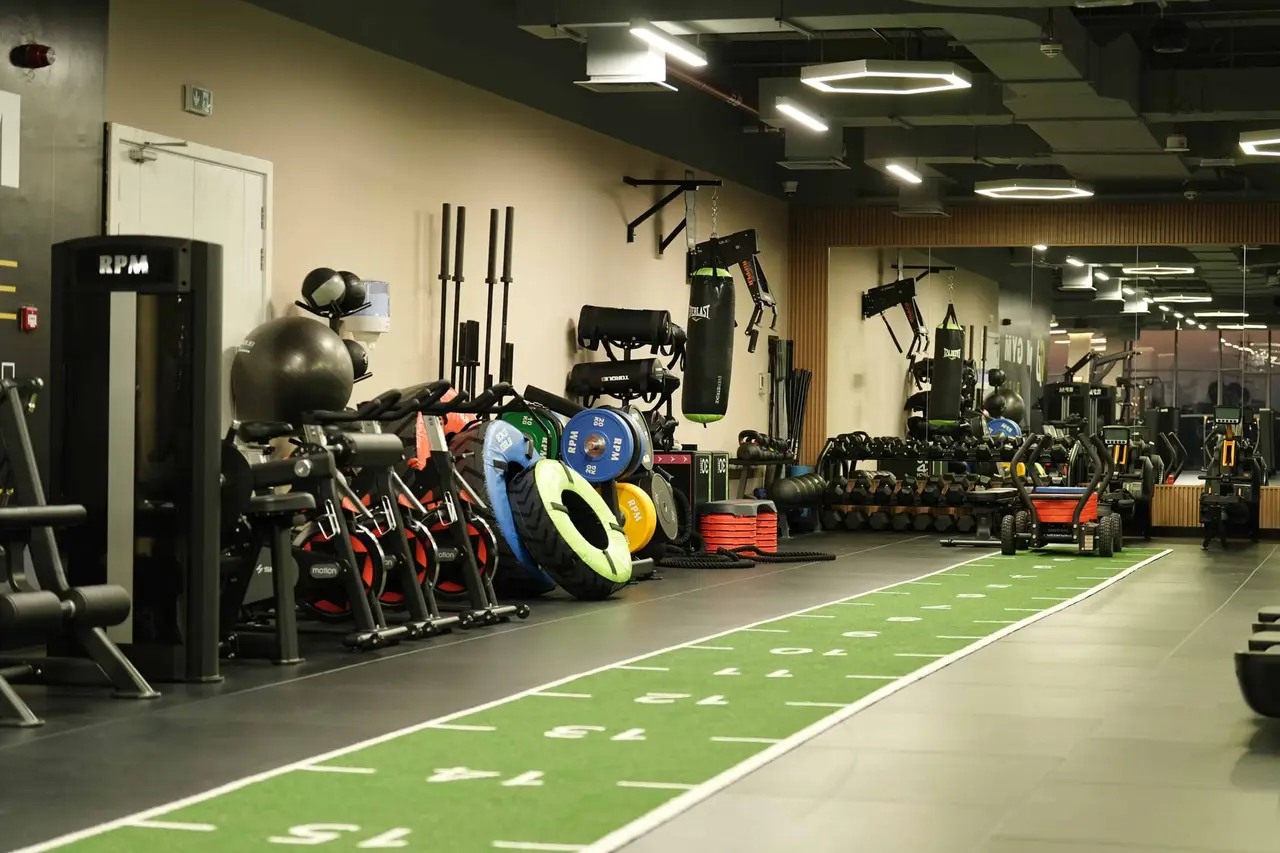
RPM's floor photos show a dumbbell rack and flat benches in Al Manhal, which cover every exercise in both sessions apart from the incline versions. An adjustable incline bench is not in the photos, so ask about one on your free guided tour. The same photos show cable towers with a pulldown seat, which fill the one gap dumbbells leave. For help choosing starting weights, book a personal training session, or ask for a female personal trainer if you prefer.
Questions, answered.
Can you build a big back with only dumbbells?
You can build a strong, well-developed back, as long as the sets are hard and the loads keep rising. The limits are the missing vertical pull and, for strong lifters, the heaviest dumbbell on the rack. A pulldown or pull-ups cover the first; slower reps and extra sets delay the second.
What dumbbell back exercises can I do without a bench?
Two-dumbbell bent-over rows, tripod rows, Romanian and single-leg Romanian deadlifts, standing rear-delt flyes, shrugs and the farmer's carry. A floor pullover replaces the bench version.
Which dumbbell exercises work the lower back?
Romanian deadlifts, single-leg Romanian deadlifts and two-dumbbell bent-over rows all make the muscles along your spine hold your back still. Supported rows deliberately take them out. If you already have back pain, see a doctor or physiotherapist before loading a hinge.
Are dumbbell back exercises different for women?
No. The exercises, sets and progression are the same for everyone; only the starting weights differ from one person to the next.
How many dumbbell back exercises should I do in one workout?
Four to six: two rows, a pullover or rear-delt fly, a hinge, and a carry or shrug if you have time. That is about 12 to 17 hard sets, enough for most people in one session.
Dumbbells or barbell for the back?
Dumbbells train each side separately and allow more elbow travel; a barbell lets you load rows and deadlifts heavier, in smaller steps. The barbell back guide covers the bar-only version, and most people do well with both.