What the pull-through trains, and why the cable matters
It is the same hip hinge as a Romanian deadlift: the hips fold back with soft knees and a flat back, then straighten. What changes is the direction of the load. A barbell pulls straight down, so it is heaviest when you are bent over and almost weightless once you stand up. The cable runs back between your legs to the pulley behind you, so it keeps pulling as you stand, and the glutes have to finish the rep against it. It also draws your hips back towards the stack as you hinge, which makes the movement easy to find: people who struggle to push their hips back on a deadlift often get it on the first set of pull-throughs.
The glutes and hamstrings are the main movers; the muscles along the spine hold the back flat, the trunk braces and the grip hangs on to the rope. A 2023 study compared the pull-through with the Romanian deadlift and the reverse hyperextension at half of each lift's estimated one-rep maximum. Activity in two of the muscles along the lower spine and in two hamstring muscles was lower on the pull-through than on the Romanian deadlift; the glutes were not among the muscles the abstract lists as changing between those two. It measured five reps in one session, not growth over months, but it matches how coaches use the lift: a hinge in which the spinal muscles and the hamstrings work less than on a free-weight one. It belongs to the hinge family in the glute exercise guide.
Setting up: rope, stance and distance from the stack
- Set the pulley at the bottom of the column and clip on a rope. A D-handle held in both hands works too, but the rope's two ends keep the hands together more easily between the thighs.
- Stand facing away from the stack, straddling the cable, and reach down between your legs to take one end of the rope in each hand.
- Walk forward two or three steps until the stack lifts with your arms long. The further out you stand, the more the cable pulls backwards rather than down and the harder the top of each rep becomes; too far and it pulls you off balance.
- Set your feet a little wider than your hips, toes turned slightly out, so the rope has room to pass between your thighs, with soft knees.
- Stand tall to start, hands just in front of your hips and ribs down. That is the finish you will return to on every rep.
- Pick a pin you could hinge with fifteen times. The exercise is about the hip action, not the number on the stack.
How to do a rep
- Push your hips straight back towards the stack, as if reaching back to touch it with your backside. The knees bend a little as the hips travel, and only a little.
- Keep your back long and your arms hanging. The rope slides back between your thighs and your hands end up between or just behind your knees.
- Stop when you feel a strong stretch in your hamstrings and the hips will not go back further without your back rounding. For most people the torso ends somewhere between halfway down and nearly level with the floor.
- Press your feet into the floor and bring your hips forward to stand tall, letting the arms come through as passengers.
- At the top, squeeze your glutes for a second with your ribs down. You are upright, not leaning back, and the cable is still pulling.
- Start the next rep by sending the hips back again; never let the stack pull you backwards.
The rope should finish near the front of your hips. If your hands end up at your chest, your arms have rowed the weight. Breathe in and brace before you hinge back, and breathe out as you stand.
Mistakes that turn the hinge into something else
| Mistake | What it looks like | The fix |
|---|---|---|
| Sitting into a squat | The knees travel forward, the hips drop and the rope barely moves back | Think hips back, not down; the shins stay close to vertical |
| Rowing with the arms | The elbows bend and the hands rise towards the stomach at the top | Let the arms hang long, hands near the front of the hips |
| Leaning back at the top | The hips push past the feet and the lower back arches to finish | Stop at upright, ribs down and glutes squeezed |
| Rounding at the bottom | The back curls to reach further between the legs | Stop where the hamstrings stop you: less depth, flatter back |
| Pulled off balance | You stagger back between reps, or the stack touches down | A step closer if you are dragged, a step out if the cable goes slack |
A pull-through is felt in the glutes and the backs of the thighs. If it hurts your lower back, stop the set, and if the pain does not settle, see a doctor or physiotherapist before you hinge again.
Glute or hamstring bias, and how it compares
More glutes or more hamstrings?
For more glutes, allow a little more knee bend, hinge a shorter distance and spend longer squeezing at the top, where the cable keeps the hips loaded. For more hamstrings, keep the knees softer but straighter, send the hips further back and take three seconds into the stretch. Either way the back stays flat.
Pull-through vs Romanian deadlift
The Romanian deadlift can be loaded far more heavily, in small plate steps, and trains the back to hold its shape under that load. The pull-through is lighter, loads the top of the rep that the deadlift leaves empty, and is quicker to learn. Many programmes use the deadlift as the main hinge and the pull-through as an accessory or a teaching drill.
Pull-through vs kettlebell swing
The kettlebell swing is the same hip action done fast, with the bell's momentum to control. The pull-through is its slow cousin: a place to learn the hip snap before adding speed, or a way to train the same muscles without the timing a swing demands.
Band pull-through
Loop a long resistance band round a low, solid anchor, take the same stance facing away from it and hinge with the band between your legs. The band pulls hardest as you stand tall, which suits the top of the rep. It is the version for home or a busy gym, though hard to progress far.
Sets, reps and where it fits in a week
| Goal | Sets × reps | How hard |
|---|---|---|
| Learning the hinge | 2–3 × 10 | Slow and smooth; every rep stops at the same depth |
| Glute and hamstring work | 3 × 12–15 | Two reps left; a one-second squeeze at the top |
| Finisher after heavy hinges or squats | 2 × 15–20 | Continuous reps, a slow way back into the stretch |
Rest about a minute between sets, a little longer if the pin is heavy. Once or twice a week suits most people.
It usually goes after the main lift of a lower-body day, or in place of a free-weight hinge when your lower back is tired from deadlifts. Count it with your other hinges for the week. Progress the reps to the top of the range, then move to the next pin. When the stack runs out, or standing further away makes balance the limit before the glutes, move the heavy work to a hip thrust or a Romanian deadlift and keep the pull-through for higher reps.
Who should pick another hinge
- Lifters chasing heavy glute or hamstring strength: the stack caps the load, so the hip thrust and the Romanian deadlift take over as you get stronger.
- Anyone whose lower back hurts when they bend forward: speak to a doctor or physiotherapist before loading a hinge.
- If the rope rubbing between the thighs bothers you, a single handle held in both hands, or a band, changes the contact.
- With no low pulley available, a dumbbell Romanian deadlift or a glute bridge trains the same hip extension.
Pull-throughs at RPM
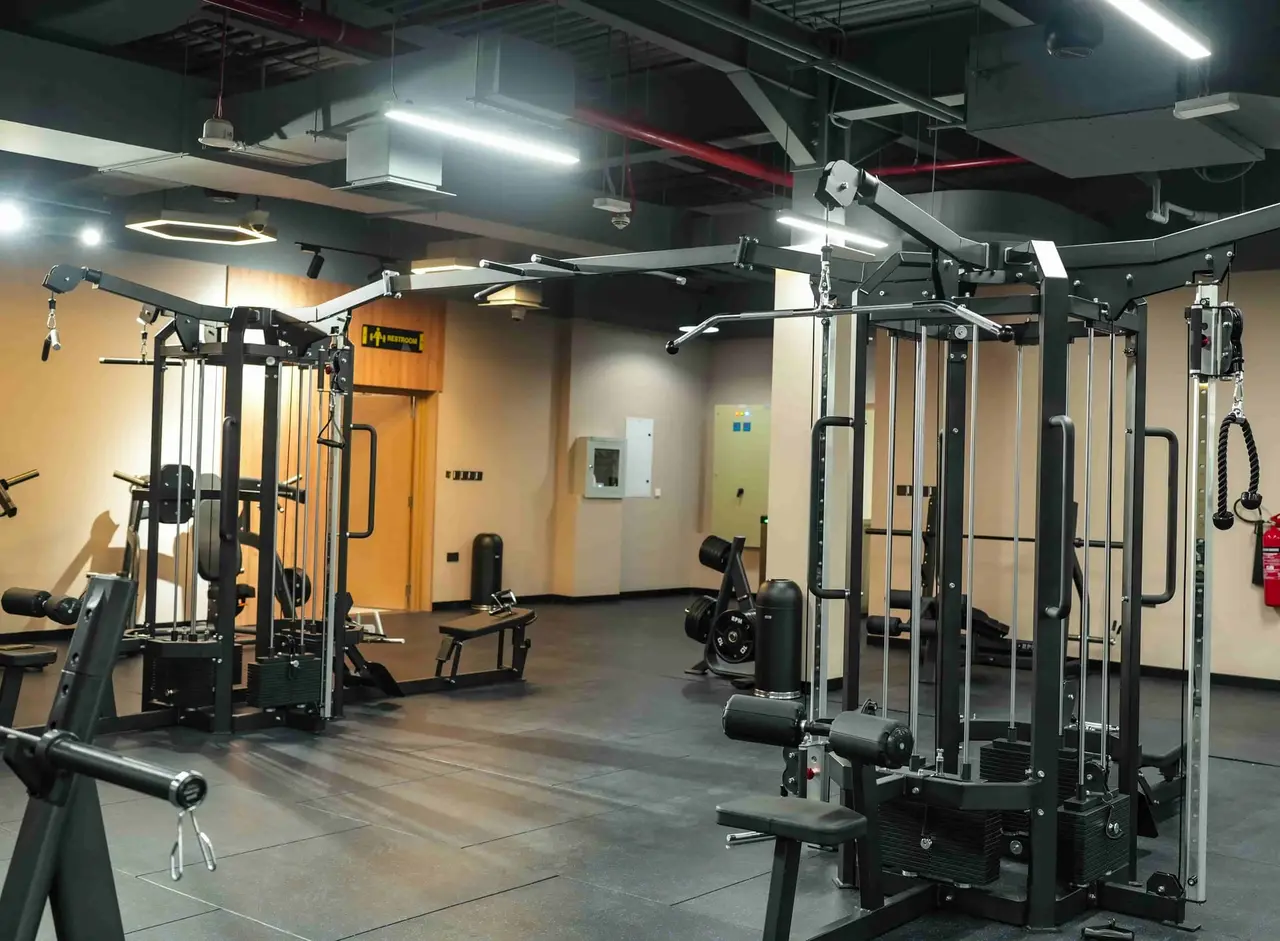
RPM's floor photos of the Al Manhal training floor show multi-station cable towers with a rope and single handles clipped to the stations. A pull-through needs a pulley at the very bottom of a column and a clear patch of floor in front of it for the walk-out, and the photos settle neither, so ask on your free guided tour which station to use. The same photos show barbells with colour bumper plates and a dumbbell rack for the Romanian deadlift, and kettlebells for swings. To learn the hinge with a coach, book personal training; the cable glute exercises page builds full sessions around this movement.
Sources
Questions, answered.
What muscles does the cable pull-through work?
Mainly the glutes and the hamstrings, which straighten the hips. The muscles along the spine hold the back flat, the trunk braces and the forearms grip the rope.
Is the cable pull-through good for beginners?
Yes, for women and men alike. The cable draws your hips back for you, which makes the hinge easier to feel than with a bar, and the load moves in small steps. Many coaches use it to teach the hinge before the Romanian deadlift.
Cable pull-through or hip thrust?
The hip thrust loads the glutes heavily at the top with a barbell and suits strength work; the pull-through is a lighter standing hinge that brings the hamstrings in as well. They fit in the same week.
Does the pull-through work the lower back?
The muscles along the spine work to hold your back flat, but in the 2023 study they were less active than on a Romanian deadlift. If you already have back pain, see a doctor or physiotherapist before you hinge under load.