What dumbbells do well, and badly, for the chest
This page answers one question: if dumbbells are what you train your chest with, how do you do it well? The chest training guide covers the wider picture, including barbells, cables, machines, bench angles and weekly sets. Everything here is built from a dumbbell rack and a bench.
Dumbbells suit the chest. Each arm works on its own, so a weaker side shows up straight away, and the hands can travel lower and finish closer together than a bar allows, which gives the chest a longer stretch at the bottom and a harder squeeze at the top. A rep you cannot finish ends with the weights lowered to your sides rather than a bar pinning you, so you can push sets hard when you train alone. And one rack gives you a press, a fly and a pullover without changing station.
The weaknesses are just as real. Getting heavy pairs from the floor into position takes effort and practice, and at some point that, not your chest, limits the weight. Nothing steadies the load, so you lift less in total than with a barbell. And a fly loads the chest only near the bottom, because once the dumbbells are over your chest gravity pulls straight down through your arms. Each of these has a workaround, covered below.
Choosing the weights
Every chest exercise needs its own pair. The flat press takes the heaviest, the incline press a step or two lighter, and a fly roughly half your pressing weight or less, because the long lever makes the bottom of the arc far harder than it looks. Start each new movement light and judge by the reps, not the number on the handle.
- Choose a pair you can press for the bottom of your rep range with about two reps left, cleanly, after a controlled kick-up into position.
- At the light end of the rack one step up can be a big share of the load. If the next pair is too heavy, stay where you are and build reps first.
- If you cannot get a pair into position without a struggle, it is too heavy for that day's set, even if you could press it once it is there. Ask someone to hand you one dumbbell at a time, or take the next pair down. The dumbbell bench press page walks through the kick-up.
- Log the pair and the reps for each exercise. Dumbbell progress shows up in reps more often than in weight, and memory is unreliable over weeks.
The movements, grouped by the job they do
Group dumbbell chest exercises by what they add and building a session gets simple: one main press, a second angle or grip, a stretch, a finisher.
- Main presses. The flat dumbbell bench press is the heaviest and the base of most sessions. The incline dumbbell press, on a low incline of about the first or second notch, moves more of the work to the upper chest. A decline version, covered on the decline bench press page, leans towards the lower chest if a decline bench is available.
- Presses with no bench. The dumbbell floor press, lying on the floor with knees bent, stops the elbows at body level. The range is shorter, but it often allows the same pair or a heavier one.
- Close-grip presses. The squeeze or crush press, with the dumbbells pressed together over your chest, keeps the chest working inward and brings in the triceps; the close-grip bench press page explains it. A neutral-grip press, palms facing, sits between the two and suits shoulders that dislike the regular press.
- Flyes. The dumbbell fly loads the chest in its stretched position with light weights; the incline fly does the same for the upper chest, and the floor fly limits the depth.
- The pullover. Lying on a bench, you lower one dumbbell behind your head and pull it back over your chest, working the chest and lats together; see the pullover.
- Push-ups on dumbbell handles. Holding a pair of hexagonal dumbbells that cannot roll lets the chest drop lower than the floor would allow, which makes a useful finisher. The push-up guide shows how to scale them.
Two sample sessions
Session A: a flat bench and dumbbells
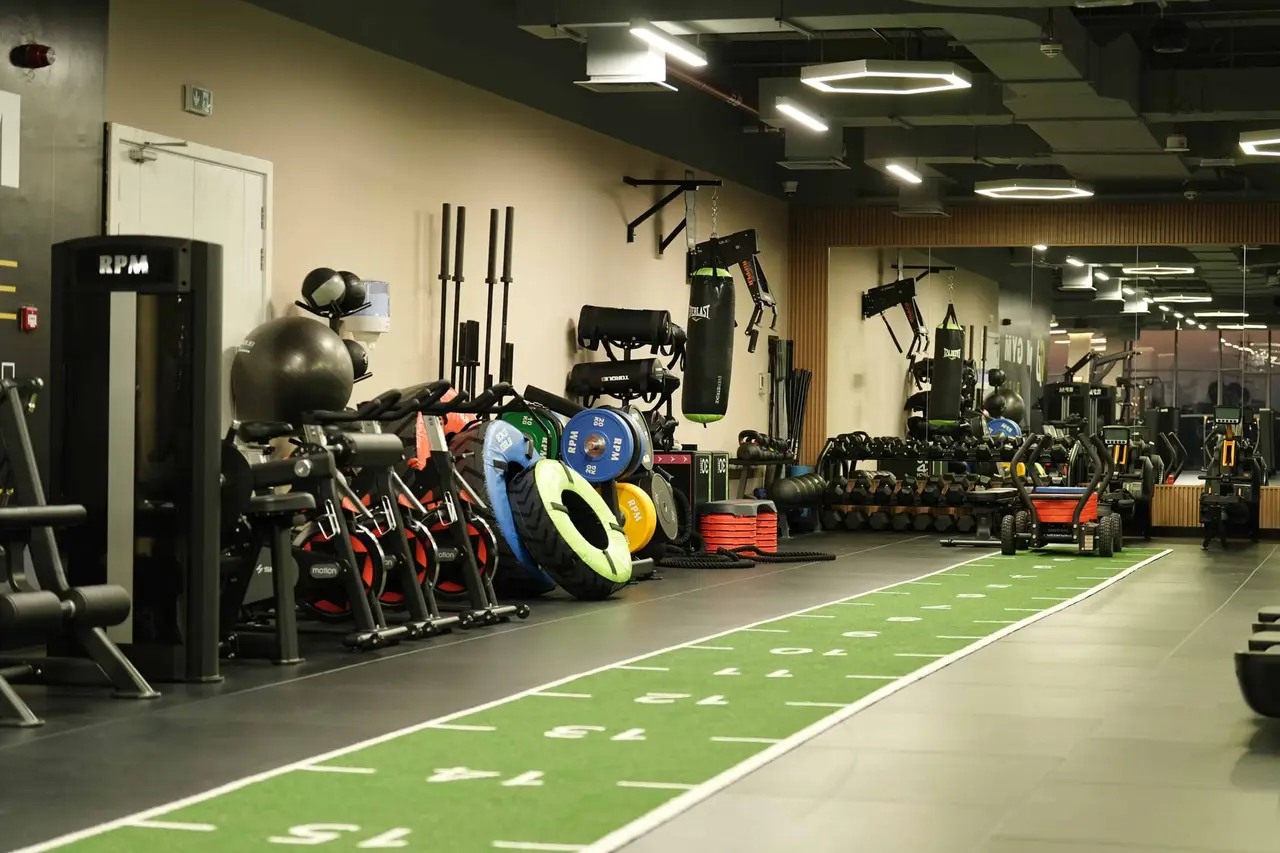
Everything here needs only a dumbbell rack and a flat bench, both of which RPM's floor photos show.
| Exercise | Sets × reps | Coaching note |
|---|---|---|
| Dumbbell bench press | 4 × 6–10 | Two minutes' rest; one or two reps left |
| Neutral-grip press | 3 × 8–12 | Elbows a little closer to your sides |
| Dumbbell fly | 3 × 10–15 | A light pair; three seconds down and a pause in the stretch |
| Pullover | 2 × 10–12 | One dumbbell, ribs kept down |
| Squeeze press | 2 × 12–15 | Press the dumbbells together for the whole set |
Session B: with an incline bench
If a bench that inclines is available, move the main press to a low angle and keep the flat work lighter.
| Exercise | Sets × reps | Coaching note |
|---|---|---|
| Incline dumbbell press | 4 × 6–10 | First or second notch; one or two reps left |
| Flat dumbbell bench press | 3 × 8–12 | A pair lighter than in Session A |
| Incline fly | 3 × 12–15 | Low angle, soft elbows |
| Push-ups on dumbbell handles | 2 × close to failure | Stop when the hips start to sag |
Each session is about 12 to 14 hard sets, which suits someone training chest twice a week; if you are newer, do the first three exercises only. The chest training guide explains how many weekly sets to build towards.
Progressing when the next pair is a big jump
Dumbbells go up in fixed steps, and the step between pairs is large next to adding small plates to a barbell. Rather than forcing the jump, work through these in order:
- Use a wide rep range, such as 8 to 12 for presses and 10 to 15 for flyes, and stay with a pair until every set reaches the top of it.
- Slow the lowering to three or four seconds, or add a one-second pause at the bottom. The same pair gets harder with no change of weight.
- Add a set to the exercise for a week or two before moving up.
- When you do move up, expect your reps to drop to the bottom of the range, then build them back.
- On the final set only, switch to a lighter pair as soon as you reach your target reps and carry on for a few more.
At the heavy end of the rack the problem changes from the size of the jump to getting the dumbbells into position. That is where paused reps, slower tempos and higher reps do more for you than heavier pairs, or where a barbell press becomes the better tool for the heavy work.
Mistakes with dumbbell chest training
- One pair for every exercise. A pair that suits the press is too heavy for a fly, and the fly turns into a bent-arm press.
- Only ever pressing flat. Add a low incline press or an incline fly at least once a week for the upper chest.
- Cutting the bottom short. The stretch at the bottom is the dumbbells' advantage over a bar; stop where the chest is stretched and the shoulder blades stay pinned, not higher.
- Clashing the dumbbells at the top. Banging them together does not make the chest work harder; stop a hand's width apart, or press them together on purpose in a squeeze press.
- Dropping them from straight arms. Lower to the chest, then to the thighs, and sit up; the dumbbells guide covers lifting and racking.
- Pushing through shoulder pain. Stop the movement that causes it and get it checked by a doctor or physiotherapist.
Dumbbell chest training at RPM
RPM's floor photos show a dumbbell rack in the functional training area and flat benches on the training floor, which covers Session A completely. Benches that incline or decline do not appear in the photos, so ask on your free tour which benches are on the floor in the Mixed and Ladies sections. If you would like a coach to choose your starting pairs and watch your kick-up, book personal training or ask for a female personal trainer.
Questions, answered.
Can you build a big chest with only dumbbells?
Yes. The chest grows from hard sets taken close to failure and from adding reps or load over months, and dumbbells provide both. The limit appears at the heavy end, when getting the pair into position is harder than pressing it; by then reps, tempo and extra sets keep you progressing.
Which dumbbell chest exercises matter most?
A flat dumbbell press and a low incline press do most of the work, and a fly adds load in the stretch. If you only had time for three, those would be the three, in that order.
How do I train my chest with dumbbells and no bench?
Use the floor: floor presses, neutral-grip floor presses, floor flyes and push-ups on dumbbell handles. The floor shortens the range, so come to a full stop at the bottom of each press and lower slowly to make up for it.
Are there good standing dumbbell chest exercises?
Not really. Standing, gravity pulls the dumbbells straight down, so presses and raises in front of the body mostly work the front shoulders. For standing chest work, use a cable, whose pull can come from behind you, as in the cable crossover; with dumbbells, lie down.
How many dumbbell chest exercises should I do in one workout?
Two to four: a main press, a second angle or grip, a fly and sometimes a finisher. Beginners do well with two exercises and a few hard sets of each.
Is dumbbell chest training different for women?
No. The exercises, sets and progression are the same for everyone; what differs is the pair each person starts with.