The answer in brief
The leg press is a multi-joint exercise: you push a sled away, so your knees and hips straighten together and the quads, glutes and inner thighs share the load. The leg extension is a single-joint exercise: you sit still and straighten only your knees against a pad, so the quads work on their own. One builds the whole leg with heavy loads; the other isolates the front of the thigh with moderate ones.
That makes them partners more than rivals, and the research below shows what each one adds. The quad training guide covers the other quad exercises and how many sets to do in a week.
Side by side
| What differs | Leg extension | Leg press |
|---|---|---|
| Joints that move | The knee only | Knee and hip together |
| Main muscles | The four quads, and little else | Quads, glutes and inner thighs; the hamstrings help a little |
| Rectus femoris, the quad head that crosses the hip | Worked hard | Worked little |
| Load | Moderate, usually from a weight stack, lowered slowly | Heavy: plates on a sled |
| What ends a set | A local burn in the front of the thigh | The whole leg, and your breathing on long sets |
| Options | Pad just above the ankle; one leg or two | Feet high, low, wide, narrow or one at a time |
| Set-up to check | Knee level with the machine's pivot | Lower back on the pad, safety handles, depth |
| Place in a session | Second or last | First or second |
| Level | Beginner | Beginner |
What a 12-week study of both machines found
A 2026 study put the question to an unusually direct test. Seventeen untrained adults trained one leg on the leg extension and the other on the leg press, twice a week for 12 weeks, doing 5 sets of 10 at 70% of their one-rep max. MRI scans measured 17 muscles before and after.
Growth of the quads as a whole was comparable: about 7% with the extension and about 5% with the press, a gap the study could not separate from chance, and the three vasti, the other quad heads, grew by similar amounts. The exception was the rectus femoris, which grew 13.2% with the extension and just 1.1% with the press. The press, and not the extension, also grew the gluteus maximus by 15.4% and the adductor magnus, the large inner-thigh muscle, by 6.2%. In a follow-up experiment, muscle activity measured on the skin broadly mirrored those results.
An earlier 2016 study helps explain why. Recording muscle activity, it found the rectus femoris clearly more active in the knee extension than in the leg press, while the vasti worked to a similar degree in both; a heavy leg press at 80% of the one-rep max produced about the same rectus femoris activity as a leg extension at 20%. When the researchers added a hip-extending effort to a knee extension, rectus femoris activity dropped, and they concluded that the difference depends on whether the exercise asks the hip to extend.
Keep the limits in view: the people were untrained, the study lasted 12 weeks, each leg did one exercise, and how trained lifters respond was not tested. Neither study says anything about a painful knee; if your knees hurt, speak to a doctor or physiotherapist first.
Reach for the leg press when
- You have time for one quad exercise: it trains more muscle with every set.
- You want the glutes and inner thighs to grow along with the quads.
- You want to work heavy and add plates in small steps over months.
- You want single-leg work on a machine, or to shift the work between quads and glutes by moving your feet.
Add the leg extension when
- You want complete quads, including the rectus femoris, which the press barely changed in the study above.
- You want a finisher that takes the quads close to failure without balance, grip or your trunk ending the set first.
- Your hips or lower back are already tired from squats or deadlifts and you still want quad work.
- You are checking one leg against the other: a one-legged set shows the weaker side within a few reps.
One leg day with both machines
| Order | Exercise | Sets × reps | Why here |
|---|---|---|---|
| 1 | Leg press, feet mid-platform and hip-width | 3–4 × 8–12 | The heavy, whole-leg lift while you are fresh |
| 2 | Romanian deadlift or leg curl | 3 × 8–12 | Neither machine does much for the hamstrings |
| 3 | Leg extension | 2–3 × 12–15 | Finishes the quads, rectus femoris included |
Rest about two minutes after leg press sets and about a minute after extensions. On a second leg day, put a squat or the hack squat in the press's place and keep the extension, one leg at a time.
Some coaches reverse the order and do the extension first, so the quads arrive at the press already tired. It works, but expect a lighter press, and keep it as a deliberate choice rather than the default.
When the machine you want is taken
The leg press is busy
The hack squat, where a gym has one, is the closest machine, and a goblet squat or Bulgarian split squat trains the same muscles with dumbbells. The hack squat vs leg press comparison explains how those two machines differ.
The leg extension is busy
Low feet on the leg press keep the work on the quads, but the hip still extends, which is what the studies above link to the rectus femoris doing little. Exercises that straighten the knee while the hip stays open come closer: a cable leg extension with an ankle strap, or the sissy squat if you are strong enough to control it.
Both machines at RPM
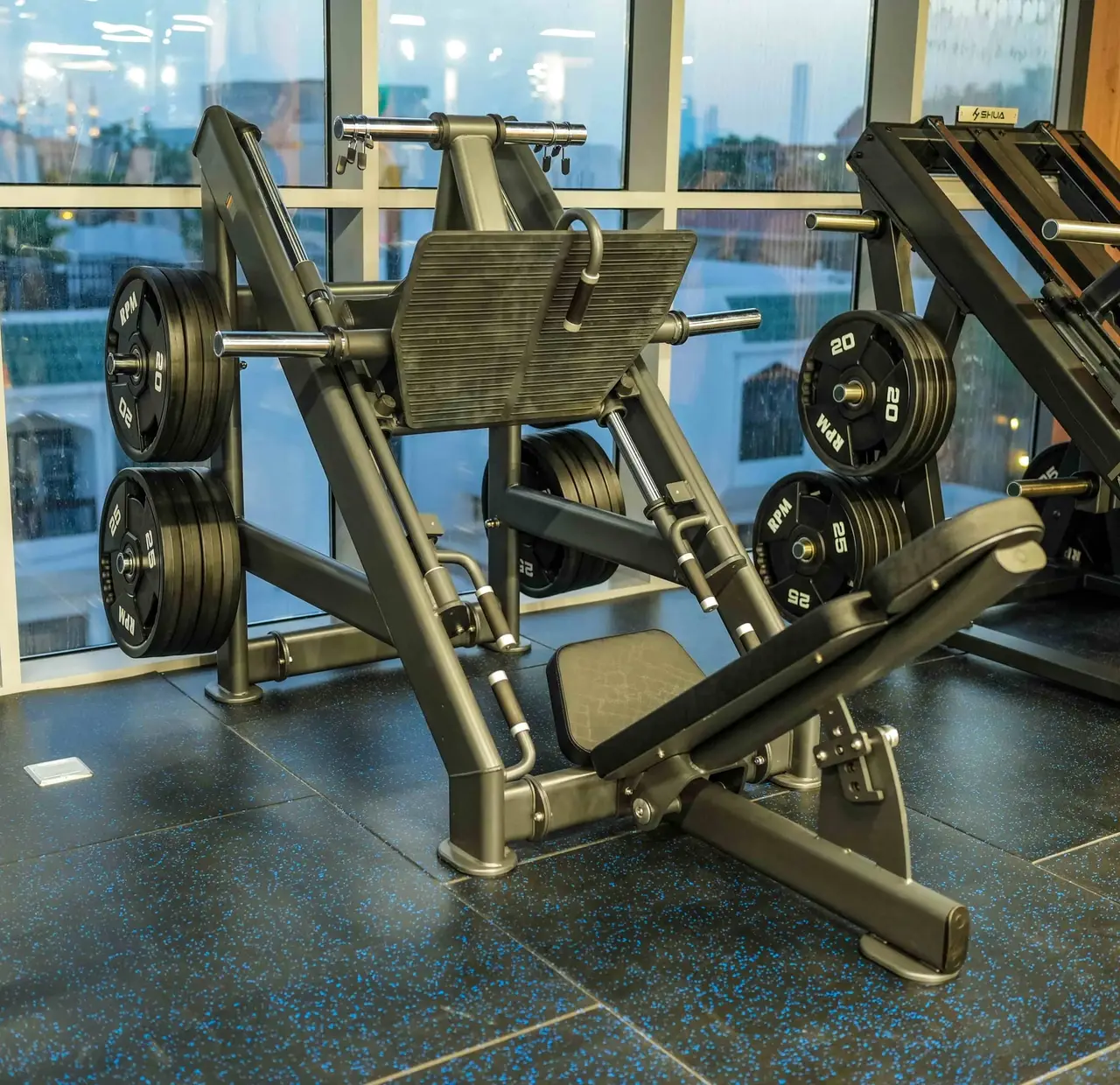
RPM's floor photos show a plate-loaded 45-degree leg press on the training floor in Al Manhal. The photos do not show a leg extension machine, so on your free guided tour ask which quad machines the floor has. A personal training session can set the seat and pads on both machines with you and pick your starting loads.
Sources
- Kinoshita M, Maeo S, Kobayashi Y, et al. Hypertrophic effects of single- versus multi-joint exercise: a direct comparison between knee extension and leg press. Medicine & Science in Sports & Exercise, 2026
- Ema R, Sakaguchi M, Akagi R, Kawakami Y. Unique activation of the quadriceps femoris during single- and multi-joint exercises. European Journal of Applied Physiology, 2016
Questions, answered.
Is the leg extension pointless if I already leg press?
No. In the 2026 study the leg press barely changed the rectus femoris, while the extension grew it clearly. The press covers most of the quads; the extension fills the gap.
Which one builds the teardrop above the knee?
That bulge is the vastus medialis, one of the vasti, and in the study both machines grew the vasti by similar amounts. Neither targets it on its own, so train through a full range on whichever you use.
Can I compare the weight I use on each?
No. The press moves far heavier loads because several large muscles share the work, and every machine's leverage differs, so track each one on its own terms.
Which is better for a beginner?
Both are beginner machines. Start with the press for whole-leg strength, add the extension once the press feels familiar, and set each one up as its own page describes.
How many sets of each should I do in a week?
Count both towards your quads. The quad training guide gives the common coaching range: roughly 6 to 10 hard sets a week when you are starting out and 10 to 20 once you have trained for a while; putting most of them on the press and a few on the extension covers the whole thigh.
Do I still need squats?
Not necessarily for muscle. Squats add balance, trunk work and the skill of the squat itself; the squat rack vs leg press guide weighs that trade-off.