Who a two-day week suits
Two sessions a week is not only a beginner's compromise. It is the right plan when the gym shares your week with something else: a sport, classes, running, long working weeks or young children. It also fits a maintenance phase, when the aim is to hold on to the strength and muscle you have through a busy season, and a return after months away, when two sessions give your joints and muscles days to readjust between visits.
For health, two days already meets the World Health Organization's minimum for muscle-strengthening work; the guide to strength training for general fitness builds a lighter health routine around that advice. This page is the complete gym version for any goal; the other weekly and goal plans sit in the workout plans library.
How to make two days count
With two sessions, each muscle is trained twice a week, so every set has to earn its place. Four rules do most of the work.
- Enough hard sets. The 2017 review by Schoenfeld and colleagues found that more weekly sets per muscle tend to bring more growth, up to a point. This plan gives each major muscle roughly five to eight hard sets a week, a workable starting range; the goal versions below add more where it matters.
- Longer sessions, not more of them. Seven exercises and about 18 working sets take 60 to 75 minutes. Rest fully on the first two lifts, because that is where most of your progress is made.
- No filler. Do not add a machine just because it is available. A set that ends far from hard, or a fourth exercise for one muscle while another gets nothing, is time the plan cannot spare.
- Two or three days between sessions. You arrive recovered, so most sets can finish a little closer to failure than they would on a four- or five-day plan.
Your two days on the calendar
Pick the pair of days you can protect every week. The gap between them matters more than which weekdays they are.
| Layout | Day 1 (squat-led) | Day 2 (deadlift-led) | Works well when |
|---|---|---|---|
| A | Monday | Thursday | Weekdays are regular and the weekend belongs to family or travel |
| B | Sunday | Wednesday | You play a match or do a long run on Friday or Saturday |
| C | Tuesday | Saturday | Saturday morning is the one slot you can always keep |
Missed a session? Do it at your next open slot and carry on from there. Squeezing both into consecutive days to catch up leaves the second one flat.
Open each session with a few easy minutes on a treadmill, cross-trainer or the upright bike, then three or four lighter ramp-up sets of the squat or deadlift. If your hips or shoulders feel stiff, the warm-up guide has a fuller routine.
Day 1: squat-led full body
Squat first while you are fresh, then a dumbbell press and row, a single-leg exercise and smaller work for the shoulders, triceps and trunk. If time runs short, do the last three as a circuit.
| Exercise | Sets | Reps | Rest | Notes |
|---|---|---|---|---|
| Back squat | 3 | 5–8 | 2–3 min | Main lift |
| Dumbbell bench press | 3 | 8–10 | 2 min | |
| Dumbbell row | 3 | 8–10 each side | 90 sec | One hand and knee on a flat bench |
| Bulgarian split squat | 2 | 8–10 each leg | 90 sec | Rear foot on a flat bench |
| Lateral raise | 2 | 12–15 | 60 sec | |
| Overhead tricep extension | 2 | 10–12 | 60 sec | Dumbbell or cable |
| Pallof press | 2 | 10 each side | 45 sec |
New to the barbell squat? Use a goblet squat for the first month and move to the bar once the pattern feels steady.
Day 2: deadlift-led full body
Deadlift first, then a standing barbell press and a pulldown, a step-up for each leg, a cable fly for the chest, a curl and a trunk exercise. The deadlift gets the longest rests; the rest of the session moves faster.
| Exercise | Sets | Reps | Rest | Notes |
|---|---|---|---|---|
| Deadlift | 3 | 4–6 | 3 min | Main lift: reset on the floor each rep |
| Overhead press | 3 | 6–8 | 2 min | Standing, barbell |
| Lat pulldown | 3 | 8–12 | 90 sec | |
| Step-ups | 2 | 8–10 each leg | 90 sec | Flat bench height or lower |
| Cable crossover | 2 | 12–15 | 60 sec | |
| Hammer curl | 2 | 10–12 | 60 sec | |
| Cable crunch | 2 | 10–15 | 45 sec |
If the deadlift is new to you, start with a dumbbell Romanian deadlift and learn the full lift with a coach. Sharp pain, or pain that lingers after the session, is a reason to drop that exercise and see a doctor or physiotherapist.
Effort and a 12-week progression
Log every weight and rep. Effort is counted in reps in reserve: how many more clean reps you had left when you stopped. With three or four days to recover before the next session, most sets can end with one or two in reserve once you know the movements, while the squat and deadlift stay at two so your technique holds.
Progress with double progression, the loading rule set out in the ACSM position stand: keep a weight until every set reaches the top of the rep range, then make the smallest jump the dumbbells or plates allow and start again from the bottom. The 3-day gym workout plan explains both ideas in more detail.
| Weeks | Sets per exercise | Reps in reserve | Focus |
|---|---|---|---|
| 1–3 | 2 on everything | 3 | Learn the lifts and find loads you can repeat |
| 4–7 | As written (2–3) | 2 | Add reps, then weight, session by session |
| 8–11 | One extra set on the squat, deadlift and both presses | 1–2 | Keep each session under 75 minutes |
| 12 | Half the sets at your current loads | 4 or more | An easier week before the next block |
Begin the next block at week 4 with your new weights. Replace an exercise only if it has stalled for three sessions in a row.
Versions for your goal
Same two days, same order. The rep ranges and the extras are what change.
For muscle gain
Leave the squat and deadlift as written. Everything after them works in the 8 to 12 range, and by week 8 the dumbbell press, dumbbell row and pulldown each get a third set. That takes the major muscles towards eight to ten hard sets a week. When the sessions grow too long to hold that, it is time for a third day.
For strength
Run the squat, deadlift and overhead press at 4 sets of 3 to 5 with three minutes' rest and keep everything else at two sets. Two heavy sessions a week leave long gaps for recovery, which suits heavy lifting well.
For fat loss or all-round fitness
The two lifting days stay as they are; walk or do easy cardio on two or three of the days in between. Lifting helps you keep muscle while your food intake drives fat loss, and the weight loss workout plan fits the cardio around your gym days.
When to move to three days
Stay on two days for as long as that is what your week allows; the plan keeps working for years. Move up when one of these is true:
- Your sessions keep running past 75 minutes because you have added sets.
- Most lifts have stalled for a month even though you sleep, eat and turn up.
- Your sport or classes have eased off and a third slot opens up most weeks.
The 3-day gym workout plan is the natural next step. If you are torn between two, three and four days, try How many days a week should I train?
Training two days a week at RPM
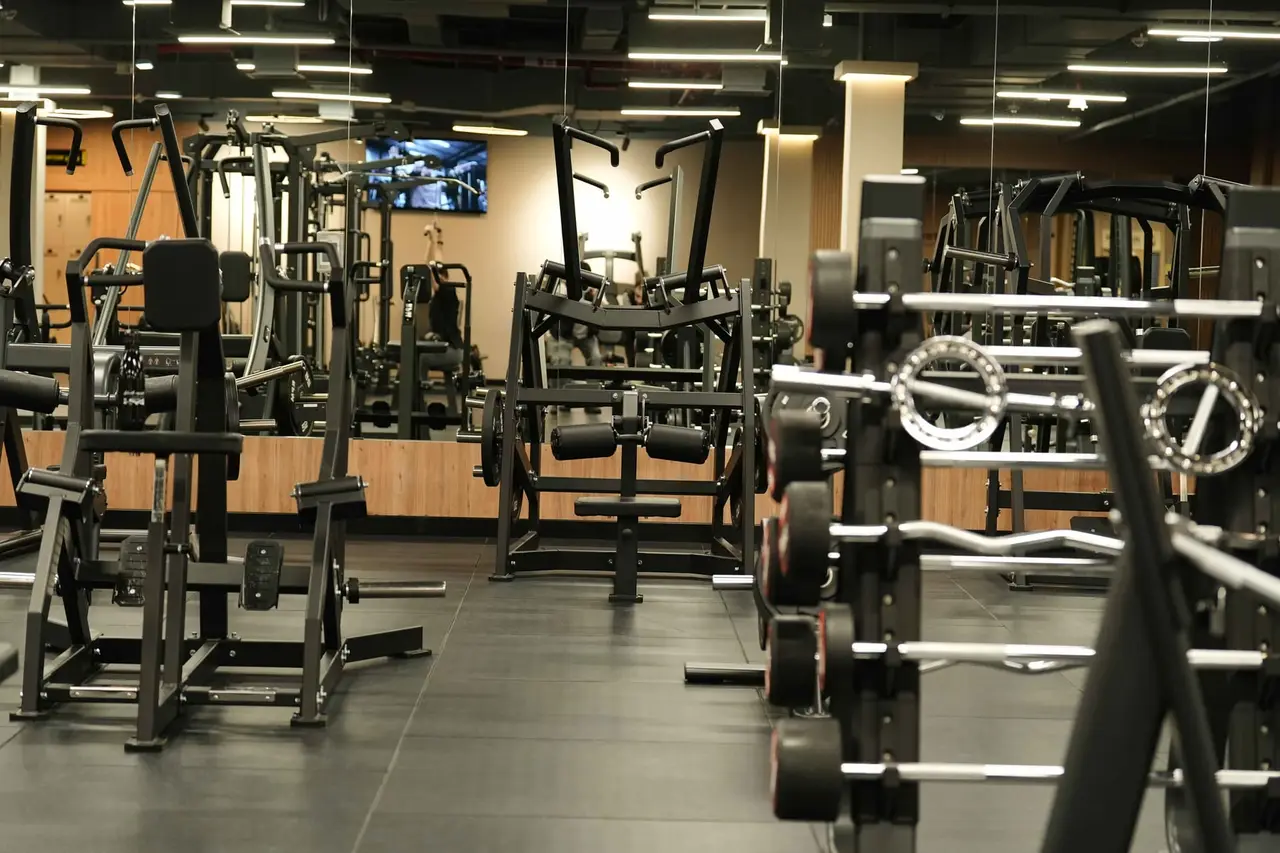
Every exercise in both sessions uses equipment RPM's own floor photos show: squat racks with barbells and colour bumper plates for the squat, deadlift and overhead press; flat benches and the dumbbell rack for the presses, rows, split squats and step-ups; and the cable towers for the pulldown, crossover, Pallof press and crunch. Come in for a free guided tour, and ask about personal training if you would like a coach to teach you the deadlift and set your first loads.
Sources
- World Health Organization, WHO guidelines on physical activity and sedentary behaviour (2020)
- American College of Sports Medicine, position stand: Progression models in resistance training for healthy adults (2009)
- Schoenfeld BJ, Ogborn D, Krieger JW. Dose-response relationship between weekly resistance training volume and increases in muscle mass: a systematic review and meta-analysis. Journal of Sports Sciences, 2017
Questions, answered.
Is a 2 day gym workout enough?
For most goals, yes, as long as both sessions happen every week and you keep adding weight or reps. Two full-body sessions train every muscle twice. What two days cannot do is hold as much weekly work as three or four, so lifters with years of training behind them usually need more days to keep building muscle.
Can I build muscle on a 2 day workout plan?
Yes. Two hard full-body sessions with enough sets and steady progression build muscle for beginners and keep intermediate lifters moving for a long time. Use the muscle-gain version above, eat enough overall, and judge it over months rather than weeks.
Should a 2 day split be upper/lower or full body?
Full body. One upper day and one lower day train each muscle only once a week, while two full-body days give every muscle two sessions, which is easier to progress on. The full body workout structure tool shapes the sessions around your days.
Does a 2 day full body plan work for runners?
Yes, and fitting lifting around running is one of the most common reasons to train twice. Put Day 2 at least two days before your long run or race, keep the split squats and step-ups, and drop to two sets on everything in your heaviest running weeks.
Is this plan different for women and men?
No. Women and men run the same sessions and progress the same way; choose loads you can lift with good form. The gym workout plan for women answers the questions women ask most.
Can I do it with dumbbells only?
Mostly. Swap the back squat for a goblet squat, the deadlift for a dumbbell Romanian deadlift, the overhead press for a seated dumbbell shoulder press and the pulldown for a second set of dumbbell rows. Strong legs eventually outgrow the dumbbells, which is when the barbell earns its place.