What the floor press trains, and why lifters use it
The muscles are the ones that work in any flat press: the chest drives the upper arms forward, the triceps straighten the elbows and the front of the shoulder helps. What the floor changes is the range. When your upper arms touch down, the weight is still a few centimetres above your chest, so the most stretched part of a bench press is gone and what remains is the middle and top, where the triceps do most of the work. Lifters whose bench press slows halfway up or at lockout often add it for that reason.
The pause matters as much as the range. Each rep ends with the elbows resting on the floor, so nothing rebounds and every press starts from a dead stop. People choose it when every bench is taken, for a heavy press over a shorter range, to train the top half of their bench press, or when the bottom of a full-range press does not feel right that day. It leaves out the stretched position that full-range presses train, so most programmes use it alongside a bench press, not instead of one. The chest training guide shows where it fits in a week.
Barbell floor press: setting up in the rack
- Lie inside a squat rack with your eyes roughly under the bar, as on a bench, so it leaves the hooks without being pressed round them.
- Set the hooks low: with straight arms, your hands should reach the bar with a few centimetres to spare, usually one of the lowest holes. If even the lowest setting is too high to unrack with a short push, use dumbbells.
- Set the safety arms just below where the bar sits when your upper arms rest on the floor, so a missed rep lands on them, not on your chest. Test with the empty bar.
- Legs straight on the floor take away almost all leg drive; knees bent with the feet flat feel steadier to many people. Either way, keep your hips down.
- Grip at your usual bench press width or a little narrower, thumbs wrapped, and pull your shoulder blades together and down into the floor.
- Start with the empty bar and add small steps. There is no fixed ratio to your bench press, so let the reps decide the load.
Dumbbell floor press: getting the weights into place
Dumbbells need no rack and give each arm its own path. The hard part, as on a bench, is getting heavy ones into position and back down without wrenching anything.
- Sit on the floor, knees bent, with a dumbbell standing on end on each thigh just above the knee.
- Hold them tight to your thighs and roll back in one movement, elbows bent and the dumbbells close to your body.
- As your shoulders reach the floor, rest your upper arms on it at about a 45-degree angle to your sides and press the dumbbells to straight arms. The first rep starts there.
- To finish, lower them to your chest, draw your knees up so the ends rest on your thighs, and rock up to sitting. Light dumbbells can be set down beside you from the bottom position, never from straight arms.
A neutral grip, palms facing each other, keeps the elbows nearer your sides and suits many lifters. One dumbbell at a time adds trunk work, because you have to stop yourself rolling towards it.
One rep, from lockout to the floor and back
- Start with the weight over your lower chest, arms straight and shoulder blades pinned to the floor.
- Lower over two to three seconds, elbows travelling at roughly a 45-degree angle to your body rather than straight out to the sides.
- Let the backs of your upper arms touch the floor softly: the last few centimetres are lowered, not dropped.
- Pause for about a second. The arms rest on the floor; your grip, upper back and trunk stay tight.
- Press back up in a straight line to lockout over your shoulders, and start the next rep from there.
Brace before you lower, hold the breath through the pause and the start of the press, and breathe out near the top. Elbows that thud into the floor mean the descent is too fast. A pinch or pain in the shoulder or elbow ends the set; if it keeps happening, speak to a doctor or physiotherapist before you press again.
Mistakes that cost you the point of the lift
| Mistake | What it looks like | The fix |
|---|---|---|
| Bouncing the elbows | The upper arms hit the floor and the rebound starts the press | Lower slowly and hold a full second on the floor |
| Elbows flared wide | Upper arms at right angles to the body and the bar drifting towards the neck | Bring the elbows in to about a 45-degree angle and lower to the lower chest |
| Hips bridging | The hips lift off the floor to help the hardest reps | Straighten the legs, or keep the feet flat and the glutes on the floor |
| Hooks set too high | Unracking takes a half-press and the bar swings out over your face | Move the hooks down until the bar sits just below straight arms |
| Relaxing in the pause | The shoulders roll forward and the bar sinks while you rest | Keep the shoulder blades pinned and the grip tight throughout |
Grip, legs, pause and other versions
Every version keeps the floor and the stop; what changes is which muscle gets the bigger share.
Close-grip floor press
Hands about shoulder width apart, elbows closer to your sides. The triceps take an even bigger share, and lifters use it to strengthen the lockout of their bench press. The close-grip bench press page covers the same grip on a bench, through a full range.
Legs straight or knees bent?
Straight legs remove nearly all leg drive and keep your lower back flat, so the upper body works most on its own; bent knees are easier to settle into. Pick one and keep it, so the weights you log stay comparable from week to week.
How long to pause
About a second is usual. Two or three seconds strip out more momentum and make the start harder. Pressing straight back up keeps the shorter range but loses the dead stop that sets this lift apart from a bench press.
No bench but want a full range? Try the push-up progressions, or the dumbbell chest exercises page for more no-bench options.
Who it suits, and when to pick something else
- It suits lifters chasing a stronger top half of the bench press, anyone with dumbbells and no bench to hand, and people who want the elbows to stop at body level.
- For chest size it partners full-range pressing rather than replacing it: keep a bench press or dumbbell bench press in the week.
- If getting down to the floor and up again is awkward, the chest press machine gives a guided press from a seat.
- If pressing hurts your shoulder or elbow, do not use the shorter range to press through it; speak to a doctor or physiotherapist first.
Sets, reps and progression
| Goal | Sets × reps | How hard |
|---|---|---|
| Learning the set-up | 2–3 × 8 | Empty bar or light dumbbells, a full second on the floor |
| Building muscle | 3–4 × 8–12 | Barbell or dumbbells, one or two reps left |
| Strength for the bench press | 3–5 × 3–6 | Barbell, heavy, the same pause on every rep |
Rest two to three minutes between heavy sets and about ninety seconds between lighter ones. The rest-between-sets calculator and the plate calculator help with rest and loading.
Once a week is enough for most people, after your main press or in its place for a block of four to six weeks. Add reps at the same load until every set reaches the top of its range, then add the smallest plates or the next pair of dumbbells. If the pause starts to shrink as the weight climbs, the load went up too quickly.
Floor pressing at RPM
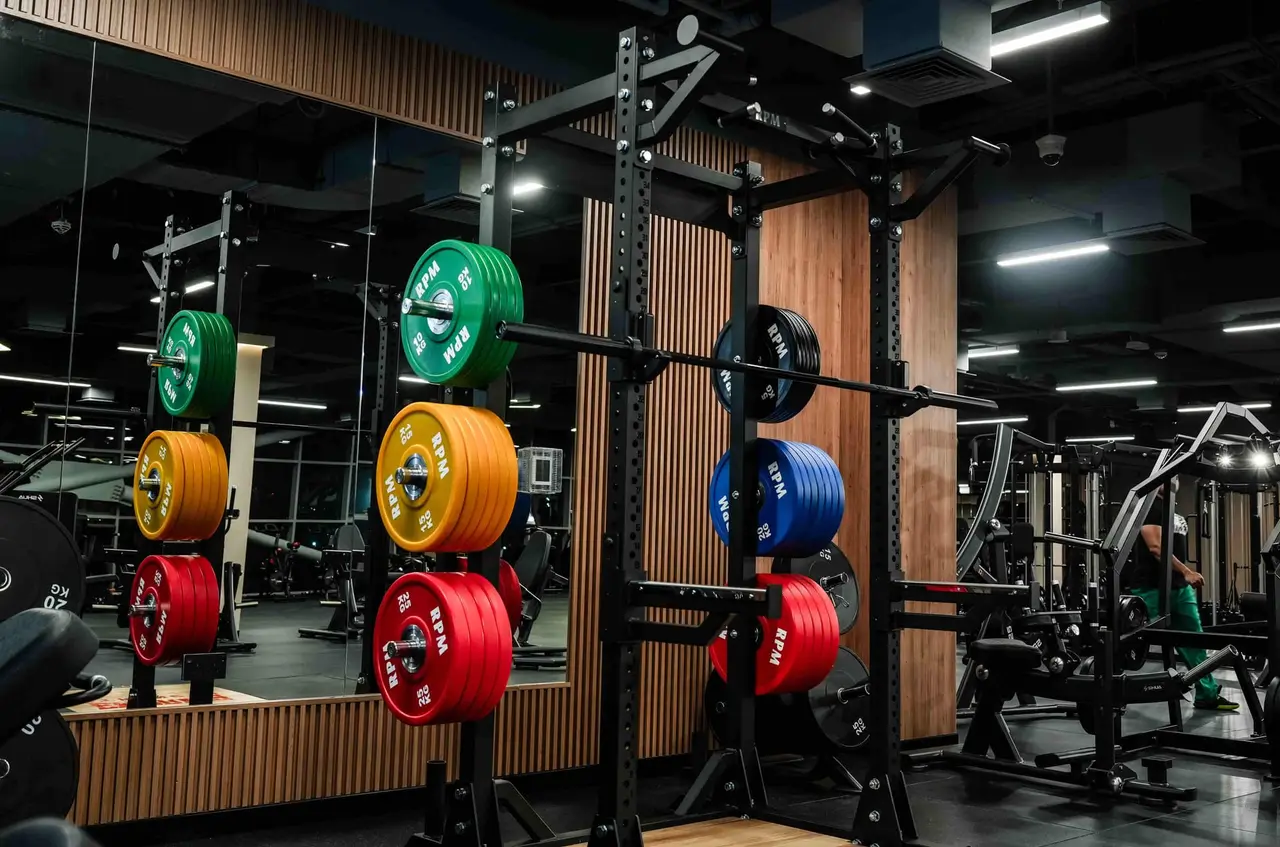
RPM's floor photos show squat racks with barbells and colour bumper plates, and a dumbbell rack, on the training floor in Al Manhal. Whether a rack's hooks and safety arms go low enough for a barbell floor press is worth checking on your free guided tour; the dumbbell version needs only a patch of floor. The power rack guide explains hooks and safety arms, and a personal training session can set your grip, elbow angle and pause.
Questions, answered.
What muscles does the floor press work?
The chest, the triceps and the front of the shoulders, as in any flat press. Because the floor takes out the deepest part of the rep, the triceps do a larger share than in a full bench press, and the chest works over a shorter range.
Floor press vs bench press: what is the difference?
The bench press lowers the bar to your chest through a full range, with your feet driving into the floor. The floor press stops when your upper arms touch down, pauses there and takes away most of the leg drive. Keep the bench press as your main chest lift and use the floor press for the top half, or when there is no bench.
Floor press or chest press machine?
The machine guides the path and lets you press from a seat through a longer range; the floor press makes you steady the load and adds a dead stop. Both suit beginners, and the machine is the easier choice if getting down to the floor is awkward.
Floor press or push-ups?
Push-ups train the same muscles through a full range with your bodyweight, but they are hard to load heavily. The floor press is easy to load and shorter. Many people use push-ups for higher reps and the floor press for heavier work.