Two ends folding to the middle: what the V-up trains
The V-up is a trunk curl and a hip fold at the same time. The rectus abdominis, down the front of your stomach, curls your ribs towards your pelvis with help from the obliques, while the hip flexors, the iliopsoas deep in the hip and the rectus femoris at the front of the thigh, raise your legs and pull the curled trunk up to meet them. Nothing anchors you. In a sit-up the feet stay down; in a lying leg raise the back stays down; in a V-up both ends leave the floor and you finish balanced on your seat. That makes it harder than either.
Your abs have two jobs: the curl you can see, and holding the pelvis steady while the hip flexors pull on it from the legs' side. That second job is hardest at the bottom of each rep, when your arms and legs are long and low and your lower back wants to peel off the mat. You also need enough hamstring flexibility to keep the legs straight; if yours stop you short, reach for your shins rather than your toes.
It needs only floor space, so it suits a core block after your main lifts or a conditioning circuit, but it is not a first core exercise: if you cannot yet do slow sit-ups and lower straight legs with your back down, start there. The core training guide shows where trunk-bending work sits beside holds and carries. If you are pregnant or postnatal, ask your doctor or midwife which core exercises suit you.
Lying long: the start position
- Lie on your back on a mat, legs straight and together, arms stretched overhead with your upper arms close to your ears.
- Tighten your thighs so the knees stay straight, and squeeze the legs together so they move as one lever.
- Breathe out and draw your ribs down until your lower back rests on the mat. If it arches as soon as your arms go overhead, let the hands hover above the floor instead.
- Lift your heels and hands an inch or two and keep the lower back down. This hover is the hollow hold position, and every rep starts and ends in it. Starting relaxed on the floor is easier, but you lose tension between reps.
- Check your space: your full length plus your arms, with nobody walking past.
One rep, from the hover to the V and back
- Breathe out and move both ends at once: the arms swing forwards as your chin, shoulders and upper back peel off the mat, and the straight legs rise.
- Fold at the hips so your chest and thighs travel towards each other. Lead with the chest; the arms follow rather than fling you up.
- At the top you balance on your seat, legs and trunk angled up to meet, hands reaching for your shins or toes. Pause for a moment.
- Lower both ends together over two to three seconds, unrolling the spine from the lower back upwards as the legs come down at the same speed.
- Stop in the hover with the lower back still down and start the next rep. If the back has lifted, touch down, reset your brace and go again.
Touching your toes is not the target: a V with your hands at your shins and straight legs beats a rounded scramble. The lowering is where the abs work hardest, so count it as half the rep, not a rest. The breathing and bracing guide covers the brace you reset at the bottom.
The V-up mistakes worth fixing
| Mistake | How you spot it | What to change |
|---|---|---|
| Jerking up | Arms flung, legs kicked, the rep over in half a second | Pause in the hover, then rise in about a second; if you need the swing, go back to tuck-ups |
| Rounding to reach the toes | The head dives, the shoulders hunch and the knees bend so the hands can touch the feet | Keep the thighs tight, reach for your shins and bring your chest towards your thighs |
| Crashing down | Back and legs drop to the mat with a thud | Two to three seconds down, unrolling from the lower back, and stop in the hover |
| One end doing all the work | The trunk sits up while the legs barely lift, or the other way round | Start both ends together, like a pocketknife closing at the hips |
| Back arching at the bottom | A gap opens under the lower back as the arms and legs go long | Hover with the hands and heels higher, or touch down between reps |
If you feel pain in your lower back or the front of your hips during V-ups, end the set and speak to a doctor or physiotherapist before you continue.
Building up to it: the V-sit, tuck-ups and single-leg V-ups
Each version shortens a lever or keeps one end on the floor. Work through them in order, and move on when the last rep of three sets looks like the first.
Bent-knee V-sit
Sit, lean back until you balance on your seat, and lift your feet so your shins are roughly level with the floor. Reach your arms forwards beside your knees and hold, chest up rather than slumped. It teaches the top of the V-up with no movement. Build to three holds of twenty to thirty seconds, then straighten the legs a little more each week.
Tuck-up
From the hover, curl your trunk up while you pull your knees towards your chest and reach your arms past your shins, then push the legs back out long as you lower. Bent knees keep the legs' weight close to your hips, so there is less to lift and the balance is easier. For most people this is the first moving version.
Single-leg V-up
Lie long with one leg on the floor, straight or bent with the foot flat, and lift the other straight leg to meet both hands as you curl up. Switch legs halfway through the set or alternate. The floor leg anchors your pelvis and halves the weight that moves, so you practise the straight-leg fold before taking both legs up.
Harder, once ten clean V-ups are easy
Slow the lowering to four seconds or pause at the top. Then hold a light dumbbell or medicine ball, or pass a medicine ball from your hands to your feet at the top and back again on the next rep, so each end carries it in turn. Add weight only when the bodyweight version has no swing.
If your hip flexors tire long before your stomach, the crunch keeps the curl and leaves them out.
How many V-ups, and where they go in a session
| Where you are | Sets × reps | What a good set looks like |
|---|---|---|
| Building up | 3 × 20–30-second V-sits, or 3 × 8–10 tuck-ups | Chest up at the top; legs back out long every rep |
| Single-leg V-ups | 3 × 6–8 each leg | A straight working leg; the floor leg stays down |
| Your first full V-ups | 3–4 × 4–6 | End the set at the first rep that needs a swing |
| Solid full V-ups | 3 × 8–12 | A slow lowering and the same shape on the last rep |
| Harder versions | 3 × 6–8 | A pause at the top, a four-second lowering or a light weight |
Rest forty-five to ninety seconds between sets. Five clean reps do more than fifteen swung ones.
Two or three core blocks a week suit most people. Put V-ups after your main lifts, so your trunk is fresh for squats and deadlifts, and pair them with an exercise for another job, such as a Pallof press or a side plank. In a timed circuit, switch to tuck-ups once your V-ups turn into jerks. Progress clean reps first, then a slower lowering, then load; past about fifteen easy reps, a harder version beats more reps.
V-ups at RPM
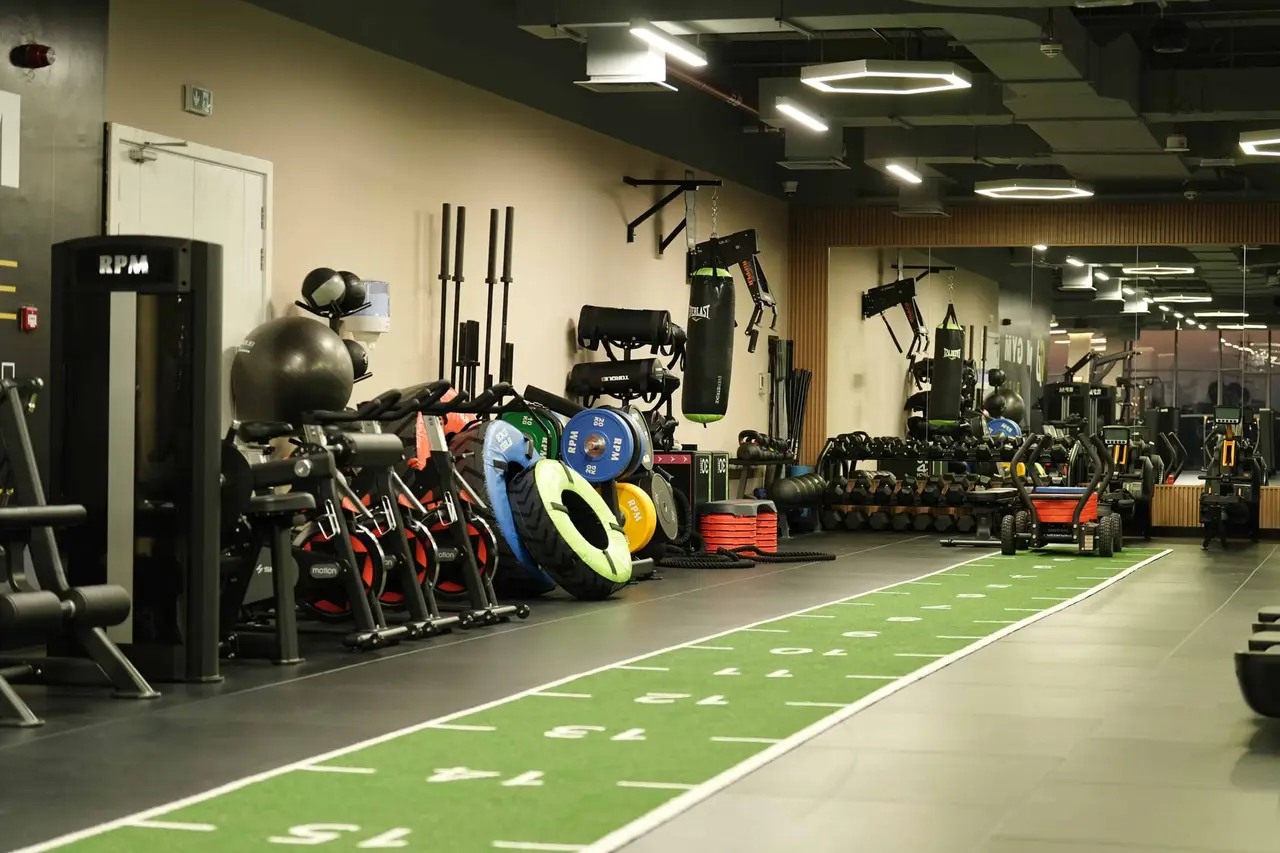
A V-up needs a mat and room to lie at full stretch with your arms overhead. RPM's floor photos show medicine balls and a dumbbell rack in the functional area for the weighted versions; on a free guided tour, ask whether mats are available and where floor work fits at your hour. For someone to watch your back at the bottom of each rep, book a personal training session, or ask for a female personal trainer.
Questions, answered.
What muscles do V-ups work?
The rectus abdominis curls the trunk and, with the obliques and the deep abdominal wall, holds the pelvis steady; the hip flexors lift the legs, so expect to feel the fronts of your hips too. V-ups do not burn fat from the stomach: how your waist looks depends on overall body fat.
V-ups vs sit-ups: which is harder?
The V-up. In a sit-up your feet stay on the floor and anchor you; a V-up moves both ends, adds the weight of your legs and leaves you balancing on your seat. If ten controlled sit-ups are not easy yet, start there.
V-ups vs leg raises: which should I do first?
Leg raises. They keep your back on the mat and teach you to hold the pelvis still while the legs move. Add V-ups, which put the trunk curl and the balance on top, once you can lower straight legs slowly without your back lifting.
What is the difference between V-ups and crunches?
A crunch is a short curl that stops when your shoulder blades leave the floor and leaves the hip flexors out. A V-up adds a full hip fold and lifts the legs, so it asks for more control and can take the crunch's place once you are ready.
Why can't I do a V-up?
Usually your abs cannot yet curl the trunk without help, cannot lift the legs and trunk together, or tight hamstrings bend your knees. Tuck-ups and bent-knee V-sits build the strength for the first two; reaching for your shins keeps the legs straight within the range you have.