Who five days suits, and when it is too many
Five sessions suit lifters with a year or more of steady training who enjoy being in the gym most days and want every muscle trained twice a week in sessions of about an hour. Splitting the work this way matches the ACSM position stand's description of advanced training: more sessions a week, each covering fewer muscles. It sits with the other weekly schedules in RPM's workout library.
It is not the only route to progress. Four days can hold almost the same weekly work, and plenty of people make steady gains on three. Drop to the 4-day gym workout plan if any of these keep happening:
- You miss one of the five sessions most weeks, so the week never runs as written.
- Your main lifts stall or slip for two blocks in a row, even with the lighter weeks.
- You sleep badly, feel flat most days, or start dreading sessions you normally enjoy.
- Work, family or a sport is taking the energy the fifth day needs.
The five days across the week
Pick either layout. What matters is the rest day between the two heavier sessions and the three volume sessions.
| Session | Layout A | Layout B | How hard |
|---|---|---|---|
| Upper (heavier) | Monday | Saturday | Hard: main lifts at 4 to 6 reps |
| Lower (heavier) | Tuesday | Sunday | Hard |
| Rest | Wednesday | Monday | A walk or nothing |
| Push | Thursday | Tuesday | Moderate: 6 to 20 reps, one or two in reserve |
| Pull | Friday | Wednesday | Moderate |
| Legs | Saturday | Thursday | Moderate |
| Rest | Sunday | Friday | Full rest |
The push pull legs split tool can rearrange the last three days around your diary, and the workout split calculator compares five-day layouts side by side.
This default has no conditioning day. If you want one, the simplest version is to run the four sessions of the 4-day gym workout plan and give the fifth slot to sled pushes, battle ropes or intervals on a spin bike: the kind of week the guide to training five days a week is built around.
The heavier days: upper and lower
These two sessions are where you push the load. Keep the main lifts heavy and everything after them brisk; neither session should run past about 65 minutes.
Upper (heavier)
Bench press and a heavy one-arm row first, then a seated dumbbell press, a close-grip bench press for the triceps and curls. This is the only day of the week the bench press goes heavy.
| Exercise | Sets | Reps | Rest | Notes |
|---|---|---|---|---|
| Bench press | 4 | 4–6 | 3 min | Main lift |
| Dumbbell row | 4 | 6–8 each side | 2 min | |
| Shoulder press | 3 | 6–8 | 2 min | Seated |
| Close grip bench press | 3 | 6–8 | 2 min | Hands just inside shoulder width |
| Bicep curl | 3 | 8–10 | 60 sec | EZ bar |
Dumbbell rows this heavy need a firm brace: one hand and knee on a flat bench, back flat, and no twisting to finish the rep.
Lower (heavier)
Squat heavy, then two heavy deadlift sets while you are still fresh enough to pull well, then step-ups, calves and an anti-rotation press for the trunk.
| Exercise | Sets | Reps | Rest | Notes |
|---|---|---|---|---|
| Back squat | 4 | 4–6 | 3 min | Main lift |
| Deadlift | 2 | 3–5 | 3 min | Heavy, two sets only |
| Step-ups | 3 | 8 each leg | 90 sec | |
| Calf raise | 4 | 8–12 | 60 sec | |
| Pallof press | 3 | 10 each side | 45 sec |
The deadlift sits second on purpose: two hard sets after squats are enough. If your lower back is tired from squatting, swap them for a moderate Romanian deadlift that day.
The volume days: push, pull and legs
The last three days add sets rather than load. Most sets end one or two reps short of failure, rests are shorter, and the exercises change angle from the heavier days so the same joints are not loaded the same way twice.
Push
The overhead press is the main lift, then an incline press, a fly and plenty of lateral raises, with triceps last.
| Exercise | Sets | Reps | Rest | Notes |
|---|---|---|---|---|
| Overhead press | 4 | 6–8 | 2–3 min | Main lift |
| Incline dumbbell press | 3 | 8–10 | 2 min | Needs an incline bench; flat dumbbell press if none |
| Dumbbell fly | 3 | 10–15 | 60 sec | |
| Lateral raise | 4 | 12–20 | 45 sec | |
| Skull crusher | 3 | 10–12 | 60 sec |
Lateral raises respond well to high reps and short rests; keep the weight light enough that your shoulders, not your traps, do the work.
Pull
A pulldown leads, then a cable row, a straight-arm pulldown to finish the lats, rear delts and biceps. No heavy hinge today: the back already had its heavy work on the Upper and Lower days.
| Exercise | Sets | Reps | Rest | Notes |
|---|---|---|---|---|
| Lat pulldown | 4 | 8–10 | 2 min | Main lift |
| Seated cable row | 3 | 10–12 | 90 sec | |
| Straight arm pulldown | 2 | 12–15 | 60 sec | |
| Rear delt fly | 3 | 12–15 | 60 sec | |
| Bicep curl | 3 | 10–12 | 60 sec | Cable or dumbbells this time |
Use different grips from the Upper day's row, wide on the pulldown and neutral on the cable row, to spread the work.
Legs
Front squat for the quads, Romanian deadlift for the hamstrings, then leg press, lateral lunges, calves and bicycle crunches. Moderate loads, real effort.
| Exercise | Sets | Reps | Rest | Notes |
|---|---|---|---|---|
| Front squat | 3 | 6–8 | 2–3 min | Main lift |
| Romanian deadlift | 3 | 8–10 | 2 min | |
| Leg press | 3 | 12–15 | 90 sec | |
| Lateral lunge | 2 | 10 each side | 60 sec | |
| Calf raise | 3 | 12–20 | 45 sec | |
| Bicycle crunch | 3 | 12 each side | 45 sec |
If a knee, hip or your back hurts sharply during a set, end the exercise there and see a doctor or physiotherapist before you load it again.
Recovery across five days
Five sessions leave two rest days, so recovery has to be planned rather than hoped for.
- Two hard days, three moderate. Upper and Lower are the only sessions where you chase heavier loads. On Push, Pull and Legs, add a rep or a set rather than big jumps in weight.
- Rest days stay light. Wednesday and Sunday are for walking, easy stretching or nothing structured. Sport played on those days is training too, so if you play, take one lifting session out of that week.
- Sleep comes first. A short night before a heavy day is a reason to move the session or lower the loads, not to grind through it.
- Spread the hard sets. No muscle is trained hard two days running: the rest day after Lower and the push, pull, legs order keep two or more days between the hard sessions for each muscle.
- Plan the lighter week. Every block ends with one, so you never have to wait until you feel run down.
- Watch the trend, not one bad day. If your lifts drop for a fortnight, take the lighter week early; if you feel unwell or have pain that does not settle, see a doctor.
Effort and progression
Use reps in reserve and double progression as set out in the 3-day gym workout plan: stay on a load until every set reaches the top of its range, then go up by the smallest step. Heavier days end with two reps in reserve, volume days with one or two.
| Weeks | Upper and Lower (heavier) | Push, Pull and Legs (volume) |
|---|---|---|
| 1–2 | Three sets on the main lifts, at loads you could lift about 8 times | Two sets per exercise while you learn the rhythm |
| 3–7 | Sets as written; add load when every set reaches 6 reps | Sets as written; add reps, then load |
| 8–11 | Add load more slowly and hold your technique | One extra set on the first two exercises of each day if you are recovering well |
| 12 | Lighter week: half the sets at your week-8 loads | Lighter week: two easy sets of each exercise |
For weekly sets, the 2017 Schoenfeld review is a useful guide: more sets per muscle tend to bring more growth up to a point, so add them slowly and stop adding when recovery suffers. By week 8 the chest, back and quads here get roughly 10 to 15 hard sets a week; the arms, shoulders and hamstrings get fewer direct sets because they also work hard in the compound lifts.
Bro split, Arnold split, PHAT and German volume training
Five-day splits come with plenty of names, and each of these suits someone. The hybrid is the default here because it trains every muscle twice a week in sessions of about an hour.
The bro split (one muscle group a day)
Chest on one day, back the next, then shoulders, legs and arms. Each muscle gets one long session a week followed by six days off. It suits people who enjoy focusing on one area with lots of exercise variety, and it works when the sessions are genuinely hard. The drawback is frequency: training each muscle twice a week tends to make progress steadier, and the hybrid does that with the same five days.
The Arnold split
Chest and back together, shoulders and arms together, then legs, with the cycle repeated: six days in its original form, so a five-day version rotates the three sessions through your five slots and the week keeps shifting. It pairs opposing muscles in long, demanding sessions and suits experienced lifters who recover well. If you want its rhythm, the 6-day gym workout plan is closer to it.
PHAT
Power hypertrophy adaptive training: two power days (upper and lower) followed by three hypertrophy days split by body part, usually back and shoulders, legs, then chest and arms, with speed sets of the big lifts. This plan uses the same skeleton, two heavier days then three volume days, with shorter sessions and no speed work. It suits intermediate lifters who want strength and size together; PHAT itself is longer and harder to recover from.
German volume training
Ten sets of ten on one or two big lifts per session with short rests, at a load you could lift about twenty times when fresh. It is a short block of four to six weeks aimed at size, not a long-term five-day plan, and it is hard on the joints and on recovery. If you want to try it, apply it to the first exercise of the Push, Pull and Legs days only, cut the accessories to one or two, and leave Upper and Lower as written.
Five days at RPM
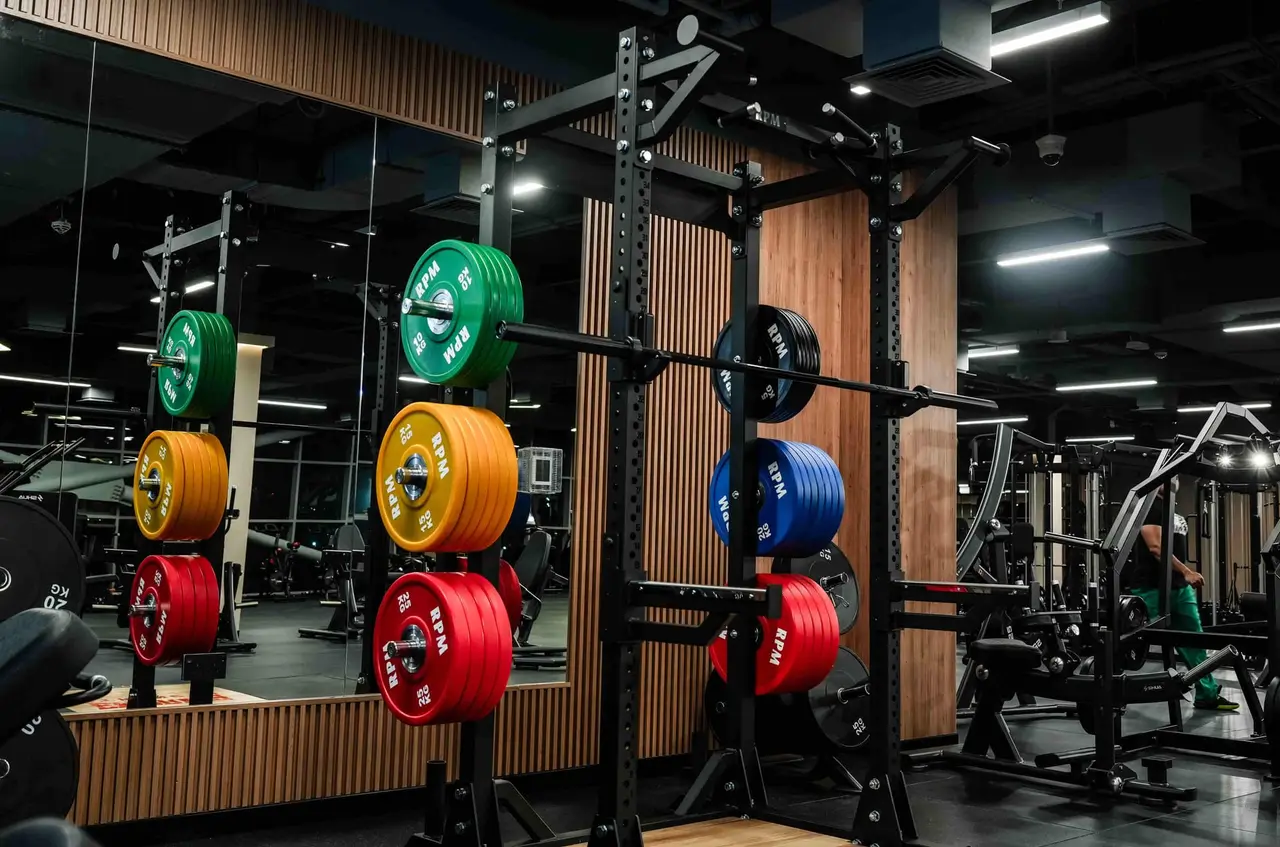
RPM's floor photos cover almost everything in this plan: racks, barbells and colour bumper plates for the squat, front squat, deadlift and bench press; flat benches and the dumbbell rack; the cable towers for the pulldown, cable row, straight-arm pulldown and rear delt work; and the plate-loaded leg press. An incline bench is not confirmed in the photos, so ask about one on a free guided tour and stick with the flat dumbbell press until you have seen it. For the conditioning variant, use the sled on the functional area's turf lane, the battle ropes or the row of spin bikes. If you would like your heavy days checked by a coach, ask about personal training.
Sources
- American College of Sports Medicine, position stand: Progression models in resistance training for healthy adults (2009)
- Schoenfeld BJ, Ogborn D, Krieger JW. Dose-response relationship between weekly resistance training volume and increases in muscle mass: a systematic review and meta-analysis. Journal of Sports Sciences, 2017
Questions, answered.
Is a 5 day split good for muscle growth?
It can be, mainly because it fits more weekly sets into sessions of about an hour. The fifth day is not what builds muscle: enough hard sets and steady progression are, and four days can provide those too. Choose five if you enjoy it and recover well.
Is a 5 day gym workout schedule OK for beginners?
Five days is more than most beginners need. Newer lifters progress well on two or three full-body sessions and recover better with more rest; start with the 3-day gym workout plan and add days once your progress slows.
Is this 5 day split suitable for women?
Yes. Women and men follow the same sessions and the same progression; choose loads you can lift with good form. If you are just starting out, the gym workout plan for women is a better first step.
Can a 5 day workout plan help with weight loss?
Lifting five days helps you keep muscle and strength while you lose fat, but what you eat decides whether the scale moves. Keep the sessions as written and add daily walking; the weight loss workout plan arranges cardio around your lifting.
Can I do a 5 day workout plan with dumbbells only?
Partly. Dumbbells cover the presses, rows, flyes, lunges, step-ups and Romanian deadlifts, but the heavier days lose most of their point without a barbell for the squat, deadlift and bench press. If dumbbells are all you have, four sessions with higher reps usually make more sense than five.