What the Zercher squat trains, and why lifters use it
The bar sits lower and further forward than in any other barbell squat: in the bend of the elbows, roughly level with the bottom of the ribcage. The legs do the usual job, quads straightening the knees, glutes and adductors opening the hips out of the bottom. What changes is above the hips. The load hangs in front of you, so the upper back stays rigid and the trunk braces hard to stop you folding over it, while the biceps and forearms hold the bar for the whole set. The lift is usually credited to Ed Zercher, an American strongman, and it still appears in strongman training.
Lifters choose it for two reasons. It keeps the torso upright, as a front squat does, without the front rack, so wrist and shoulder mobility do not limit it. It trains the brace and upper back against a load pulling you forward, which carries over to lifting anything held in front of you. It is not a first squat: learn the goblet squat and a barbell squat first. The leg exercises guide shows where it sits in a week.
The bar presses into the soft inside of the elbow, which most people find uncomfortable at first. Pressure is expected; sharp or lasting pain in the elbow, or pain anywhere else, is not: stop, and speak to a doctor or physiotherapist before you load it again.
Setting the rack and the bar
- Set the hooks a little below the crook of your elbows when you stand with upper arms by your sides and forearms level, around the bottom of the ribs for most people. You should unrack with a short knee bend, not a half squat.
- Set the safety arms just below the lowest point the bar reaches in your deepest squat. That is lower than you might expect, because the bar starts at waist height and travels all the way down with you.
- Step in, bend your knees slightly and slide your forearms under the bar until it sits deep in the bend of both elbows. Clasp your hands or make two fists, palms facing you, in front of your chest.
- Squeeze your upper arms against your ribs so the bar is pinned to your body, brace, and stand to lift it off the hooks. Take two short steps back, feet a little wider than shoulder width, toes slightly out.
- Start with the empty bar. Your working weight will be well below your back squat, and the hold, not the legs, tells you when to stop adding plates.
Squatting a rep with the bar in your elbows
- Breathe into your belly and brace before you move: here the brace is what stops the bar dragging your chest down.
- Sit down between your heels, knees travelling forward and out over your toes. Keep your hands up and the bar tight to you; if the hands drift down, the bar rolls towards them.
- Stay as upright as you can while the elbows travel down between your knees. Go as deep as you can with a flat back and heels down, often until the elbows come close to the inside of the thighs.
- Drive up by pushing the floor away and lifting chest and elbows together, so hips and shoulders rise at the same rate.
- Breathe out at the top, settle the bar back into the elbows if it has slipped, and brace again. To finish, walk into the rack and lower the bar onto the hooks with a slight knee bend.
Do not rest the elbows on your thighs at the bottom or bounce off them: that is where the back rounds and the bar slips. If you miss a rep, sit down until the bar rests on the safety arms and step out from under it.
Zercher squat mistakes
| Mistake | What it looks like | The fix |
|---|---|---|
| Hands dropping | The forearms tilt down and the bar slides out of the elbows towards the wrists | Keep the hands at chest height and the forearms close to vertical |
| Upper back rounding | The chest folds over the bar as you descend or start to stand | Brace harder, lighten the load and lead the way up with your chest |
| Bar drifting away from the body | A gap opens between the bar and your stomach and the bar feels far heavier | Squeeze the upper arms in so the bar stays pinned against you |
| Elbows bouncing off the thighs | The arms land on the legs at the bottom and the rep rebounds | Stop just before contact, or touch lightly and pause |
| Stance too narrow | The elbows hit the knees long before full depth | Widen the feet a little and turn the toes out to make room |
Zercher vs front squat vs back squat
| What changes | Zercher squat | Front squat | Back squat |
|---|---|---|---|
| Where the bar sits | In the crook of the elbows | Across the front of the shoulders | Across the upper back |
| Torso | Upright | Upright | Leans forward more |
| What usually gives out first | The arm hold and upper back | The rack position and upper back | The legs and hips |
| Mobility it asks for | Hips and ankles | Wrists, shoulders and upper back, plus ankles | Shoulders to hold the bar, plus hips and ankles |
| Typical load | Well below the back squat; versus the front squat it varies by lifter | Below the back squat | The heaviest |
Choose by need: the back squat to move the most weight, the front squat if you train the Olympic lifts, the Zercher squat for an upright squat without a front rack or extra work for the brace. The front squat vs back squat comparison covers the other two in depth.
Variations: from the pins, to a box, and on one leg
Zercher squat from the pins
Set the safety pins at the bar's height in your bottom position, squat down, cradle the bar and stand from a dead stop. With no rebound it is harder at a lighter load, it teaches you to brace before the hardest part, and you never unrack a heavy bar at waist height.
Box Zercher squat
Sit back to a stable box set at your target depth, touch down without relaxing, then stand. The box gives the same depth every rep and keeps the elbows off the thighs, a good way to learn the lift.
Zercher lunges and carries
Away from the rack, the same hold works for reverse lunges and split squats with far less weight. Strongman training also carries the bar this way; ask the team where there is room before you walk a loaded bar across a busy gym.
If your elbows will not tolerate the bar yet, a goblet squat with a heavy dumbbell gives the same upright, front-loaded pattern.
Who it suits, and who should choose another squat
- It suits intermediate lifters who squat to good depth and want an upright barbell squat, lifters whose front rack is not working yet, and anyone training for strongman-style lifts.
- Choose another squat if the elbow pressure does not ease after a few light sessions: the goblet squat and front squat keep the upright pattern with a different hold.
- To move the most weight with your legs, the back squat or the leg press loads them more, because the arms are not the weak link.
- New to squatting? Start with the goblet squat; the Zercher asks for a confident brace first.
Sets, reps and progression
| Goal | Sets × reps | How hard |
|---|---|---|
| Learning the hold | 3 × 5 | Empty bar or light plates; pause one second at the bottom |
| Strength | 4–5 × 3–5 | Stop with two reps left; every rep to the same depth |
| Building muscle | 3–4 × 6–8 | One or two reps left; beyond about eight reps the arms and upper back usually tire before the legs |
Rest two to three minutes between work sets; the rest-between-sets calculator gives a starting range.
Use it as the main squat for a few weeks, or as a lighter second squat after back squats or deadlifts. Once a week is plenty; when you add it, cut a set or two of another squat rather than stacking it on top. Add the smallest plates when every rep looks the same; if your hands start to drop or your back rounds, stay at that weight until the reps look clean again. Log it as its own lift, not a percentage of your back squat.
Zercher squats at RPM
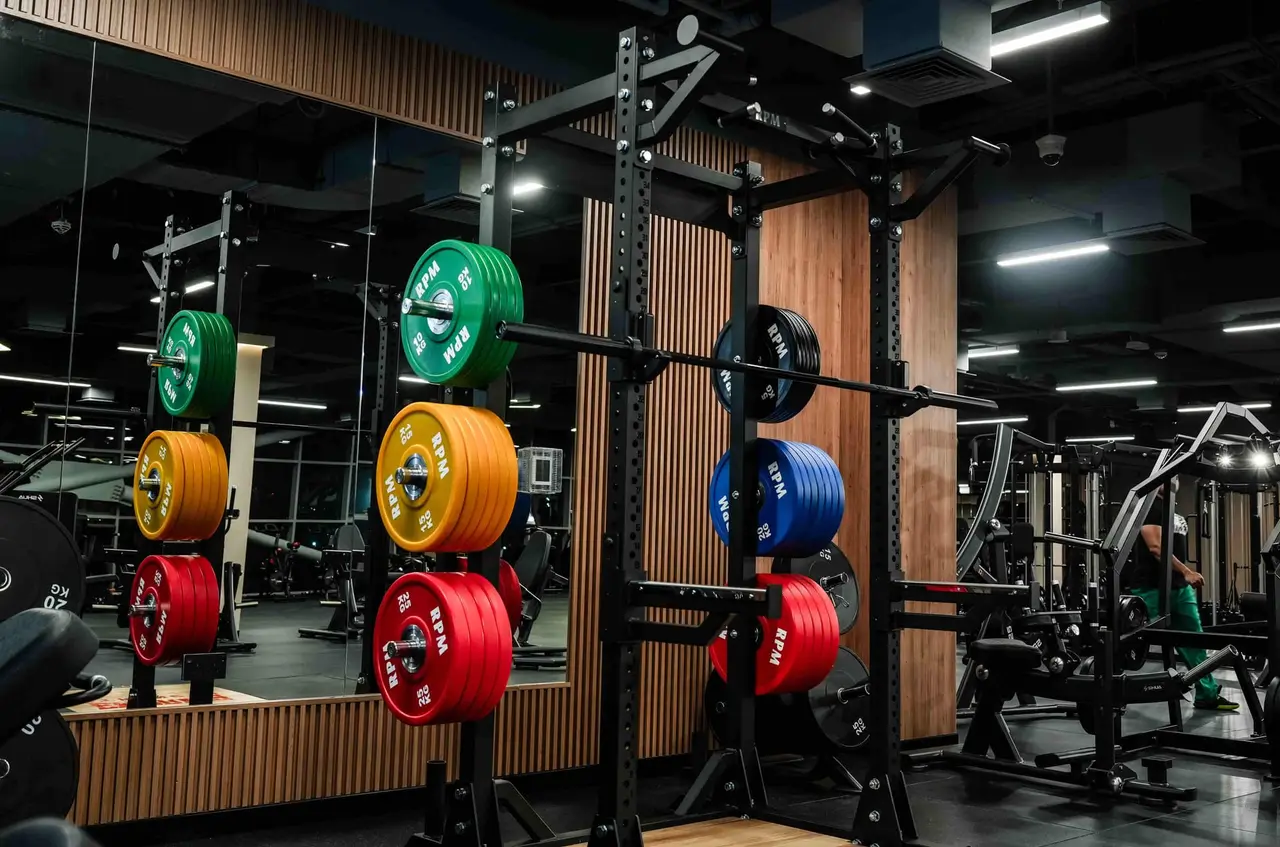
RPM's floor photos show squat racks with barbells and colour bumper plates. A bar pad is not in the photos, so ask on your free guided tour if you would like one; long sleeves do much of the same job. The squat rack guide covers setting the hooks and safety arms, and a personal training session is a quick way to find the hook height and hand position that work for you.
Questions, answered.
What muscles does the Zercher squat work?
The quads, glutes and inner thighs move the load. The upper back, the muscles along the spine and the trunk hold you upright against the bar, and the biceps and forearms hold it in the elbows.
Is the Zercher squat better than the front squat?
Neither is better in general. Both keep you upright; the Zercher swaps the front rack for an elbow hold, which suits lifters without a comfortable front rack yet, while the front squat matters more for the Olympic lifts.
How do I make the bar more comfortable in my elbows?
Wear long sleeves, keep the bar deep in the bend of the elbow rather than on the forearm, and build the load over several sessions so the pressure becomes familiar. A thin bar pad helps some people. If it is pain rather than pressure, stop and have it checked by a doctor or physiotherapist.
Zercher squat vs back squat: which is heavier?
The back squat. With the bar on your upper back only the legs and hips limit the load, whereas in the Zercher squat the arm hold and upper back usually give out first. Keep them as separate lifts with separate numbers.