Where an upper-body day fits in your week
An upper-body day suits anyone who splits training into upper and lower halves. The usual pattern is four days a week, two of each, which is how the 4-day gym workout plan is built. On three days, rotate upper, lower and upper one week, then lower, upper and lower the next. Pair it with the lower body gym workout, and leave at least a day between two upper sessions so your shoulders and elbows get a rest.
It sits among the single sessions in the workout plans library: a page to open on the gym floor when today is an upper day. Because it covers chest, back, shoulders and arms at once, it does not go deep on any one of them. For that, see the guides to training your chest and training your back, and the shoulder exercises hub.
How the session is ordered
Four rules decide the order, and both versions follow them.
- Big lifts first. The heaviest press and the heaviest pull open the session while you are fresh, because they move the most weight and need the most skill.
- A pull for every push. Pressing is the part most people enjoy, so it is easy to do twice as much of it. Matching the sets keeps the upper back and rear shoulders working as hard as the chest and front shoulders.
- Shoulders in the middle. The overhead press or lateral raises come after the big lifts and before the arms, when the shoulders are warm but not yet worn out.
- Arms last. Biceps and triceps help in every row and press, so training them early would cut short the lifts that matter more.
Version 1: free weights
Barbell, dumbbells and a flat bench, done as straight sets: finish every set of one exercise before you start the next. Warm up with a few minutes of easy cardio, then two lighter bench press sets that build to your working weight; the warm-up guide has a fuller routine.
| Exercise | Sets | Reps | Rest | Notes |
|---|---|---|---|---|
| Bench press | 3 | 6–8 | 2–3 min | Main push |
| Bent over row | 3 | 8–10 | 2 min | Main pull: torso still, bar to the lower ribs |
| Shoulder press | 3 | 8–10 | 90 sec | Dumbbells, seated on a flat bench |
| Dumbbell pullover | 3 | 10–12 | 90 sec | A vertical pull without a bar or cable |
| Skull crusher | 2 | 10–12 | 60 sec | EZ bar, lowered slowly to the forehead |
| Hammer curl | 2 | 10–12 | 60 sec | Neutral grip |
Three pushes and three pulls, sixteen working sets. Short of time? Alternate sets of the skull crusher and the hammer curl instead of doing them one after the other. If the benches and barbells are all taken, a dumbbell bench press and a one-arm dumbbell row do the same jobs.
Version 2: machines and cables
The same balance on the cable towers and a chest press, done in pairs: one set of the push, one set of the pull, rest, and repeat until the pair's sets are done. One side recovers while the other works, so eight exercises fit in under an hour. The cable machine page explains the attachments and pulley heights.
| Exercise | Sets | Reps | Rest | Notes |
|---|---|---|---|---|
| Chest press machine | 3 | 8–12 | 30 sec | Pair 1. Not in RPM's photos: dumbbell bench press |
| Lat pulldown | 3 | 8–12 | 90 sec | Pair 1 |
| Cable crossover | 2 | 12–15 | 30 sec | Pair 2. Pulleys at shoulder height |
| Seated cable row | 2 | 10–12 | 90 sec | Pair 2 |
| Lateral raise | 2 | 12–15 | 30 sec | Pair 3. Cable, one arm at a time |
| Face pull | 2 | 15–20 | 60 sec | Pair 3. Rope at forehead height |
| Tricep pushdown | 2 | 10–15 | 30 sec | Pair 4 |
| Bicep curl | 2 | 10–15 | 60 sec | Pair 4. Cable, low pulley |
Eighteen sets: nine for the chest, front and side shoulders and triceps, nine for the back, rear shoulders and biceps. The short rest inside each pair is only the walk between stations; the longer one comes after the pull.
Beginner and intermediate versions
| What changes | Beginner | Intermediate |
|---|---|---|
| Which version | Version 2 for the first month, then one free-weight lift at a time | Either; many people do one of each every week |
| Sets | Two of every exercise | As written, with a fourth set on the first two lifts if you recover well |
| Reps | The top of each range, with a lighter weight | As written; on the heavier of two weekly sessions, 5–6 reps on the first two lifts |
| Effort | Stop with three reps left | Stop with one or two left |
| How often | Once or twice a week | Twice, at least two days apart |
Not sure how many reps you had left? The RPE calculator turns that feeling into a number you can log.
Progress the same way in both versions: reps first, then weight. When all your sets reach the top number, move to the next dumbbell, plate or pin and rebuild the reps from the low end. The American College of Sports Medicine's position stand on progression describes this rule, and it works on a cable stack as well as on a barbell.
Mistakes that waste an upper-body day
| Mistake | What it costs | Fix |
|---|---|---|
| Three chest exercises and one row | The upper back and rear shoulders fall behind | Count sets: one pull for every push |
| Curls and pushdowns first because they are quick | Tired arms cut short the presses and rows | Arm work goes last |
| Heaving the bent-over row | The hips and lower back move the bar, not the upper back | A lighter bar, torso still, a pause at the top |
| Every set to failure | Shoulders and elbows ache and the next session suffers | Keep one or two reps in hand on most sets |
| A new session every week | You cannot tell whether you are getting stronger | Run the same version for six to eight weeks and log it |
| Pressing through shoulder pain | A small problem can become a long one | Stop the exercise and get it checked by a doctor or physiotherapist |
Women, men, dumbbells or machines
The searches differ; the session barely does.
Upper body workout for women
Use either version as written. Women and men build upper-body strength through the same exercises, and the starting weight is the only real difference. Many women begin on Version 2 because the machines are quick to learn; the gym workout plan for women fits upper and lower work into a three-day beginner week.
Upper body workout for men
Also the same session. If more size is the goal, run Version 1, add a third set to both arm exercises once recovery is good, and look at the muscle building gym program, which counts weekly sets per muscle.
Upper body workout with dumbbells only
Take Version 1 and swap the barbell lifts: a dumbbell bench press for the bench press and a one-arm dumbbell row for the bent-over row, with dumbbells on the skull crusher too. Each arm works on its own, so expect lighter loads than with a bar. A flat bench is the only other kit you need.
Upper body workout on machines
Version 2 is that session. The one station to check is the chest press: where there is none, a dumbbell press or a standing cable press fills the slot. The machine-only workout is a full-body beginner plan built entirely on machines and cables.
This session at RPM
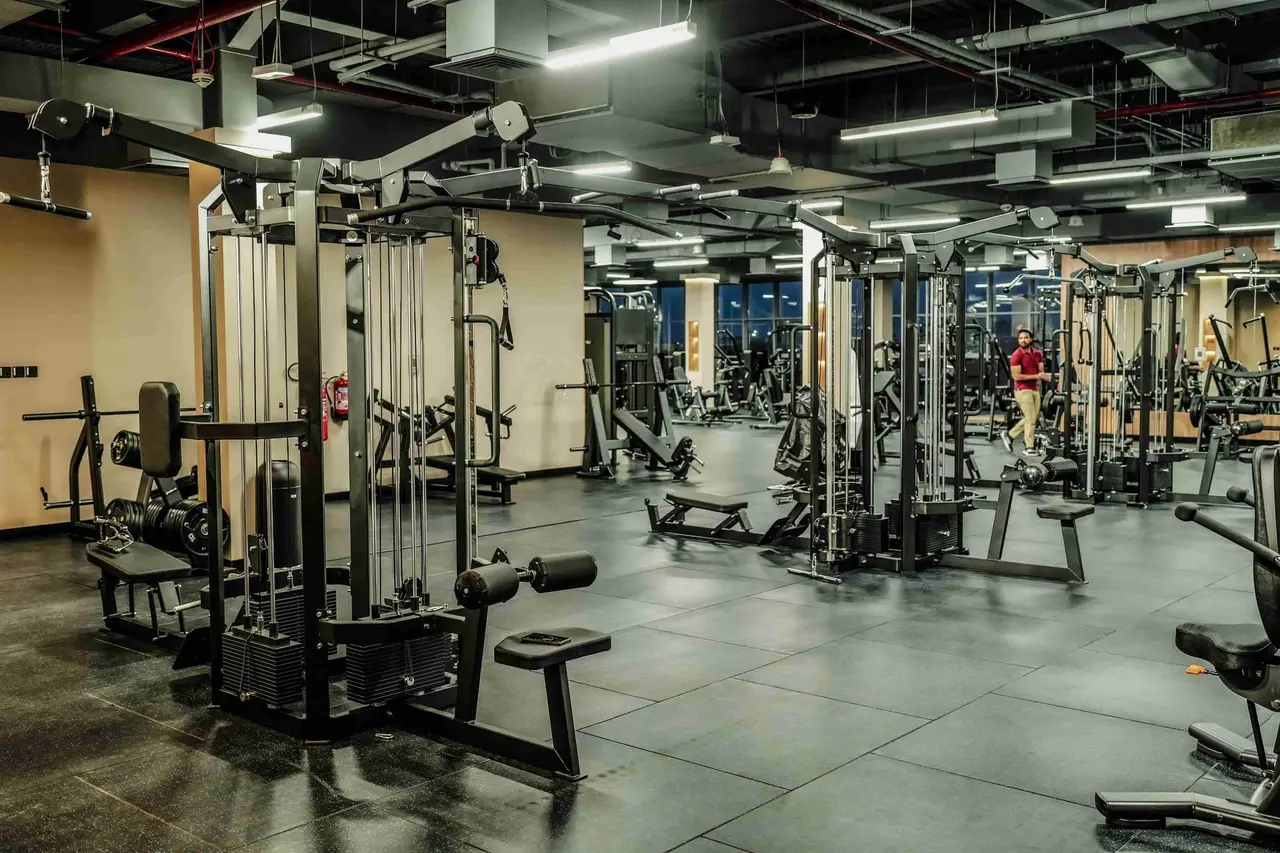
Version 1 uses equipment that RPM's floor photos show: barbells and squat racks, the rack of fixed barbells with its EZ bars, the dumbbell rack and flat benches. Version 2 runs on the cable towers and their pulldown seat. A chest press machine is not in those photos, so ask on the free guided tour whether there is one, and which stations the women-only Ladies section has. To have a coach choose your starting weights, ask about personal training.
Sources
Questions, answered.
How many exercises should an upper body workout have?
Six to eight. Two big presses and two big pulls do most of the work, and two to four smaller exercises cover the shoulders and arms. More than that usually means fewer hard sets where they count, or a session that runs well past an hour.
How often should I train upper body?
Twice a week suits most people, with two or three days between the sessions, so each muscle is trained twice. The upper/lower split calculator lays out a week around the days you can train.
Can I train upper body two days in a row?
It is better not to. The same muscles and joints need time to recover between hard sessions, so put a lower-body day or a rest day in between.
How long should an upper body workout take?
About 45 to 60 minutes with the warm-up. Version 2 is usually quicker because the pairs keep rest short. With only half an hour, do the first four exercises of either version, or pick one of the short gym workouts.
Can I do an upper body workout at home?
Partly. Push-ups and their harder versions train the chest, shoulders and triceps anywhere, and the push-up guide builds up to them. Pulling is the hard part without a bar, bands or dumbbells, which is why this session is written for a gym.