Why pair the chest with the back
The chest pushes the arms forward; the lats and upper back pull them back. A press and a row therefore work opposing muscles, and while one side rests, the other can do its set. That is why chest and back suit alternating sets in a way that chest and triceps do not: on a chest and triceps day the triceps help finish every press, so the two tire together.
The research is encouraging, with limits. A 2010 review by Robbins and colleagues of agonist-antagonist paired-set training concluded that its value for an immediate performance boost is limited, but that it may hold merit as a time-efficient way to develop strength and power. In a 2017 study by Paz and colleagues, 15 trained men did three sets of bench press and three of wide-grip seated row with a ten-rep-max load, either one exercise after the other or alternated. Alternating produced more total work in less time, and more fatigue in the muscles measured. Both describe single sessions in small groups of trained men; neither shows that pairing builds more muscle over months.
The other common grouping, the chest and triceps workout with the back and biceps workout, trains muscles that help each other. Chest and back trains opposing ones and leaves the arms for a day of their own. Every session and plan is in the workout plans library.
Paired sets or supersets: how long to rest
A paired set keeps a short rest between the two exercises; a superset runs them back to back and rests after both. A 2020 study by Zhao and colleagues compared the two in 11 recreationally trained men doing five rounds of bent-over row and bench press. One arrangement had a minute after each exercise, the other ran the two back to back with two minutes after, so the total rest matched. The work done, blood lactate and the fatigue measure did not differ, but the paired version was rated easier.
- Heavy first pair: about 90 seconds after each exercise, so roughly three minutes pass before you return to the same lift.
- Lighter pairs: 45 to 60 seconds after each exercise.
- Short of time: run the last pair as a true superset, then rest about a minute and a half before the next round.
- If the second exercise keeps falling short of its reps, add 30 seconds inside the pair.
Set both stations up before your first set. When the floor is busy, choose pairs that need one spot rather than holding two stations while others wait, or do that pair as straight sets.
Free-weight version: barbell, dumbbells and benches
Finish all the rounds of a pair before you move on. Warm up with two light sets of the bench press and one of the row. Pair 2 uses one incline bench for both exercises: face down for the row, face up for the press.
| Exercise | Sets | Reps | Rest | Notes |
|---|---|---|---|---|
| Bench press | 4 | 6–8 | 90 sec | Pair 1: then the row |
| Bent over row | 4 | 6–8 | 90 sec | Pair 1: then back to the bench |
| Chest supported row | 3 | 8–10 | 60 sec | Pair 2: chest on the incline bench |
| Incline dumbbell press | 3 | 8–10 | 60 sec | Pair 2: same bench, turned over |
| Dumbbell fly | 2 | 12–15 | 45 sec | Pair 3: light pair, gentle stretch |
| Dumbbell pullover | 2 | 12–15 | 45 sec | Pair 3: across a flat bench |
Nine chest sets and nine back sets. A bench that inclines is not in RPM's floor photos, so ask; on a flat bench, pair 2 becomes a flat dumbbell press with a one-arm dumbbell row. If your lower back tires during the bent-over rows, finish pair 1 with one-arm rows instead.
Cable and machine version
For a floor with cable towers and stack machines, or for anyone newer to free weights. The machines set the path, so the pairs move quickly and about a minute after each exercise is enough.
| Exercise | Sets | Reps | Rest | Notes |
|---|---|---|---|---|
| Chest press machine | 3 | 8–10 | 60 sec | Pair 1. If no chest press machine is available: use a dumbbell bench press. |
| Seated cable row | 3 | 8–10 | 90 sec | Pair 1. Pause with the handle at your ribs |
| Lat pulldown | 3 | 10–12 | 60 sec | Pair 2. Shoulders down before each pull |
| Cable crossover | 3 | 12–15 | 60 sec | Pair 2. Pulleys high, hands meet low |
| Pec deck | 2 | 12–15 | 45 sec | Pair 3. If no pec deck is available: use a low-to-high cable fly. |
| Straight arm pulldown | 2 | 12–15 | 45 sec | Pair 3. Arms straight, lats only |
Eight chest sets and eight back sets. With the swaps in the notes, the whole version runs on cable towers, a flat bench and dumbbells. The cable machine guide explains the attachments and pulley heights.
Where a chest and back day fits
Pairing the chest with the back leaves the shoulders and arms for a session of their own, so the week usually rotates three sessions: chest and back, legs, then shoulders and arms.
Two ways to run the rotation. On an upper and lower split, this session can instead replace one of the two upper days, as long as the other covers shoulders and arms, as the upper body gym workout does.
| Day | Three days a week | Six days a week |
|---|---|---|
| 1 | Chest and back | Chest and back |
| 2 | Rest | Legs |
| 3 | Legs | Shoulders and arms |
| 4 | Rest | Rest |
| 5 | Shoulders and arms | Chest and back |
| 6 | Rest | Legs |
| 7 | Rest | Shoulders and arms |
On six days, make the second chest and back session the cable version. The lower body gym workout covers the legs day, and the shoulder exercises hub the shoulders.
Beginner and intermediate versions
- First month or two: the cable and machine version, first two pairs only, two rounds each, three reps in hand. Keep 90 seconds after each exercise; no supersets yet.
- After a few months: either version as written, one or two reps in reserve. Twice a week? Make one session the free-weight version and the other the cable version at 10 to 12 reps.
- Progress each exercise on its own. Once all its sets reach the top of the range, take the next weight step and rebuild the reps; the two halves of a pair rarely move at the same pace. That matches the ACSM position stand's advice to add load once you beat the target by a rep or two.
Mistakes on a chest and back day
| Mistake | What it costs | Fix |
|---|---|---|
| Racing through the pair with no rest | The second exercise loses reps every round | A minute or more after each exercise; a planned superset only on the last pair |
| More pressing rounds than pulling rounds | The back ends up with less work than the chest | The same number of sets on both halves of every pair |
| Shoulders creeping up on rows and pulldowns | The upper traps take over from the lats and mid-back | Shoulders down before each pull, then lead with the elbows |
| Losing the bench set-up after a row | Shoulder blades drift apart and the press feels unstable | Reset your feet and shoulder blades on every press set |
| Holding two busy stations | Others wait, and you end up rushing | Pairs that share one spot, or straight sets when the floor is full |
| Pressing or rowing through shoulder pain | A small problem can become a long one | Stop the exercise and have it checked by a doctor or physiotherapist |
Dumbbells only, women and training at home
Chest and back workout with dumbbells
Take the free-weight version and swap pair 1 for a dumbbell bench press and a one-arm dumbbell row; pairs 2 and 3 already use dumbbells. The dumbbell chest exercises and dumbbell back exercises pages have more movements to pair up.
Chest and back workout for women
The same session; only the starting loads differ. Many women begin on the cable version because a weight stack goes up in small steps. For a whole beginner week, see the gym workout plan for women.
Chest and back workout at home
With a pair of dumbbells or a band you can pair push-ups with one-arm rows, then floor presses with bent-over dumbbell rows. Pulling is the harder half without kit; if you have a sturdy bar, the first pull-up guide covers the bar work.
This session at RPM
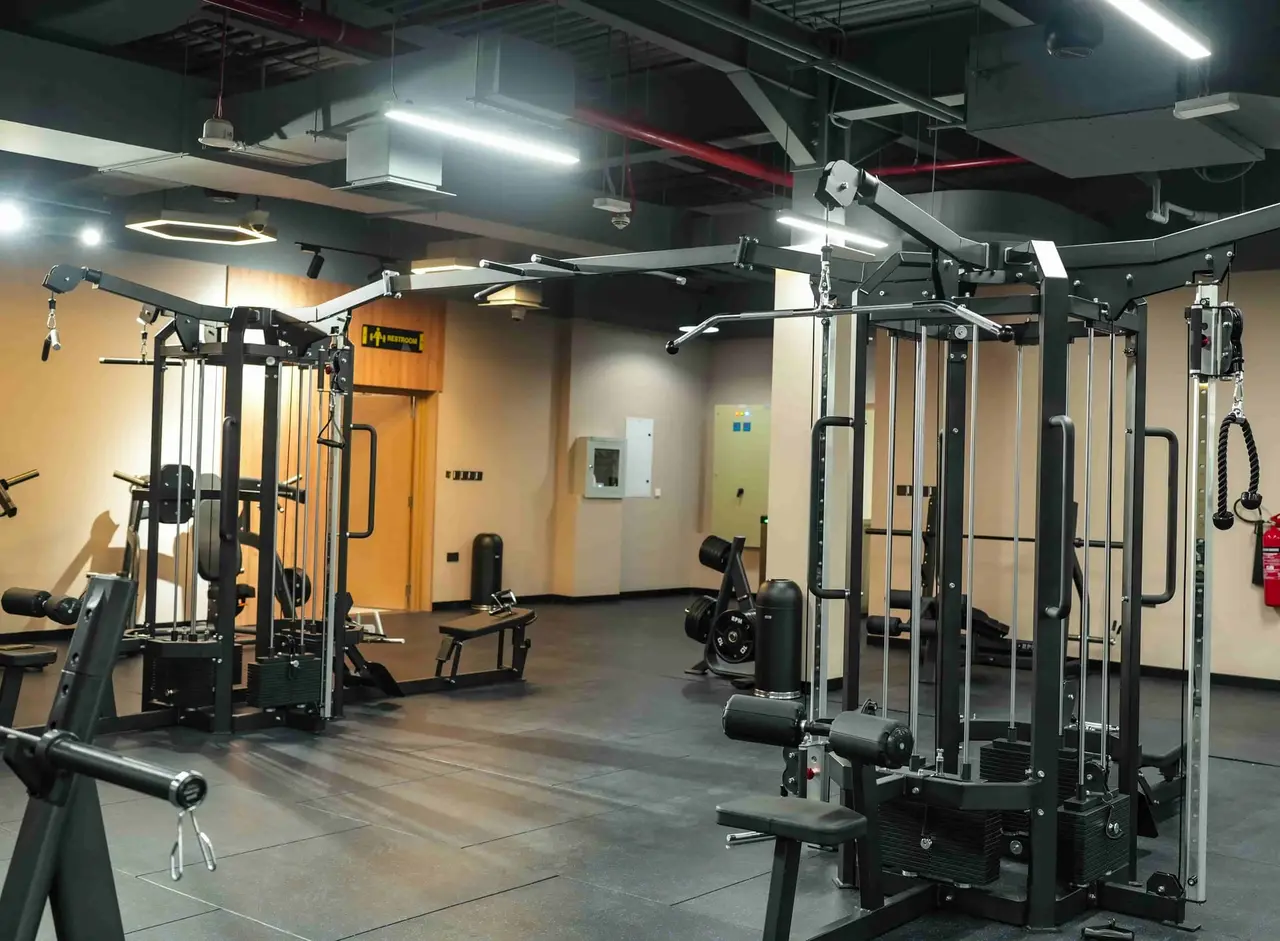
The free-weight version runs on kit that RPM's floor photos show: squat racks with barbells, flat benches and the dumbbell rack. The cable version uses the multi-station cable towers with their pulldown seat. A bench that inclines, a chest press machine and a pec deck do not appear in those photos, so ask on the free guided tour whether there are any, and which stations the women-only Ladies section currently holds. For a coach to set up your pairs and check your rowing, ask about personal training.
Sources
- Robbins DW, Young WB, Behm DG, Payne WR. Agonist-antagonist paired set resistance training: a brief review. Journal of Strength and Conditioning Research, 2010
- Paz GA, Robbins DW, de Oliveira CG, Bottaro M, Miranda H. Volume load and neuromuscular fatigue during an acute bout of agonist-antagonist paired-set vs. traditional-set training. Journal of Strength and Conditioning Research, 2017
- Zhao H, Yamaguchi S, Okada J. Effects of rest interval array on training volume, perceived exertion, neuromuscular fatigue, and metabolic responses during agonist-antagonist muscle alternative training. Journal of Sports Medicine and Physical Fitness, 2020
- American College of Sports Medicine, position stand: Progression models in resistance training for healthy adults (2009)
Questions, answered.
Is it good to train chest and back on the same day?
Yes, for most people. They are opposing muscle groups, so one recovers while the other works, and alternating them fits more work into the same time. The cost is that you need two stations, or a pair that shares one.
Should I train chest or back first?
Within a pair it matters less, because you alternate. Put the exercise you most want to improve first, while you are freshest. Here pair 2 opens with the pull, so neither side always goes second.
How many sets of chest and back in one workout?
Sixteen to eighteen working sets, split evenly, is plenty for one session. Beyond that, the last rounds are usually done tired and add little.
Can I add arms to a chest and back day?
Yes: a curl and a pushdown as a fourth pair keeps the session near an hour. If you do, make your shoulders-and-arms day mostly shoulders, so the arms are not trained hard twice in a few days.
How long does a chest and back workout take?
About 45 to 60 minutes with the warm-up. Paired sets save time because each rest is the other exercise's set; the cable version is usually the quicker of the two.